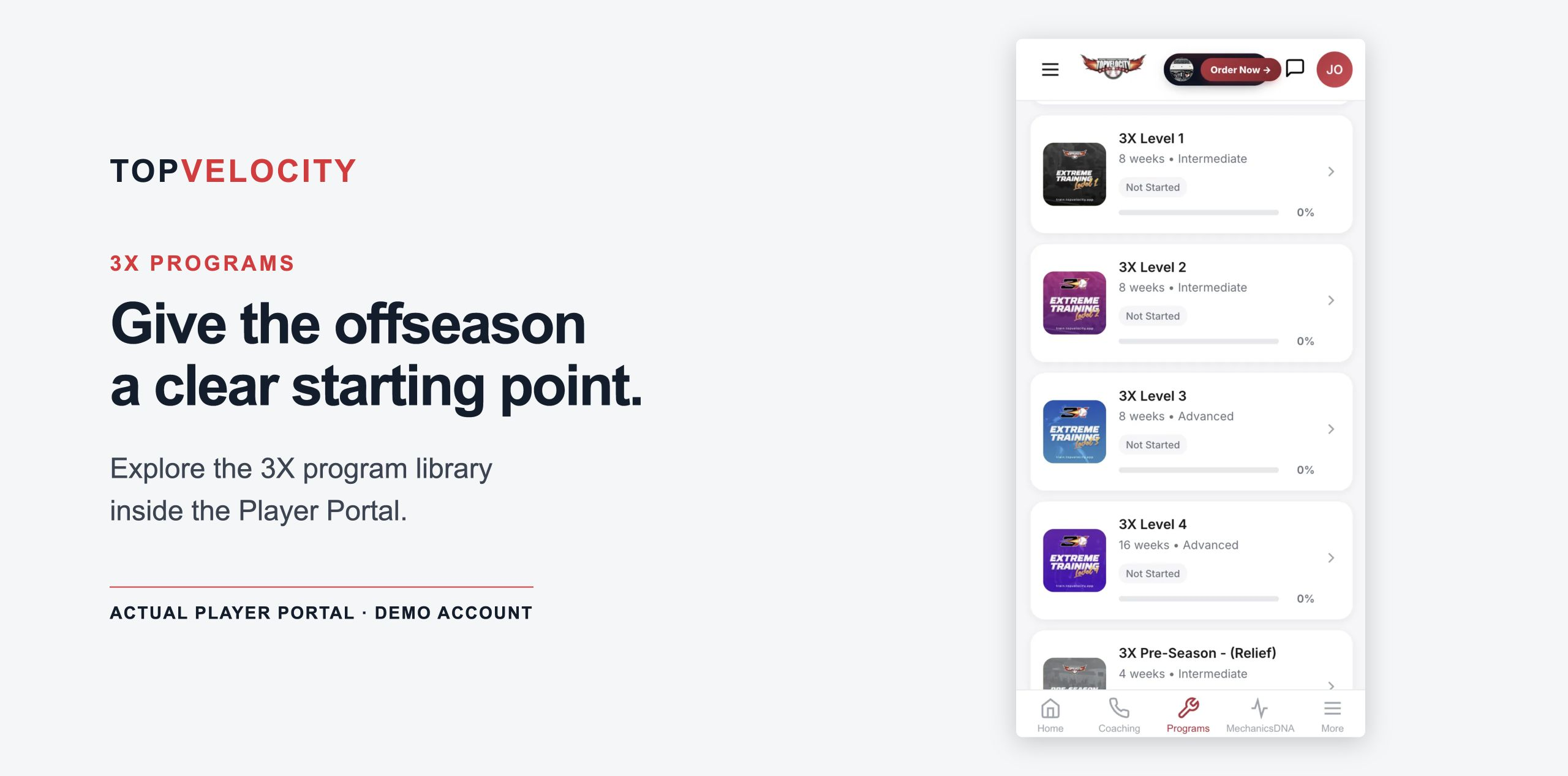
Short answer: Among the best pitching velocity programs, no single one is right for every pitcher. Driveline is known for data and weighted-ball training, Tread for fully remote coaching, the Texas Baseball Ranch for its long record with pro pitchers, Cressey Sports Performance for strength and conditioning, and TopVelocity’s 3X Pitching for lower-body power through Olympic lifting and 3D mechanics analysis. Choose based on the pitcher’s age, arm health, budget, location and how much in-person coaching they need.
Disclosure: TopVelocity publishes this page, and 3X Pitching is our program. We’ve tried to be fair. Facts about other programs come from their own websites or published sources, linked below. We left out prices we couldn’t verify, so contact each program directly for current pricing and formats.
What do the best pitching velocity programs have in common?
Before comparing names, know what separates a good program from a risky one. Our full guide, What a Good Velocity Program Looks Like, covers this in depth. In short, look for:
- An assessment first, including strength, power, mobility and mechanics, not a one-size template.
- Measured results. Velocity, jump and mechanics data should be tracked over time.
- A clear plan for arm stress, with workload limits, recovery and arm care.
- Age-appropriate methods. A 13-year-old shouldn’t train like a professional.
- Honest claims. Be wary of guaranteed velocity numbers.
How do the best pitching velocity programs compare?
| Program | Based in | Format | Known for |
|---|---|---|---|
| TopVelocity (3X Pitching) | Covington, Louisiana | In-person camp, online camp, Player Portal app | Triple extension, Olympic lifting, MechanicsDNA 3D mechanics analysis |
| Driveline Baseball | Kent, Washington, plus Arizona and Texas locations | In-person and remote, TRAQ training platform | Data-driven training, weighted balls, pitch design |
| Tread Athletics | Charlotte area, North Carolina | Primarily remote, facility visits by appointment | Individualized remote coaching for high school, college and pro |
| Texas Baseball Ranch | Montgomery, Texas | In-person training | Ron Wolforth’s long track record with MLB pitchers |
| Cressey Sports Performance | Hudson, Massachusetts, and Palm Beach Gardens, Florida | In-person training | Strength and conditioning for baseball players |
TopVelocity 3X Pitching: what are the pros and cons?
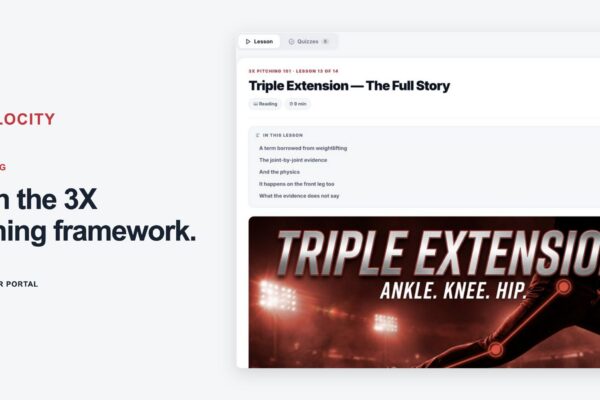
TopVelocity was founded by Dr. Brent Pourciau, a former professional pitcher with a PhD in Health Sciences (Exercise and Sport Science) and an M.S. in Kinesiology. The 3X method is built on triple extension and the kinetic chain. It uses Olympic lifting, full-range squats and medicine-ball work to build lower-body power. MechanicsDNA measures the delivery in 3D.
Pros:
- Overload goes to the legs and trunk, not the throwing arm. TopVelocity has long argued against heavy weighted-ball training.
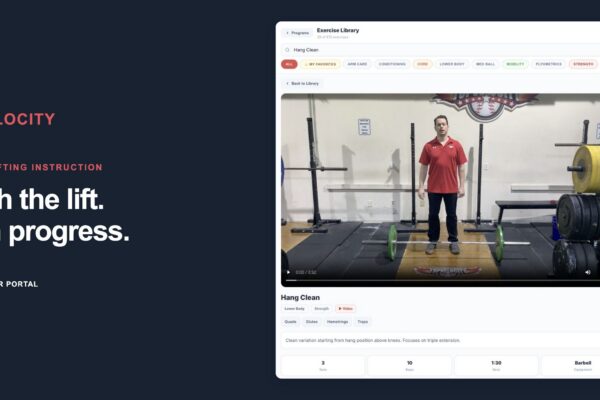
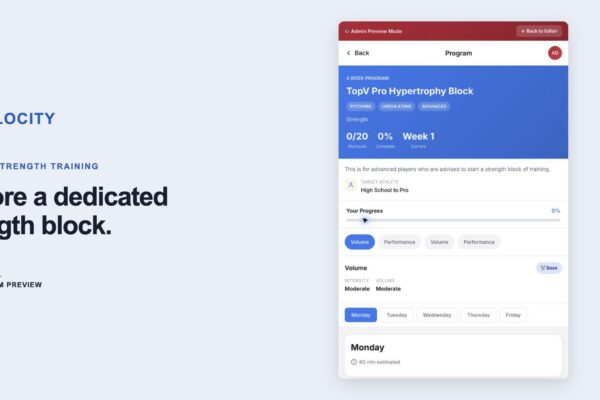
- Training is available in person, through an online camp or in the Player Portal app.
- Small in-person camp sessions with direct access to Dr. Pourciau.
- Free tools let you check fit first: the velocity calculator and MechanicsDNA Mini.
Cons:
- The in-person camp is only in Covington, Louisiana, so most athletes have to travel.
- Olympic lifting has a learning curve and needs good coaching.
- No randomized trial has tested the full 3X program. Dr. Pourciau’s own study found no immediate velocity effect from lifting right before pitching.
For a closer look, read the pros and cons of the 3X Velocity Camp.
Driveline Baseball: what are the pros and cons?
Driveline was founded by Kyle Boddy. Its main facility is in Kent, Washington, with additional locations in Arizona and Texas, according to Wikipedia. Its program uses weighted baseballs along with recovery, mechanics, command and pitch-design work, and it uses pitch-tracking tools like Rapsodo and TrackMan. Boddy has consulted for several MLB clubs. Driveline’s TRAQ platform supports in-person and remote training.
Pros:
- Deep data infrastructure and a strong pitch-design focus.
- Multiple facilities plus remote options.
- Professional credibility, with Boddy’s consulting work for MLB clubs.
Cons:
- Weighted-ball training is still debated. In a 2018 randomized trial (not of Driveline’s program specifically), 24% of teenage pitchers on a six-week weighted-ball program were injured, compared with none of the controls.
- A data-heavy approach may be more than a young pitcher needs.
See our full 3X Pitching vs. weighted balls comparison.
Tread Athletics: what are the pros and cons?
According to Tread’s FAQ, Tread is primarily a remote program. Athletes work with an assigned coach by video calls, email and text, and the Charlotte-area facility is open by appointment. Coaches program throwing, pitch design, strength and conditioning, mobility, nutrition and mental work. The program serves high school, college and pro athletes, and remote training generally starts at age 14. Tread describes a 12-month commitment with an assessment fee and monthly or annual payments.
Pros:
- You can train from anywhere with a dedicated coach.
- Training is individualized across throwing, strength and pitch design.
Cons:
- Remote coaching gives limited hands-on instruction for skills like lifting technique.
- The 12-month commitment is a bigger decision than a short camp.
- Remote training isn’t generally offered to athletes under 14.
Texas Baseball Ranch: what are the pros and cons?
The Texas Baseball Ranch in Montgomery, Texas, was founded by Ron Wolforth, who has written five books on pitching. His clinician profile lists MLB clients including Justin Verlander, Scott Kazmir and Trevor Bauer.
Pros:
- A long track record with professional and draft-level pitchers.
- Wolforth’s books let families learn the philosophy before committing.
Cons:
- Training is in person in Texas, so most athletes have to travel.
- We couldn’t verify current program formats from a primary source, so ask directly.
Cressey Sports Performance: what are the pros and cons?
Eric Cressey co-founded Cressey Sports Performance, which has facilities in Hudson, Massachusetts, and Palm Beach Gardens, Florida, according to his bio. He specializes in applied kinesiology and strength and conditioning for baseball players. The same bio also says he joined the New York Yankees in January 2020 as Director of Player Health and Performance.
Pros:
- Program design rooted in applied kinesiology, corrective exercise and strength, according to Cressey’s bio.
- A good fit for pitchers whose main limit is strength or movement quality.
Cons:
- It’s a performance facility, not a velocity-only program, so mechanics and throwing may be handled differently by each coach.
- Training is in person at two locations.
How do you choose among the best pitching velocity programs?
- Start with age and maturity. Compare your pitcher to pitching velocity by age benchmarks. Younger arms need power and mechanics more than arm overload.
- Find the limiting factor. A low vertical jump points to power. Poor hip-shoulder separation points to mechanics. See the best lifts for pitchers.
- Weigh arm history. Pitchers with past elbow or shoulder pain should be cautious with heavy weighted-ball work.
- Match the format to your life. Remote programs suit athletes far from a facility. In-person camps suit athletes who need hands-on correction.
- Ask for measurements. Any good program should show before-and-after data, not just testimonials.
Still deciding whether a camp is worth it at all? Read Are Velocity Camps Worth It?
Frequently asked questions
What is the best pitching velocity program?
There isn’t one best program for everyone. Driveline is known for data and weighted balls, Tread for remote coaching, the Texas Baseball Ranch for its pro track record, Cressey Sports Performance for strength and conditioning, and TopVelocity 3X for Olympic lifting and 3D mechanics. The best choice depends on age, arm health, location and coaching needs.
Is Driveline or TopVelocity better?
They take different approaches. Driveline uses weighted balls with data-driven training and pitch design. TopVelocity’s 3X system puts overload on the legs and trunk through Olympic lifting and measures mechanics with MechanicsDNA. Pitchers with arm-injury history or younger arms may prefer an approach that doesn’t load the arm.
Are online pitching velocity programs effective?
They can be, especially for self-motivated athletes with access to a gym and video. Remote programs such as Tread and TopVelocity’s Player Portal use video review and assigned programming. Skills like Olympic lifting technique are easier to learn with some in-person coaching.
How much velocity can a pitcher gain from a program?
Results vary widely, and no program can guarantee a number. In one randomized trial, a six-week weighted-ball program increased velocity by 3.3% but also had a 24% injury rate. Be cautious of any program that promises a specific gain.
Why does this page leave out prices?
Prices change, and we only list facts we could verify from a primary source. Contact each program directly for current pricing.
Who publishes this comparison?
TopVelocity publishes this page, and 3X Pitching is our program. We link to each competitor’s own website or published sources so you can check the facts yourself.
Try the 3X program
Start a 7-day free trial of the TopVelocity Player Portal to see the 3X program and MechanicsDNA tracking for yourself. If you want in-person coaching, the 3X Velocity Camp in Covington, Louisiana, includes a biomechanics evaluation and one-on-one work with Dr. Pourciau.
About the author
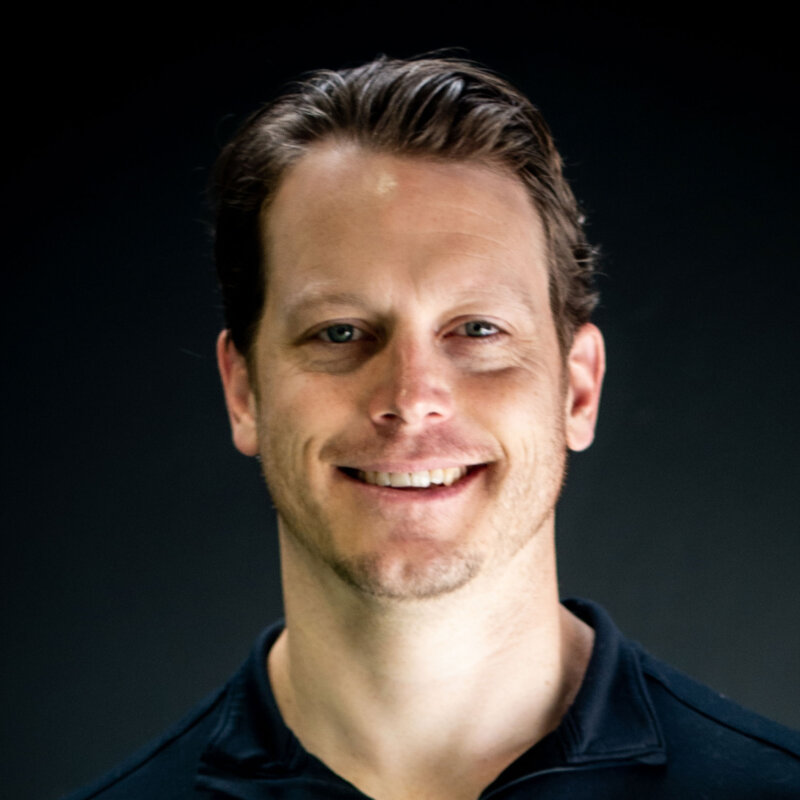
Dr. Brent Pourciau is the founder of TopVelocity and creator of 3X Pitching and MechanicsDNA. He holds a PhD in Health Sciences (Exercise and Sport Science) from Liberty University and an M.S. in Kinesiology, pitched professionally for the San Diego Surf Dawgs, and has spent more than 20 years building TopVelocity in Covington, Louisiana.