Short answer: Olympic lifting for pitchers uses lifts such as the power clean and push jerk to train triple extension, the fast, coordinated extension of the hips, knees and ankles that also drives a pitcher’s push off the rubber. Research links lower-body power to fastball velocity and shows Olympic lifting improves jump performance, but they work as a long-term power builder, not an instant velocity boost. Pitchers should learn the lifts with light loads under a qualified coach, progress by age and training history, and schedule them around their throwing.
This page is the TopVelocity hub for Olympic lifting. It covers the why, the evidence and age-based programming, and links to our detailed guides.
Why does Olympic lifting for pitchers matter?
Pitching velocity is built from the ground up. A 1998 study in the American Journal of Sports Medicine measured ground-reaction forces in pitchers and found that wrist velocity correlated highly with leg drive. The authors concluded that lower-extremity strength is likely important for both performance and injury prevention.
Olympic lifts train three qualities pitchers need:
- Triple extension. The second pull of a clean extends the hips, knees and ankles together, the same pattern the drive leg uses to push toward the plate.
- Rate of force development (RFD). A pitch happens in a fraction of a second. Olympic lifts train athletes to produce force quickly, not just to produce a lot of it.
- Force transfer. The bar only moves fast if force flows from the floor through the hips and trunk. That is the kinetic-chain idea behind the 3X Pitching method.
What does the research say about Olympic lifting and velocity?
No randomized trial has yet tested Olympic lifting alone as a way to raise pitching velocity. The case rests on two kinds of evidence.
Lower-body power is linked to velocity
In 19 Division I pitchers, countermovement-jump concentric impulse and peak power correlated with fastball velocity (r = 0.71 and 0.68) (Sakurai et al., 2024, Journal of Strength and Conditioning Research). In 32 adolescent pitchers, jump braking force and body height together explained 43.3% of the variation in fastball velocity (Hsiao & Lee, 2025, Journal of Human Kinetics). Our article on vertical jump and pitching velocity goes deeper.
Olympic lifting improves jump power
A meta-analysis in the British Journal of Sports Medicine (Hackett et al., 2016) pooled six studies with 232 participants. Olympic weightlifting improved vertical jump by 7.7% compared with control groups and 5.1% compared with traditional resistance training. Results were similar to plyometric training.
Put together: Olympic lifting builds jump power, and jump power is associated with velocity. That is a reasonable rationale, not proof of a direct effect on the radar gun.
Does post-activation potentiation (PAP) add velocity right away?
PAP is the idea that a heavy or explosive set can briefly boost the next explosive movement. A meta-analysis by Seitz and Haff (2016) found the effect on throwing performance is small (effect size 0.26) and larger in stronger, more experienced lifters.
Dr. Brent Pourciau’s doctoral dissertation tested this directly. Thirteen collegiate pitchers did clean pulls, power cleans and power jerks before pitching. The published abstract reports no statistically significant differences in velocity, spin, movement or accuracy compared with a standard warm-up. We break down the details in Olympic Lifting Before Pitching: What a 13-Pitcher Study Found.
The practical lesson: Olympic lifts belong in your long-term training plan, not your pre-game routine.
Are Olympic lifts safe for pitchers?
Taught well, they carry a modest injury risk. A systematic review in the British Journal of Sports Medicine (Aasa et al., 2017) found 2.4 to 3.3 injuries per 1,000 hours of weightlifting training. That rate is similar to other non-contact strength and power sports and low compared with contact sports. The spine, shoulder and knee were the most common injury sites.
For young athletes, the 2014 International Consensus position statement on youth resistance training supports supervised, technique-first resistance training for children and adolescents. Qualified coaching and sensible progression are the keys.
For pitchers, the shoulder needs extra thought. Many coaches avoid or limit the full snatch for pitchers because of the overhead catch. Clean variations, pulls and jumps develop triple extension with less shoulder demand.
Which Olympic lift variations work best for pitchers?
- Clean pull and high pull. These train the triple-extension pull without the catch, so they’re good teaching tools.
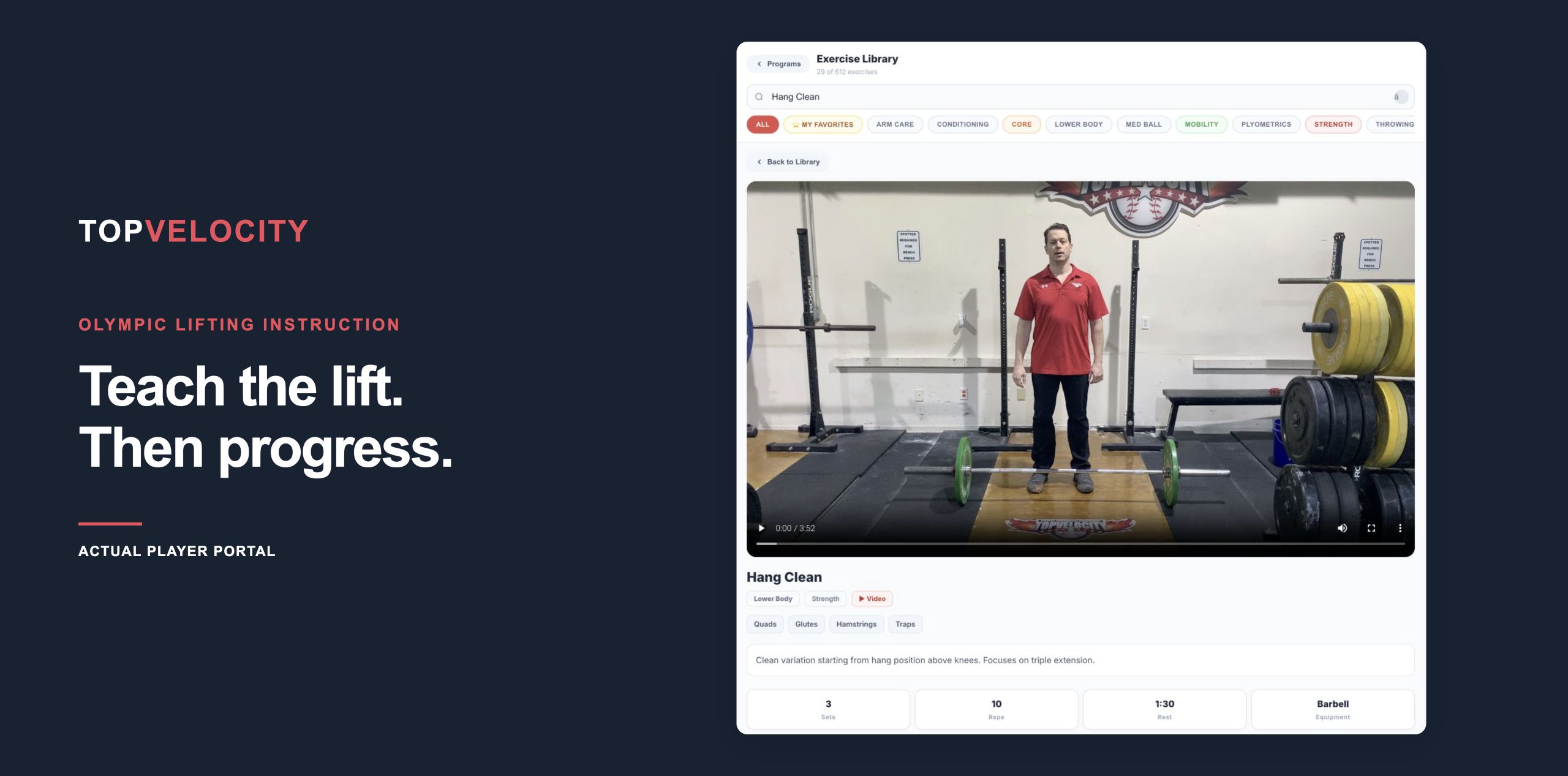
- Hang power clean. This is the go-to power lift. Starting from the hang shortens the learning curve.
- Power clean from the floor. This is for athletes who have mastered the hang positions.
- Push press and push jerk. These transfer leg drive overhead. Use them only when shoulder mobility and control are good.
- Full-range barbell squat (front or back). This isn’t an Olympic lift, but it’s the foundation. TopVelocity coaches deep, full-range squats because pitchers need pelvic stability and strength through the full range of motion the delivery demands.
For the full list of lifts that transfer (and two that don’t), see The 5 Best Lifts for Pitchers.
How should Olympic lifting for pitchers be programmed by age?
Age is only a starting point. Training age, maturity and coaching quality matter more. Use this as a general progression, not a prescription.
| Stage | Typical age | Focus | Example tools |
|---|---|---|---|
| Foundations | 8 to 12 | Movement skill, jumping and landing, bodyweight squat depth | Dowel or PVC lift drills, bodyweight squats, broad jumps, light med-ball throws |
| Technique | 13 to 15 | Learning hang positions and the pull with light bars, full-range squat pattern | Technique bar or light barbell, clean pulls, hang power clean, goblet and front squats |
| Development | 16 to 18 | Progressive loading with clean technique, power output | Hang and floor power cleans, push press, back and front squats |
| Advanced | College and pro | Power and RFD peaks matched to the throwing calendar | Power clean, push jerk, loaded jumps, contrast sets |
Compare your pitcher’s numbers to pitching velocity by age to see where they stand. Our skill-before-load progression explains how coaches advance each stage.
How do you fit Olympic lifts around a throwing schedule?
- Keep reps low and quality high. Sets of 1 to 3 reps keep bar speed up and technique clean.
- Lift power before fatigue. Put Olympic lifts early in the session, before squats and accessory work.
- Separate hard days. Avoid heavy lifting right before a start or a high-intent bullpen.
- Cut volume in season. Keep intensity, drop volume. See our in-season strength and throwing plan.
- Build in the off-season. That’s when technique and loading progress fastest. See the off-season 3X plan.
Where does Olympic lifting fit in the 3X system?
Olympic lifting is one part of TopVelocity’s Fusion System, which combines mobility training, strength training, Olympic lifting, mechanics training and anaerobic conditioning into one program. Lifting builds the engine. Mechanics training, measured with MechanicsDNA 3D analysis, teaches the delivery to use it. The triple-extension coaching progression connects the two.
One caution: getting stronger and throwing harder both raise arm stress. A 2026 study of 54 high-school pitchers found eight weeks of hip and trunk strength training increased ball speed and elbow varus moment. Pair any power program with smart workload management and arm care.
Frequently asked questions
Should pitchers do Olympic lifts?
Many can benefit. Olympic lifts train triple extension and rate of force development, and lower-body power is correlated with fastball velocity. They should be taught with light loads by a qualified coach, and pitchers should favor clean variations over the overhead snatch.
Do power cleans increase pitching velocity?
There is no direct trial yet. Olympic lifting improved vertical jump by 7.7% versus control groups in a 2016 meta-analysis, and jump power is associated with velocity in pitchers. That makes power cleans a reasonable long-term tool, not a guaranteed velocity gain.
What age can pitchers start Olympic lifting?
Children as young as 8 to 12 can learn the movement patterns with a dowel or PVC pipe and bodyweight drills. Loaded barbell technique usually starts around 13 to 15 with light bars, and progressive loading comes later. Training history and coaching quality matter more than age alone.
Does lifting before pitching increase velocity?
Probably not in the short term. Dr. Brent Pourciau’s study of 13 collegiate pitchers found no statistically significant change in velocity after an Olympic-lifting sequence before pitching. A meta-analysis also found post-activation potentiation effects on throwing are small.
Is the snatch safe for pitchers?
Many coaches limit or avoid the full snatch for pitchers because of the overhead catch position. Clean pulls, hang power cleans and jumps train the same triple extension with less shoulder demand.
How often should pitchers do Olympic lifts?
A common approach is one to three sessions a week in the off-season with low reps of 1 to 3, reduced to lower volume in season. Avoid heavy lifting right before a start or a high-intent bullpen.
Start training with the 3X system
Start a 7-day free trial of the TopVelocity Player Portal for guided Olympic-lifting progressions, the 3X program and MechanicsDNA tracking. If you want coaching in person, the 3X Velocity Camp in Covington, Louisiana, includes a biomechanics evaluation and hands-on lifting and mechanics instruction. You can also estimate your ceiling with the free velocity calculator or scan your delivery with MechanicsDNA Mini.
About the author
Dr. Brent Pourciau is the founder of TopVelocity and creator of 3X Pitching and MechanicsDNA. He holds a PhD in Health Sciences (Exercise and Sport Science) from Liberty University, with a dissertation on Olympic-lifting post-activation potentiation and pitching velocity, and an M.S. in Kinesiology. He pitched professionally for the San Diego Surf Dawgs and has spent more than 20 years developing pitchers through TopVelocity in Covington, Louisiana.