

Are weighted baseballs safe? If you’re asking, you’ve probably already heard both pitches: trainers promising 5 mph in six weeks, and surgeons shaking their heads. Here’s what the controlled research actually says. The velocity gains are real but small. However, the injury rate in the best study ever run on the subject was 24% in the weighted-ball group — versus zero in the control group. That’s not a trade most parents would knowingly make.
What the Weighted Baseball Study Actually Found
The study every parent should read is Reinold, Macrina, Fleisig, Aune and Andrews (2018), published in Sports Health. Researchers at the American Sports Medicine Institute ran a six-week randomized controlled trial with pitchers aged 13–18. One group threw a weighted-ball program. The control group trained normally.
The external-rotation number explains the other two. The velocity didn’t come from the athletes getting stronger or moving better. Instead, it came from the throwing shoulder stretching into more layback. Connective tissue adapted to the heavier load by getting looser. More external rotation does mean more velocity. But joint laxity gained that fast isn’t an adaptation — it’s the early stage of an injury. ASMI’s own characterization of extreme weighted-ball velocity training: “stressful and risky.”
So, Are Weighted Baseballs Safe for Young Pitchers?
Based on the only randomized controlled evidence available: no, not as a velocity program for developing arms. One in four injured in six weeks is not a rounding error. Furthermore, the mechanism of the velocity gain — rapid capsular laxity — is exactly the adaptation that precedes UCL and labrum injuries in throwers.
We’ve seen this play out at our facility. Athletes who completed TopVelocity programs and then bolted a weighted-ball running-throw program on top of them have torn UCLs and labrums doing it. The pattern is consistent enough that we’ve taken a hard public stand against extreme weighted-ball velocity training since its resurgence. The research has only strengthened that position.
Why the Arm Is the Wrong Place to Add Load
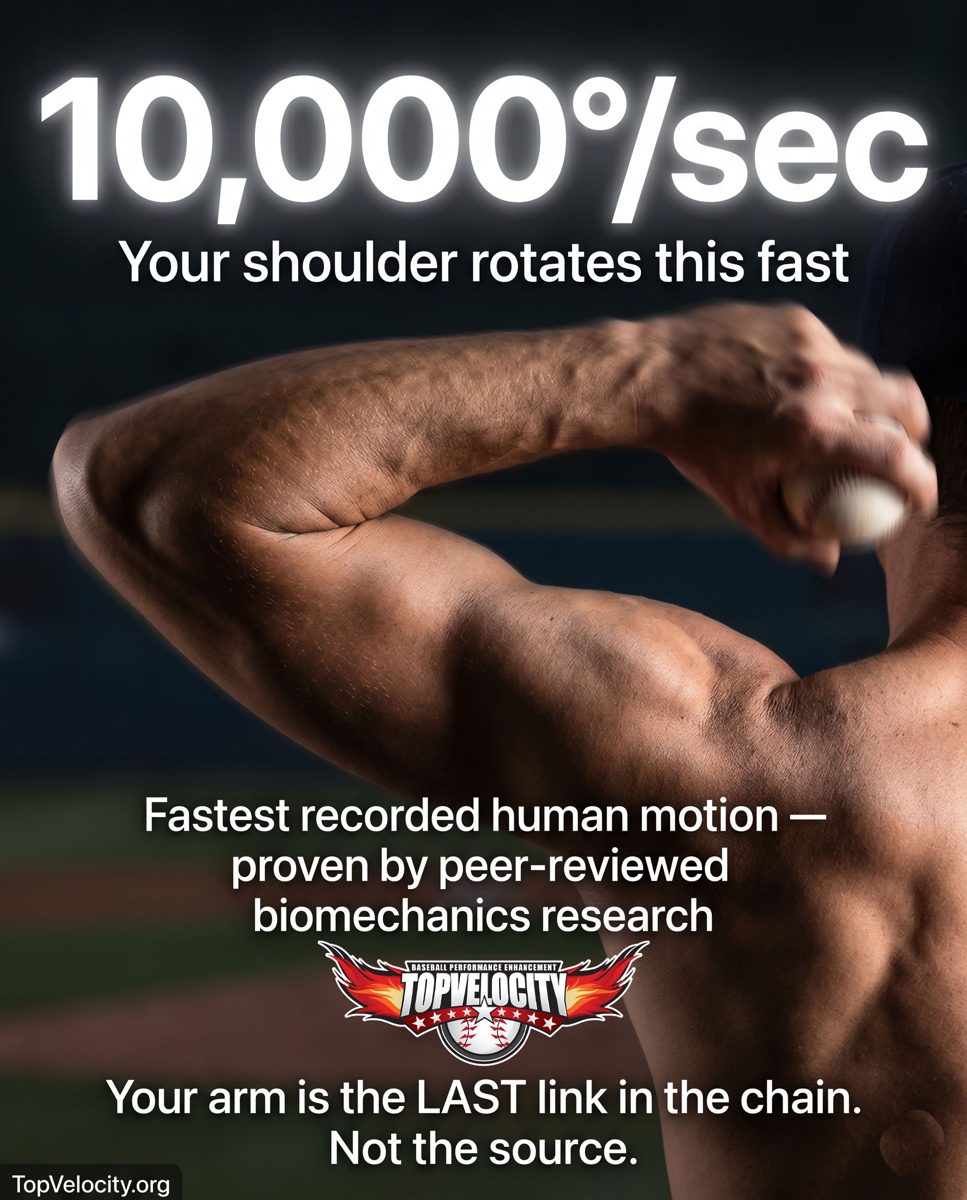
Conventional wisdom says overload the throwing arm and it gets stronger, like any other muscle. Science says the throwing arm isn’t the engine in the first place. As a result, overloading it stresses the weakest link in the chain while ignoring the actual source of velocity.
Biomechanics research measured ground reaction forces in pitching back in 1998. Drive-leg push-off and front-leg landing forces correlate strongly with ball velocity, and elite pitchers produce landing forces around 150% of body weight (MacWilliams et al., American Journal of Sports Medicine). Roughly 80% of real pitching velocity is generated from the ground up and delivered through hip-to-shoulder separation torque. The arm is the last link — the delivery mechanism, not the power plant.
So when a training program adds load to the baseball, it adds stress precisely where the kinetic chain is most fragile: the shoulder capsule and the ulnar collateral ligament. Meanwhile, the legs and trunk — where the power should come from — go undertrained.
How to Add Velocity Without Loading the Arm
The safe version of overload training moves the load off the baseball and onto the body parts built to handle it:
- Medicine ball throws (2 lb, two hands). All the overload stimulus for the throwing pattern, distributed across the trunk and hips instead of concentrated in one ligament. The 3X med-ball series — overhead slams, rotational throws, linear pitch simulations — maps each drill to a phase of elite mechanics.
- Olympic lifting. The hang clean’s second pull produces around 52.6 watts per kilogram of bodyweight. That’s more than four times the power output of a back squat (Garhammer). It trains explosive triple extension — the exact drive-leg pattern that produces velocity — with zero throwing-arm stress. And the fear that lifting hurts pitchers runs backwards: D1 pitchers who stopped resistance training for just eight weeks lost velocity (Gdovin et al. 2024, JSCR).
- Ground-force training. Tools like the King of the Hill trainer give instant feedback when the drive leg produces enough force. Likewise, the TopVelocity Sled loads the drive-leg pattern directly — overload for the legs, not the elbow.
- Mechanics that transfer the force. Triple extension timed just before front-foot strike, full hip-to-shoulder separation, and a stable front leg. All of it is trainable with video analysis. Start with a free MechanicsDNA Mini scan.
What If You’re Already Throwing Weighted Balls?
Watch for the warning signs the research flags. Rapid gains in shoulder range of motion. Soreness on the inside of the elbow. Velocity gains that arrive without any change in strength or mechanics. Those are laxity gains, not performance gains. A two-minute Arm Risk Assessment will score your current injury risk factors free.
And if velocity is the goal — it should be — train it where it lives. The TopVelocity Player Portal ($99/month, 7-day free trial) runs the complete ground-up system: 3X mechanics training, Olympic-lift-based strength programs, med-ball throwing work, arm care, and AI evaluation tracking. Pitchers in our system average 5–10+ mph of gains — without ever throwing a heavy ball. For where your velocity should be in the first place, see our velocity benchmarks by age.
Frequently Asked Questions
Modestly. The 2018 ASMI randomized trial (Reinold et al., Sports Health) found a 3.3% velocity gain after six weeks – but 24% of the weighted-ball group got injured versus zero in the control group, and the gain came largely from increased shoulder joint laxity.
The same trial measured a 4.3-degree increase in shoulder external rotation in six weeks. That rapid range-of-motion gain reflects connective-tissue laxity, not strength – it raises velocity while loading the UCL and shoulder capsule, the two most injury-prone structures in throwing.
Move the overload off the arm: two-hand medicine ball throws (2 lb), Olympic lifting for explosive triple extension, and ground-force training tools like the King of the Hill. These train the legs and trunk – where roughly 80% of velocity is produced – without stressing the elbow.
Yes. Lower-body power, mechanics, and strength training are the documented drivers of velocity. TopVelocity athletes average 5-10+ mph gains through ground-force mechanics (3X), Olympic-lift programming, and med-ball work, with arm care built in.
About the Author
Brent Pourciau, M.S., is the founder of TopVelocity. After tearing his rotator cuff at 18 and being told he would never pitch again, he rebuilt his delivery through peer-reviewed biomechanics research and returned to throw 94 mph in professional baseball. He holds a master’s degree in kinesiology with doctoral work in health sciences, and has trained 10,000+ athletes including 100+ MLB draft picks through the TopVelocity Player Portal and Performance Center licensing program.