

STOP GUESSING.
START MEASURING.
THEY BUILD UP — UNMEASURED.
Youth pitchers who threw more than 100 innings in a year were 3.5× more likely to suffer a serious throwing injury (elbow or shoulder surgery, or retirement from throwing injury).
Fleisig et al. 2011, Am J Sports Med — 10-year prospective study of 481 youth pitchersProfessional pitchers with a total shoulder rotation deficit of more than 5° had a 2.6× greater risk of elbow injury. Small range-of-motion differences may not be obvious without structured measurement.
Wilk et al. 2014, Am J Sports Med — 8-season prospective pro pitcher cohortMany workload, strength and range-of-motion factors require structured assessment rather than visual observation alone.
You can’t manage what you never measure.TEST
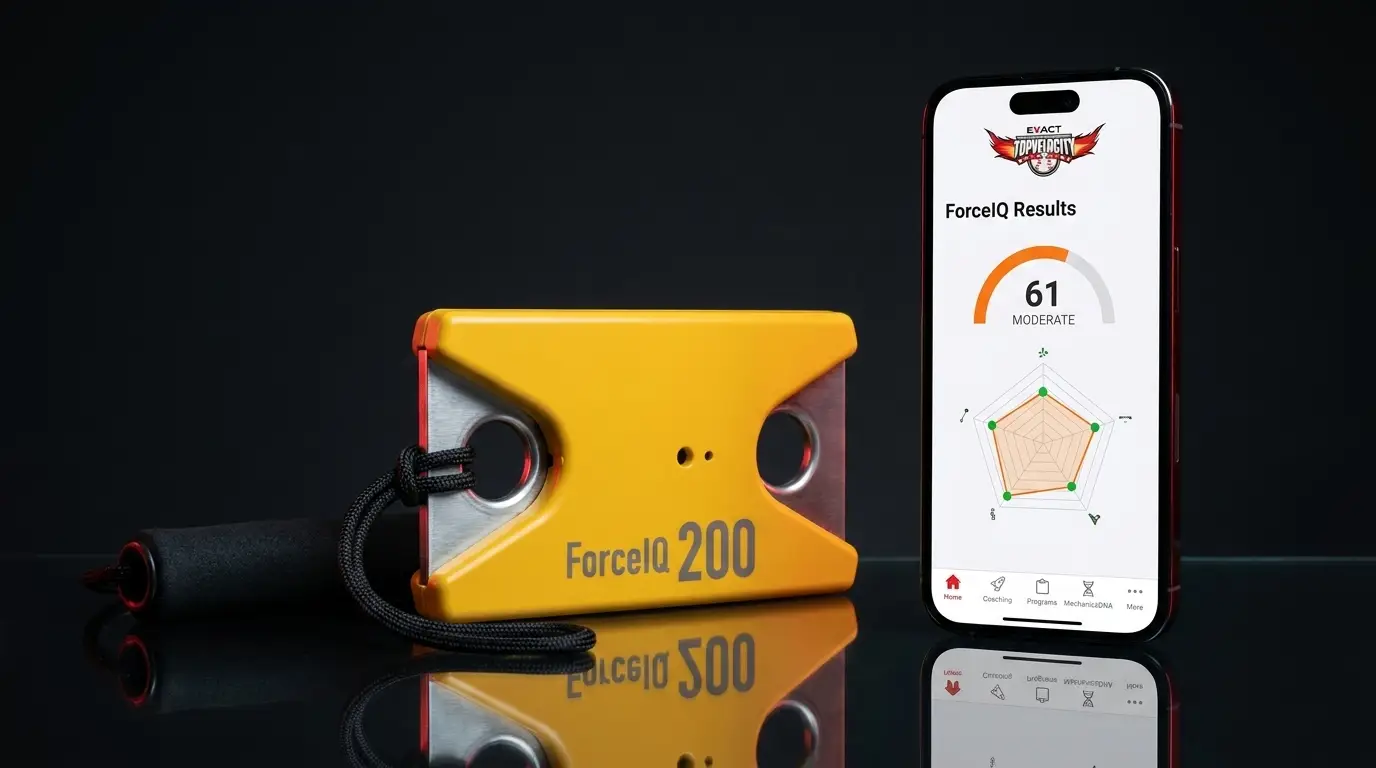
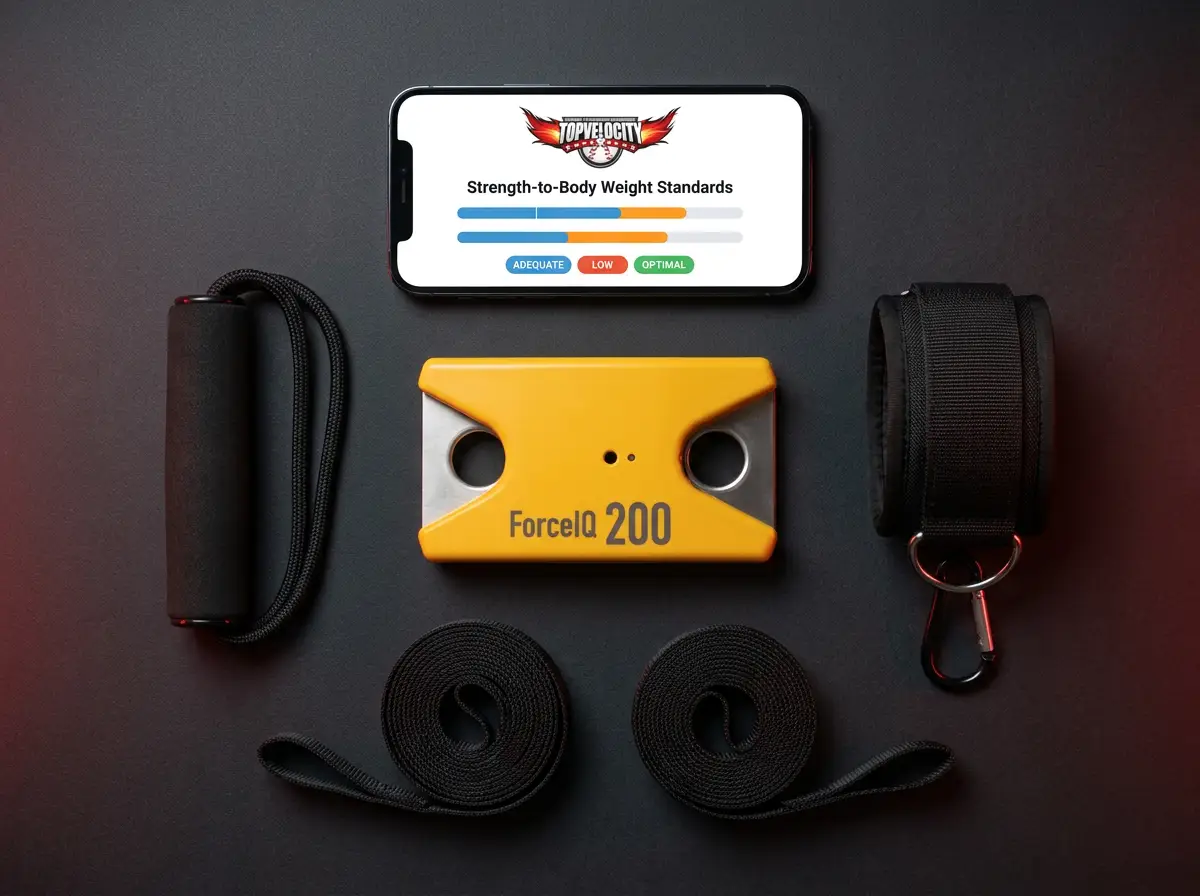
Clip in the grip or ankle connector and run 20 guided isometric tests — shoulder, hip, scap and grip — about 30 seconds each. The app walks you through every position.
SCORE
Every joint is compared against strength-to-bodyweight and bilateral-ratio benchmarks — a mix of published reference values and internal TopVelocity benchmarks, labeled in the app. You receive a proprietary Kinetic Chain Index (0–100) that summarizes the factors measured by the ForceIQ assessment. The score is a training and monitoring aid, not a diagnosis or a validated prediction of injury.
FIX
Your measured results feed straight into training recommendations and your Brent AI custom training program — so every deficit found becomes a deficit trained.
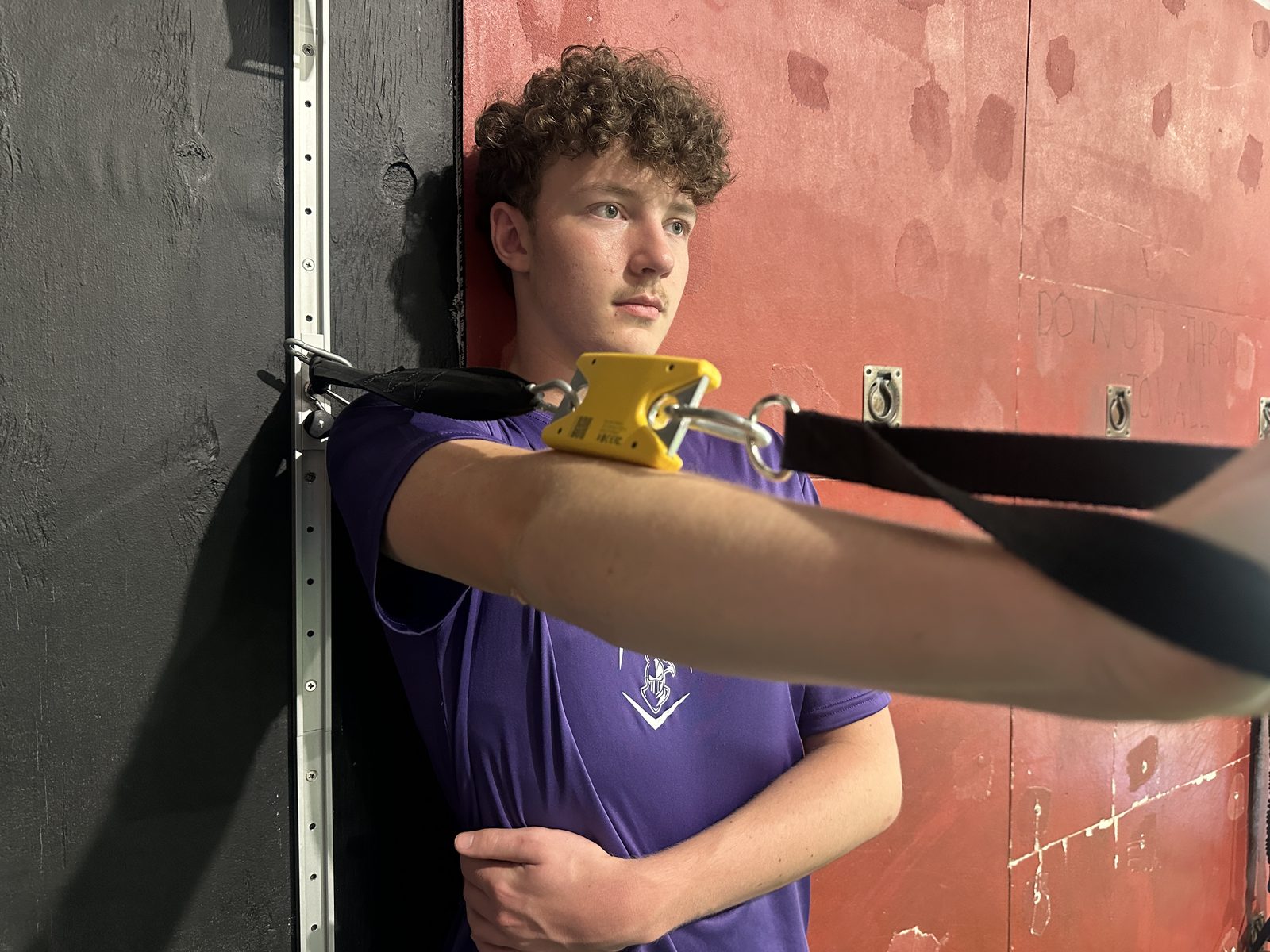
Shoulder — the velocity engine’s fuse box
- External & internal rotation strength, both arms — ER ratios can provide context when reviewing shoulder strength balance alongside workload, symptoms, history and professional evaluation
- Scaption & serratus strength — the scapular platform your arm whips around
- Side-to-side asymmetry to review alongside workload, symptoms and how the athlete is recovering
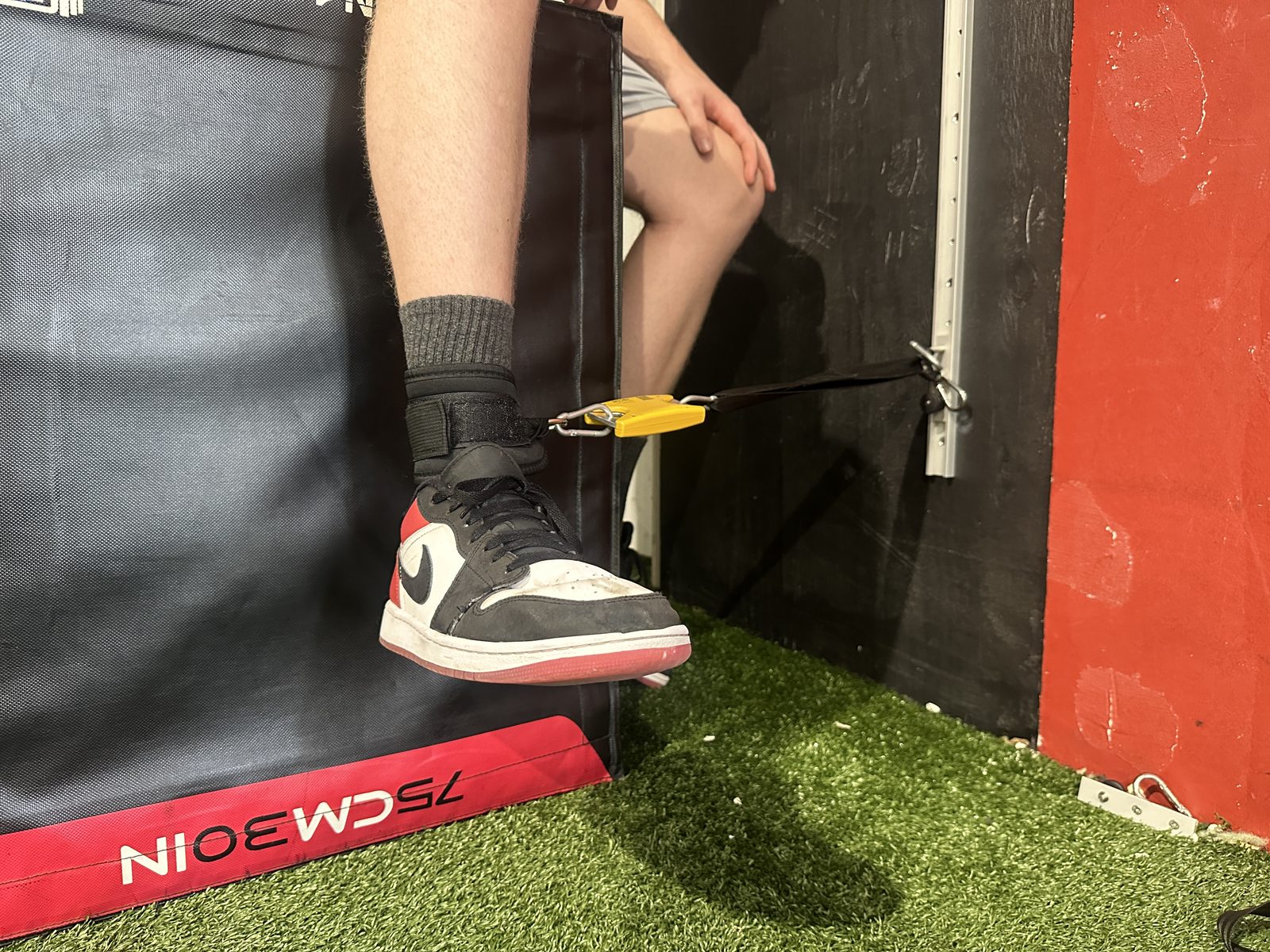
Hips — where velocity is born
- Hip abduction, rotation, flexion and extension force with the ankle connector
- Drive-leg vs. lead-leg comparison — the lead-leg force that correlates with pitch velocity
- Grip strength — the last link between your kinetic chain and the baseball
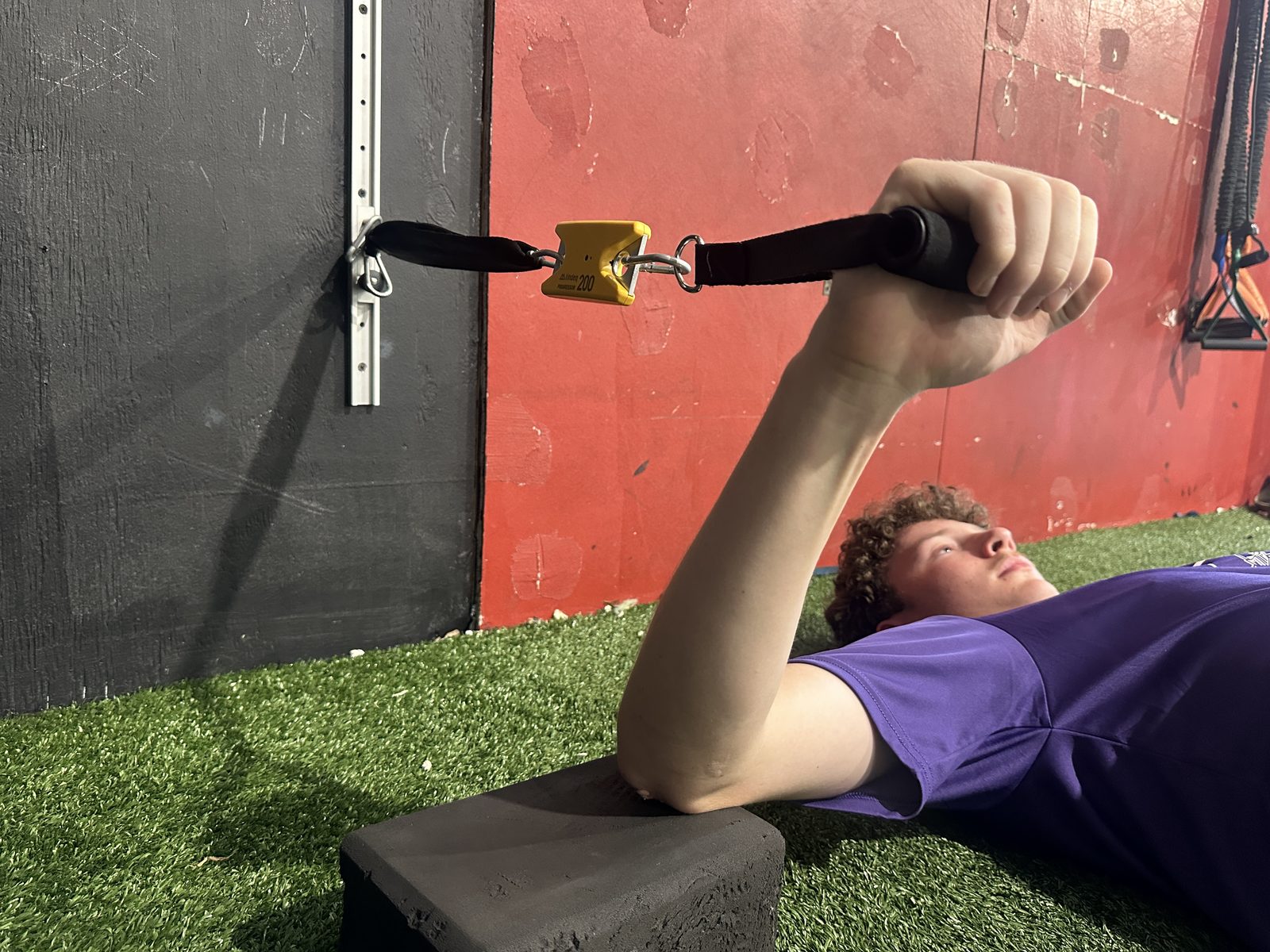
Set up anywhere in seconds
- Anchor to any rack, rig, wall mount or door — the included straps control exact distance
- Bluetooth connection to the ForceIQ module in the TopVelocity app — live force curve as you pull
- Test a full team in one session — every athlete’s numbers saved to their profile
Bilateral Asymmetry Detection
Compare left vs. right strength ratios across every major muscle group to find dangerous imbalances.
Rate of Force Development
Measure explosive power output — the key metric that separates elite velocity from average.
Injury Risk Scoring
Joint-by-joint overuse risk analysis with evidence-based thresholds for shoulder, elbow, hip, and trunk.
Corrective Exercise Rx
Personalized exercise recommendations based on your specific assessment results and weak links.
Progress Tracking
Track improvements over time with historical comparison charts and trend analysis.
Training Readiness
Pre-session force checks to review recovery trends before high-intensity training.
PITCHERS
Find the weak link that’s capping your velocity, train it, and re-test until the number moves. Prove you’re ready — with data, not feel.
PARENTS
Track your athlete’s strength numbers season to season — and walk into any coach conversation with objective measurements instead of guesswork.
COACHES
Screen an entire staff in one practice. Review objective strength numbers when making workload calls, and track every athlete all season.
“Every elite pitching lab measures arm strength before they touch a program. ForceIQ puts that exact standard in your hands — graded against the same research-informed benchmarks we use with our pro athletes.”
Methodology draws on published research (see Methodology & Citations below) and internal TopVelocity benchmarks
Cancel the app subscription any time. Device ships in 3–5 business days — app access activates immediately.
THE 30-DAY MEASURE-IT GUARANTEE
Test with ForceIQ for 30 days. If it doesn’t show you exactly where your athlete’s weak links are — clearly enough to act on — send the kit back for a full refund of the device price. Cancel the app subscription any time, no questions asked.
What ForceIQ measures. Peak isometric force during guided test positions — shoulder external and internal rotation, scaption, grip, and hip strength — on both sides of the body, plus derived values such as strength-to-bodyweight ratios, ER:IR ratios and side-to-side symmetry.
How measurements are collected. The ForceIQ device is a Bluetooth load-cell force sensor (the same instrument class as clinical handheld dynamometry). The app guides each test position and anchor setup; each effort takes roughly 30 seconds, and values record automatically to the athlete’s profile.
Research comparisons vs internal benchmarks. Published research informs our approach — for example, Cools et al. 2016 provides handheld-dynamometry rotator-cuff strength reference values and ER:IR ratios from 201 tennis, volleyball and handball athletes aged 18–50. That is a normative dataset from other overhead sports and different testing protocols; it does not establish universal ForceIQ or baseball-specific thresholds. The specific numeric targets shown in ForceIQ (such as the ≥0.75 ER:IR ratio and ≥90% bilateral symmetry) are TopVelocity training targets informed by published strength research and internal practice with athletes training in our system — they are not universal clinical cutoffs, and each value in the app is labeled as a training target or internal benchmark accordingly.
How the Kinetic Chain Index is calculated. The Kinetic Chain Index is a proprietary 0–100 summary that weights the measured strength, ratio and symmetry factors from the assessment into a single training and monitoring number. The exact weighting is proprietary. The index summarizes what was measured; it is not a diagnosis and not a validated prediction of injury.
Limitations and intended use. ForceIQ is an educational training and monitoring tool for athletes and coaches. It is not a medical device, does not diagnose or predict injury, and does not determine medical readiness to throw. Strength is one factor among many — workload, mechanics, recovery, growth and history all matter. Athletes with pain, weakness, numbness, swelling or reduced function should stop throwing and be evaluated by a licensed healthcare professional.
Methodology last updated: August 27, 2026.
- Fleisig GS, et al. Risk of serious injury for young baseball pitchers: a 10-year prospective study. Am J Sports Med. 2011;39(2):253–257. Population: 481 youth pitchers aged 9–14 at enrollment; serious injury was defined as elbow surgery, shoulder surgery, or retirement due to throwing injury. doi:10.1177/0363546510384224
- Wilk KE, et al. Deficits in glenohumeral passive range of motion increase risk of elbow injury in professional baseball pitchers: a prospective study. Am J Sports Med. 2014;42(9):2075–2081. Population: professional (major and minor league) pitchers in one organization over 8 seasons; the 2.6× finding applies to that professional-pitcher cohort. doi:10.1177/0363546514538391
- Byram IR, et al. Preseason shoulder strength measurements in professional baseball pitchers: identifying players at risk for injury. Am J Sports Med. 2010;38(7):1375–1382. doi:10.1177/0363546509360404
- Cools AM, et al. Eccentric and isometric shoulder rotator cuff strength testing using a hand-held dynamometer: reference values for overhead athletes. Knee Surg Sports Traumatol Arthrosc. 2016;24(12):3838–3847. Population: 201 tennis, volleyball and handball athletes aged 18–50 — a normative dataset from other overhead sports, not a baseball-specific threshold source. doi:10.1007/s00167-015-3755-9
These studies describe injury-risk associations and reference values in the populations studied. They validate the value of structured measurement generally — they are not validations of ForceIQ or of the Kinetic Chain Index.
By purchasing you agree to our Terms of Service and Privacy Policy.