The best lifts for pitchers are the ones that train explosive triple extension — the ankle-knee-hip drive that produces velocity from the ground up. That means Olympic lifts first (hang clean, power clean), full-depth squats, straight-bar pulls, and hip thrusts, supported by med-ball and lateral jump work. Below: the five that transfer to the radar gun, the science behind each, and two popular gym staples that don’t earn their spot.
One number frames everything. Garhammer’s research measured power output across the classic lifts. The squat produces about 12 watts per kilogram of bodyweight. The bench press: about 4. The second pull of the hang clean: 52.6 W/kg — over four times the squat. Pitching is a power event, so train the lift that produces power.
The 5 Best Lifts for Pitchers
1. Hang Clean / Power Clean
The king. The clean’s second pull is explosive triple extension under load — the same ankle-knee-hip pattern, at the same intent, that drives the body down the mound. It trains force and the timing of force, which is what separates throwers from pitchers. Our pro standard at TopVelocity is a 1.5x bodyweight power clean, and the entire program ladder builds toward it.
2. Full-Depth Squat (Back and Front)
The strength base the clean is built on. Full range of motion matters: deep squats train the loaded drive-leg position — “the Load” in 3X mechanics — that a half-squat never reaches. Don’t fear the weight room: D1 pitchers who removed resistance training for just eight weeks lost velocity (Gdovin et al. 2024, JSCR).
3. Straight-Bar Deadlift Variations & Clean Pulls
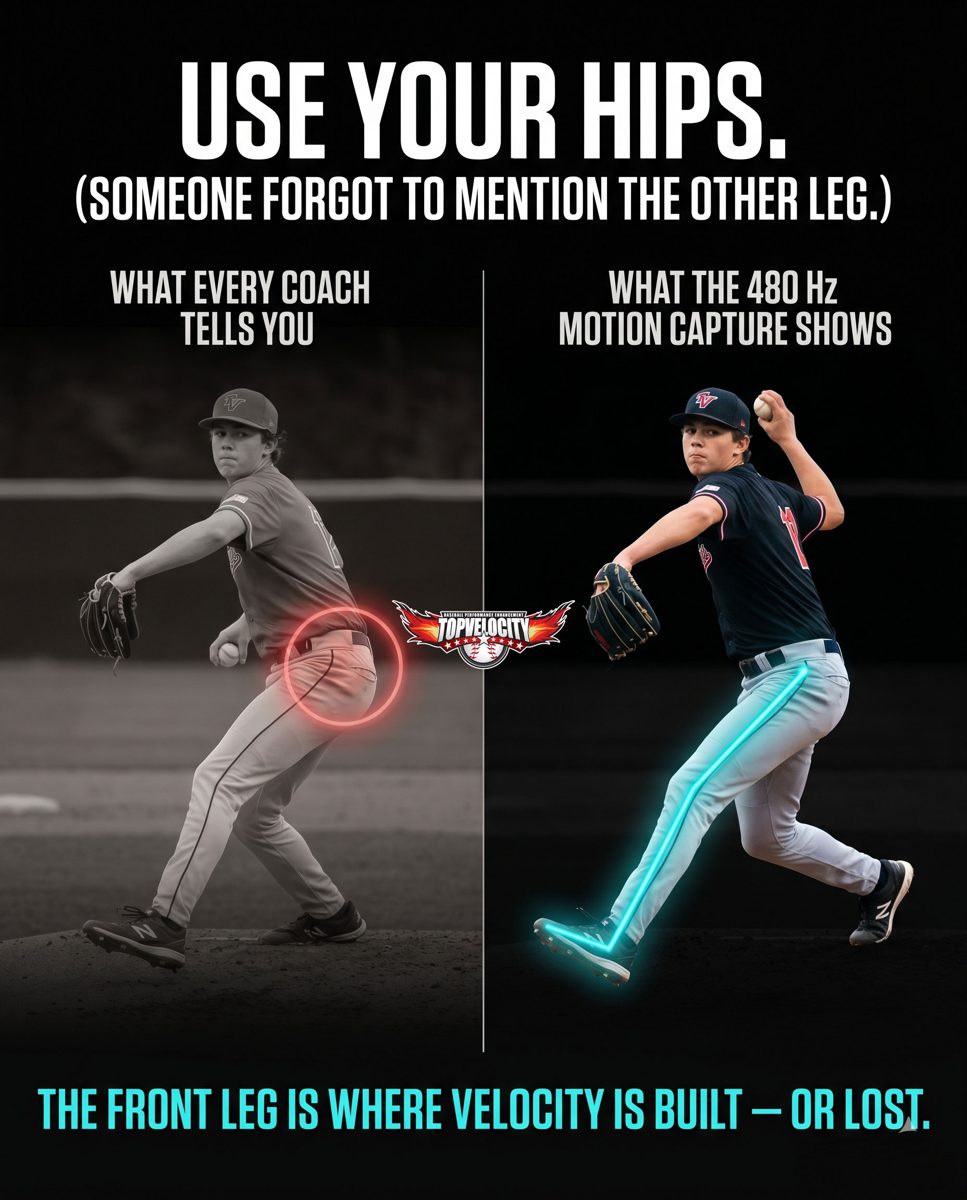
Posterior-chain strength — hamstrings and glutes — powers hip extension and stabilizes the landing leg that absorbs roughly 175% of bodyweight at front-foot strike. Conventional straight-bar pulls and clean-grip variations keep the hinge pattern honest and feed directly into the Olympic lifts.
4. Hip Thrust
The most direct glute-max loading available. In the EMG research comparing lower-body pulls, the hip thrust produced the highest gluteus maximus activation (Andersen et al. 2018, JSCR 32(3)). Hip extension is the “hip” in triple extension — this lift trains it in isolation so the clean can express it at speed.
5. Med-Ball Throws & Lateral Jumps
Not barbell lifts, but they earn the spot. Lateral-to-medial jumps — power in the same frontal plane as the pitching drive — correlate strongly with throwing velocity in college players (Lehman et al. 2013, JSCR), and our own 1,500-athlete prediction model ranks jump metrics above nearly every arm measurement. Rotational med-ball throws (2–6 lb, two hands) train trunk power transfer with zero arm stress.
The 2 Popular Choices That Don’t Transfer
Hex-Bar (Trap-Bar) Deadlift
Despite the name, the hex-bar deadlift behaves more like a squat variation — the EMG data shows it shifts load toward the quadriceps and away from the hamstrings, while the straight bar activates the biceps femoris significantly more (Andersen et al. 2018). A pitcher’s program is already rich in quad-dominant squatting. Adding a second squat pattern dressed as a deadlift just duplicates work and crowds out the hinge. That’s why TopVelocity programs use straight-bar pulls, clean pulls, and hip thrusts for the posterior chain instead — and reserve the explosive work for the Olympic lifts.
Machine Isolation Circuits
Leg extensions, pec decks, and cable kickbacks build muscle in isolation but train no timing, no ground force, and no kinetic chain. Pitching velocity is a coordination of forces, not a sum of parts. Pitchers who live on machines are leaving 5–10 mph in the weight room. The exception: targeted arm-care and cuff work, which is maintenance — not a velocity program.
| Lift | Verdict | Why |
|---|---|---|
| Hang clean / power clean | TRAIN IT | Triple extension at speed — 52.6 W/kg |
| Full-depth squat | TRAIN IT | Strength base; trains the loaded drive-leg position |
| Straight-bar pulls / clean pulls | TRAIN IT | Posterior chain for hip extension & landing-leg brake |
| Hip thrust | TRAIN IT | Highest glute-max activation in the EMG research |
| Med-ball throws & lateral jumps | TRAIN IT | Frontal-plane power correlates with velocity (Lehman 2013) |
| Hex-bar deadlift | SKIP | A squat in disguise — duplicates quad work, starves the hinge |
| Machine isolation circuits | SKIP | No timing, no ground force, no kinetic chain |
How Should Pitchers Program These Lifts?
Three rules from the research. First, sequence it: build a strength base before maximizing the Olympic lifts — our programs run 16-week calendars that begin with anatomical adaptation before the explosive phases. Second, keep lifting in-season at maintenance volume, because the detraining data is unforgiving (Gdovin 2024). Third, manage fatigue around outings: both upper- and lower-body fatigue independently reduce pitch velocity (Tremblay et al. 2024, JSCR), so heavy lower-body days don’t belong the day before a start.
If you want the complete, level-by-level version — lift standards from Youth 1 through TopV Pro, Olympic-lift instruction, and the 3X mechanics work the lifting feeds — it’s all inside the TopVelocity Player Portal ($99/month, 7-day trial). For the ground-force tools that bridge the weight room to the mound — the King of the Hill trainer and TopVelocity Sled — visit the TopVelocity store. And to see how your lower-body power already predicts your fastball, start with our vertical jump and velocity breakdown.
Frequently Asked Questions
Yes – with a straight bar. Conventional and clean-grip deadlifts train the hamstrings and glutes that power hip extension and stabilize the landing leg. The hex-bar version shifts load to the quads like a squat, duplicating work pitchers already do, which is why TopVelocity programs skip it.
Yes, with coaching and progression. Major pediatric and sports-medicine organizations endorse supervised youth resistance training, and roughly 96% of MLB strength coaches program Olympic lifts and plyometrics. Learn the hang clean with a qualified coach and build load gradually.
Yes, at maintenance volume. D1 pitchers who stopped resistance training for eight weeks lost velocity (Gdovin et al. 2024). The adjustment is timing – keep heavy lower-body work away from start days, since lower-body fatigue measurably reduces pitch velocity (Tremblay et al. 2024).
TopVelocity’s pro standard is a 1.5x bodyweight power clean, reached through a level-by-level ladder from youth through TopV Pro. The standard matters less than the pattern: explosive triple extension under progressively heavier load, built on a full-depth squat base.
About the Author
Brent Pourciau, M.S., is the founder of TopVelocity. After tearing his rotator cuff at 18 and being told he would never pitch again, he rebuilt his delivery through peer-reviewed biomechanics research and returned to throw 94 mph in professional baseball. He holds a master’s degree in kinesiology with doctoral work in health sciences, and has trained 10,000+ athletes including 100+ MLB draft picks through the TopVelocity Player Portal and Performance Center licensing program.