A pitcher can have years of baseball experience and still be a beginner with a clean or a jerk. The first useful question is therefore not how much the athlete can lift. It is what the athlete can repeat, understand and control with the exercise being taught.
Olympic-based strength and conditioning is one component of the TopVelocity 3X curriculum, alongside mobility, drill-based throwing and conditioning. This article proposes a coaching progression for teaching that component. It is a lesson-planning framework, not a universal loading prescription or evidence that mastering a particular lift guarantees more pitching velocity.
See this inside the Player Portal
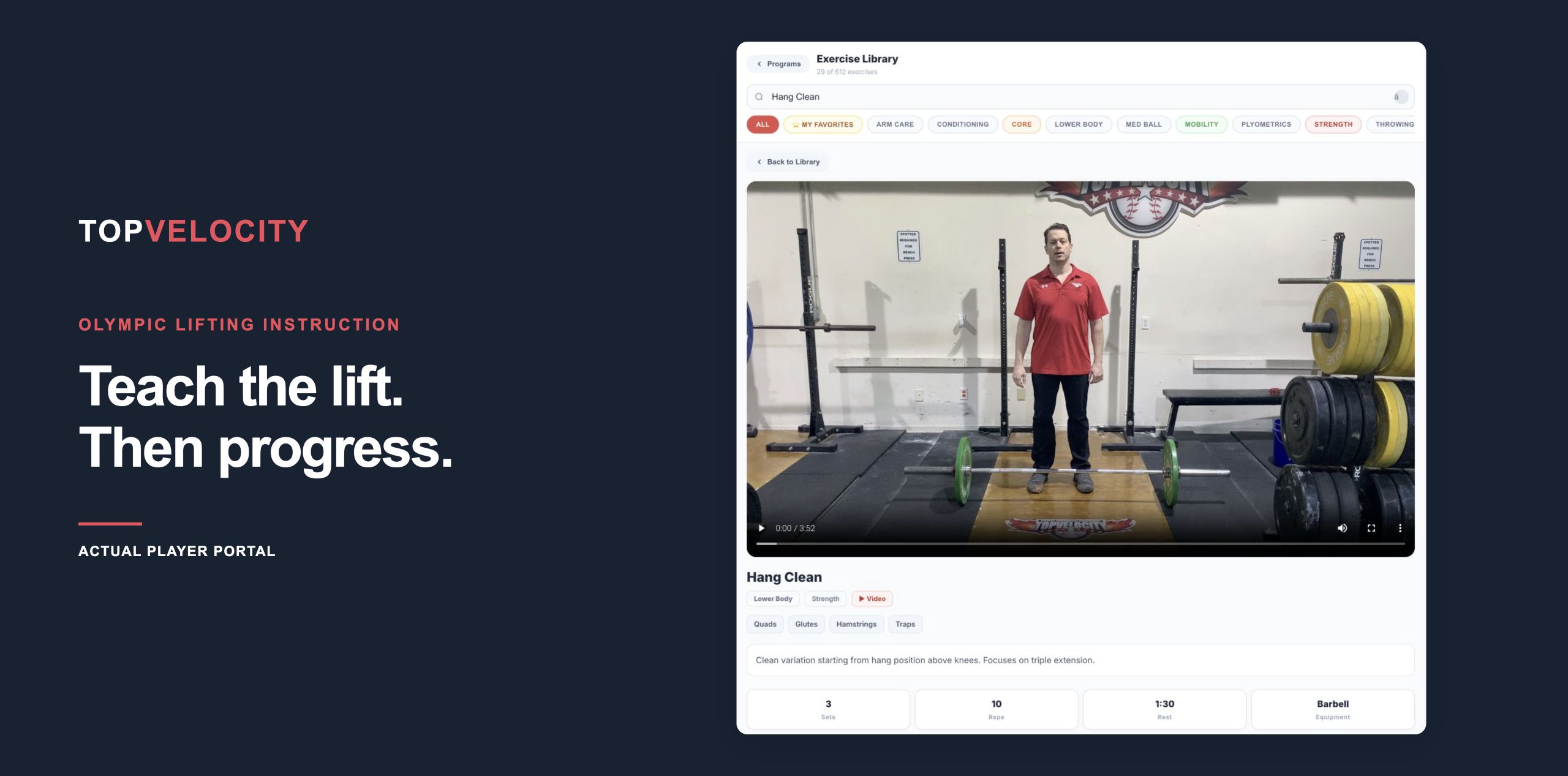
The Hang Clean video lesson shown above gives the coach and athlete a shared exercise reference inside the Player Portal. The coach still teaches the starting task, observes execution and selects an appropriate variation and load. Access to a lesson does not establish lifting readiness or replace qualified supervision.
See the portal in an organization demo or review organization plans and register.
Start with the athlete’s lifting experience
Playing level and lifting experience answer different questions. A professional pitcher may be unfamiliar with receiving a bar. A younger athlete may have practiced a movement consistently but lack experience with heavier loading. Neither the uniform nor the athlete’s confidence tells the coach which lesson comes next.
Begin by asking which variations the athlete has learned, who supervised them, how recently they were practiced and what the athlete finds difficult. Watch a familiar, manageable version before adding a new challenge. Include relevant restrictions communicated by the athlete’s healthcare team. This is coaching preparation; a lifting observation does not diagnose a medical condition.
TopVelocity’s Foundations of 3X Pitching describes individualized preparation and ongoing assessment. Applied to a lifting lesson, that means selecting the task from the athlete’s current skill and purpose rather than assigning the same exercise simply because everyone is a pitcher.
Give the exercise one clear teaching purpose
Before the set, finish this sentence: “Today we are using this movement to practice…” The answer might concern a consistent starting position, coordinated extension or controlled receiving mechanics. Keep it specific enough that the athlete can tell whether the attempt addressed the lesson.
For example, a coach teaching a clean-pull variation might focus on maintaining balance through the finish. Adding a catch would introduce another task. If the pull already loses its intended shape, increasing both complexity and load makes it harder to determine what needs attention.
Use a brief demonstration and one instruction the athlete can act on. Then watch the response. A long list of corrections can turn each repetition into a memory test. When an instruction produces no useful change, reconsider the instruction or the exercise before concluding that the athlete is unwilling to learn.
Choose the variation that fits the lesson
The Olympic lifts contain several skills. A coach can select a derivative that emphasizes a particular part without requiring the athlete to perform the complete lift immediately. The choice should reflect available coaching, equipment, current competence and individual tolerance.
A pull variation removes the receiving phase. A start from the hang changes the starting task compared with a start from the floor. Neither option automatically makes the exercise appropriate for every athlete, and neither should be treated as a permanent label for a pitcher. The coach still needs to observe execution and decide whether the variation serves the intended purpose.
Do not make a catch a compulsory test of commitment. If receiving the bar is not appropriate or useful for the current objective, choose an alternative the athlete can perform under qualified supervision. If a catching variation is selected, teach its positioning and control as skills in their own right. Persistent pain or concerning symptoms require stopping that task and involving the appropriate healthcare professional.
Record the lesson before changing the load
The worksheet below makes a coaching decision reviewable. Complete it for the selected exercise, using the athlete’s own observations rather than a generic pass score. It is a proposed lesson record, not a validated screening test.
| Record | What the coach writes | How it informs the next lesson |
|---|---|---|
| Purpose | The specific skill or physical-training objective for this exercise. | Keep only changes that support the stated objective. |
| Starting task | Exercise variation, starting position, implement and actual load. | Make the next observation comparable. |
| Instruction | The main cue or demonstration used. | Record which instruction helped the athlete understand the task. |
| Observed response | What was repeatable, what changed and what the athlete reported. | Distinguish an isolated attempt from a consistent pattern. |
| Next decision | Repeat, simplify, change the variation or progress one demand. | State the reason and who will supervise. |
| Follow-up | Next lesson date and the feature to observe again. | Check whether the skill persists beyond today’s coaching. |
A completed record might say that an athlete maintained the selected start position when coached but lost it after the demonstration was removed. That is useful information: the next lesson can repeat the task and check independent execution. It is not a reason to manufacture a heavier successful attempt for the training log.
Progress one demand and keep the comparison understandable
A progression can involve load, movement complexity or the amount of work. It does not have to involve all three. Choose the change deliberately, then check whether the intended movement remains recognizable and the athlete can explain the task.
Record the actual work completed, including adjustments. If execution changes substantially, a coach can reduce the demand or return to a previously manageable variation. This recommendation does not establish an exact fatigue threshold. It keeps an exercise lesson tied to observable behavior instead of treating completion of the written session as the only success.
Keep lifting skill, physical development and pitching results separate
Improved execution shows that the athlete learned something about the lift. Changes in strength or power require appropriate physical measures. Changes in pitching require throwing observations collected under comparable conditions. One result cannot substitute for the other two.
The same distinction applies to timing. Brent Pourciau’s 13-pitcher dissertation study found no statistically significant group advantage from its tested acute Olympic-lifting warm-up. That finding does not settle the effects of months of training, and a long-term training rationale does not establish a pregame velocity boost. The TopVelocity study article explains the protocol and its limits.
For a pitching program, the practical standard is straightforward: teach the lifting task well, choose its place in the athlete’s broader preparation, and evaluate pitching development separately. The barbell is a training tool. The athlete’s development remains the purpose.
Discuss how this fits your pitchers
Professional staffs can discuss a defined pitching-development question with Brent, including how lifting instruction would fit existing staff responsibilities and the athlete’s training experience.
Academies and facilities can review TopVelocity’s organization program and staff-training options. Choose the service after clarifying who will teach the exercises, what support the staff needs and how athlete progress will be reviewed.