A medicine-ball drill earns its place in a pitching program when the coach can explain its purpose and recognize a useful response. Throwing the ball farther is one possible outcome. Learning to coordinate a particular movement is another. The session becomes clearer when the staff decides which outcome it is training.
For 3X movement practice, start with a task the athlete can understand, observe how he solves it, and change the task deliberately. The ball is part of the learning environment. Its presence does not, by itself, make an exercise specific to a pitcher’s development need.
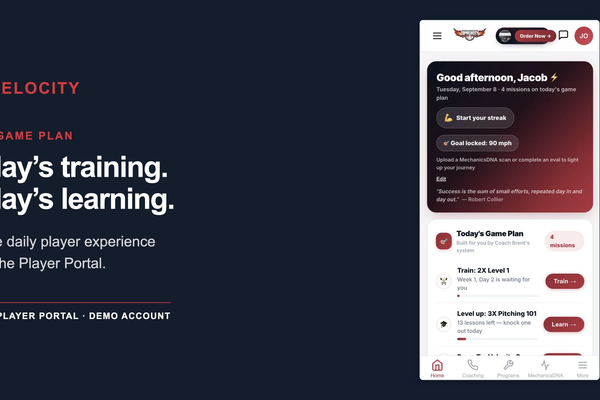
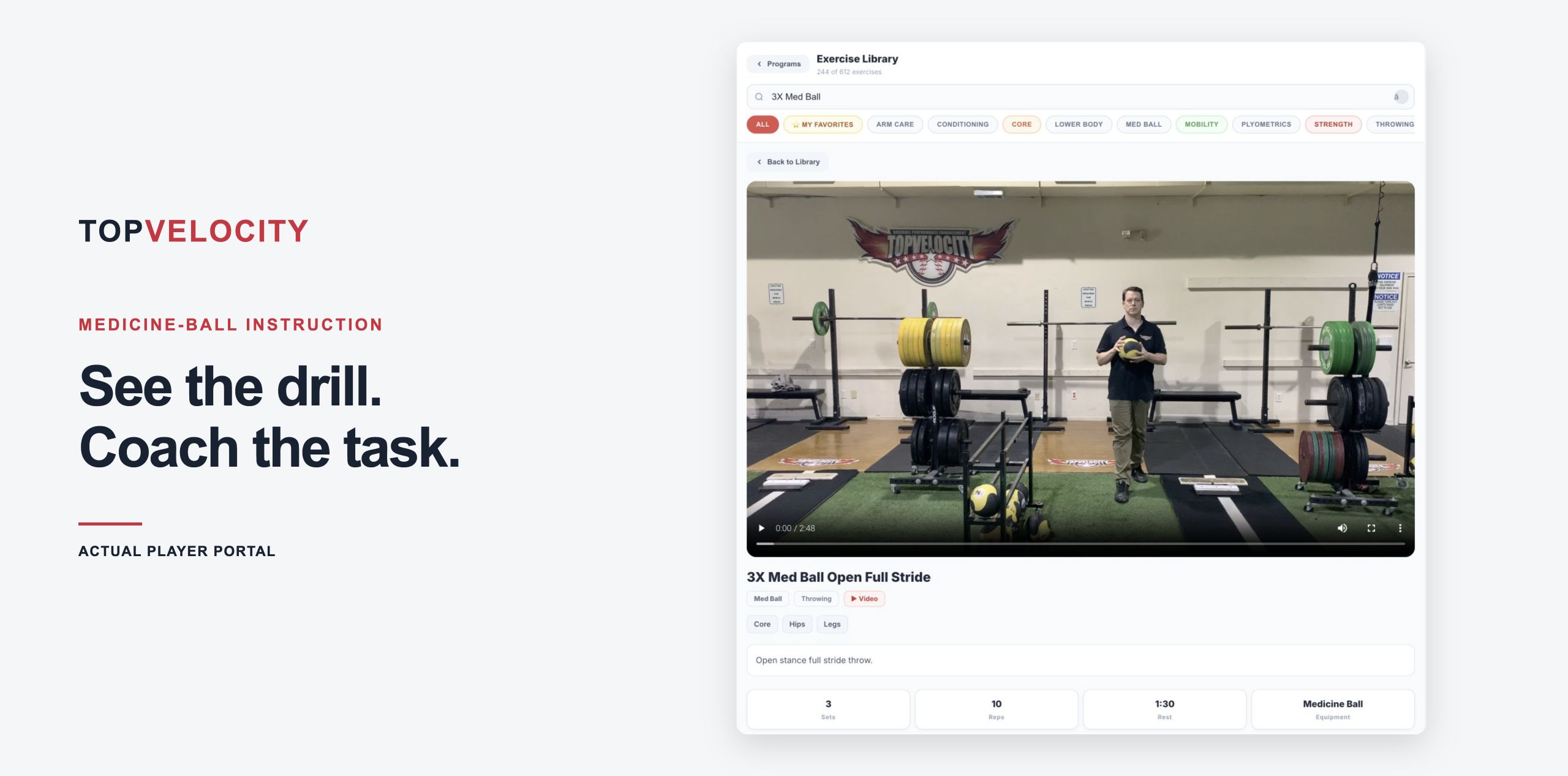
See this inside the Player Portal
The Player Portal’s Exercise Library includes the 3X Med Ball Open Full Stride video lesson shown above. Use it as a teaching reference, then choose whether the task fits the athlete’s objective and current plan. The displayed sets, reps and rest are not an individualized prescription for every pitcher.
See the portal in an organization demo or review organization plans and register.
Where medicine-ball work fits in 3X
The TopVelocity 3X curriculum includes medicine-ball work within a broader program of movement practice, throwing and physical preparation. Its 2018 article on building the foundation of 3X mechanics applies a motor-learning framework to tasks that vary in starting conditions, whole-body movement and object handling.
That approach gives the coach variables to work with. A player might understand an action in a stable position, find it more difficult when stepping, and respond differently when the target changes. The coaching value lies in discovering those differences and using them to select the next task.
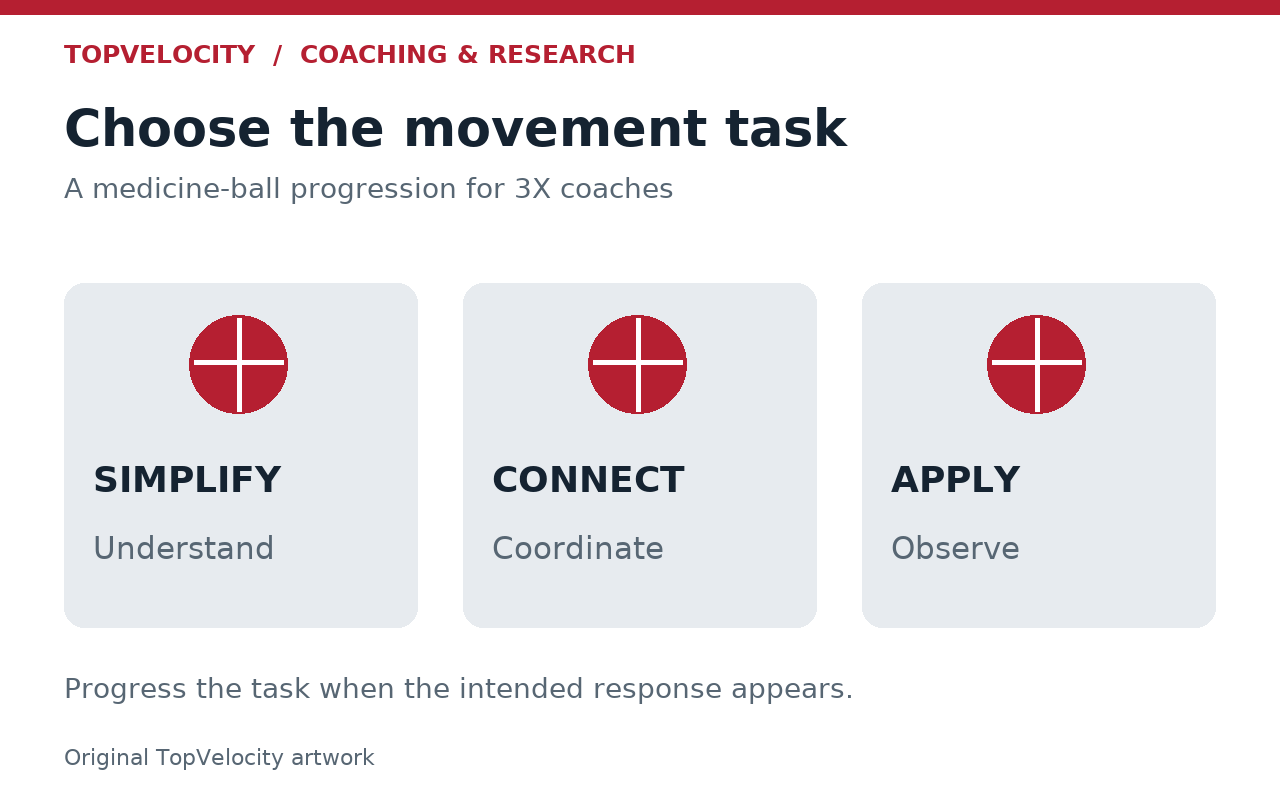
The progression below is an original planning tool for applying those curriculum principles. It is not a prescribed sequence every pitcher must complete, and its steps are not a tested guarantee of increased velocity.
Write the goal before selecting the exercise
A useful movement goal states what the athlete is learning to organize. For example: coordinate the start of pelvis rotation with the subsequent trunk action in a controlled throwing task. A physical-training goal might instead concern repeated forceful effort under a strength coach’s supervision.
Those goals can use similar equipment while requiring different observation and feedback. If the objective is movement learning, the coach needs to see whether the intended relationship appears. If the objective is physical preparation, the staff needs an appropriate prescription and a relevant way to monitor that work.
Do not ask one medicine-ball score to answer both questions. Record the exercise conditions so that a later comparison means something: starting position, ball characteristics, instructions, target and the method used to observe the response.
Four task choices a coach can use
Find a clear starting action
Choose a manageable position and a simple destination for the throw. The coach demonstrates the objective and gives the athlete time to explore it. At this stage, success means the athlete understands the task and can identify a meaningful difference between attempts.
If the instruction produces confusion, reduce the number of things the athlete must manage. The coaching task is to establish a useful starting point, not to make the first exercise difficult.
Link the action to more of the body
Introduce a relevant movement, such as a step or a different starting orientation, when it serves the objective. Observe whether the movement relationship survives that addition. A larger motion can create a new coordination problem even when the athlete handles the ball comfortably.
Changing one feature at a time makes the response easier to interpret. If the task stops serving its purpose, return to the last useful version and decide what needs a clearer instruction or more practice.
Adapt to a changing requirement
Once the athlete can organize the task, vary a relevant requirement. A coach might change the target between attempts while retaining the movement objective. The question becomes whether the athlete can adapt his action without needing every detail rehearsed in advance.
Variation should have a reason. Adding movement, load, speed and a changing target simultaneously makes it hard to know what the athlete has learned or why an attempt failed.
Check the connection to baseball throwing
Return to an appropriate throwing task within the athlete’s planned workload. Look for the relationship that motivated the medicine-ball practice. The athlete may demonstrate it in the drill but need a different instruction to find it while pitching.
That result helps the coach refine the program. A successful drill performance is worth recording, but the pitching objective still needs to be evaluated in pitching.
A coach sheet for the next session
| Goal | Task constraint | Response to observe | Progress or adjust |
|---|---|---|---|
| Help the athlete recognize the selected movement relationship. | A repeatable starting position and one target. | Can the athlete reproduce and describe the intended action? | Add movement when the objective is understood; simplify the instruction if it is not. |
| Connect the action with whole-body movement. | A selected step or starting orientation. | Does the action remain organized when the athlete moves into it? | Retain the task if the response is useful; reconsider the added movement if it obscures the goal. |
| Develop adaptation within the task. | A relevant target change between attempts. | Can the athlete adjust while preserving the objective? | Increase the demand deliberately, or return to a more predictable target. |
| Investigate the connection to throwing. | An appropriate baseball task already included in the plan. | Does the intended relationship appear, and what happens to pitch execution? | Continue, modify or replace the drill based on its usefulness to the throwing goal. |
Load is a choice within the task
The selected ball must suit the athlete, exercise and training purpose. A heavier ball can change the task itself. If it prevents the athlete from practicing the intended action, increasing load has moved the session away from its stated goal.
The supervising coach should also organize adequate throwing space, appropriate equipment and the planned training volume. New pain is a reason to stop and consult the responsible clinical professional, rather than modify technique until the athlete can push through it.
Keep the learning framework and the evidence distinct
A. M. Gentile’s original work on skill acquisition provides historical context for thinking about how teaching relates to the task. TopVelocity’s curriculum applies a task-progression framework to 3X practice. Neither reference is a controlled trial establishing that the proposed session sheet increases pitching velocity or prevents injuries.
The practical recommendation here is to make coaching decisions observable. A coach should be able to say what changed in the task, how the athlete responded and why the next step follows. TopVelocity’s assessment and individual-goal approach supports keeping that record specific to the pitcher.
Professional player-development staff: talk with Brent Pourciau about a defined 3X coaching project, including how task selection would support your athlete’s existing development plan.
Facilities and academies: review TopVelocity’s organization platform and coaching curriculum for managing evaluations, program assignments and staff development.