Hip–shoulder separation gives a coach something to examine, but it does not tell the coach what to train. A pitcher may have difficulty accessing a movement, coordinating it, or using it in the delivery. Those are different starting points.
In 3X coaching, the practical goal is to connect the pelvis and trunk within the pitcher’s delivery. That means understanding the movement available to the athlete, choosing a task he can organize, and then checking the sequence as pitching demands increase. A larger separation angle is not the objective by itself.
See this inside the Player Portal
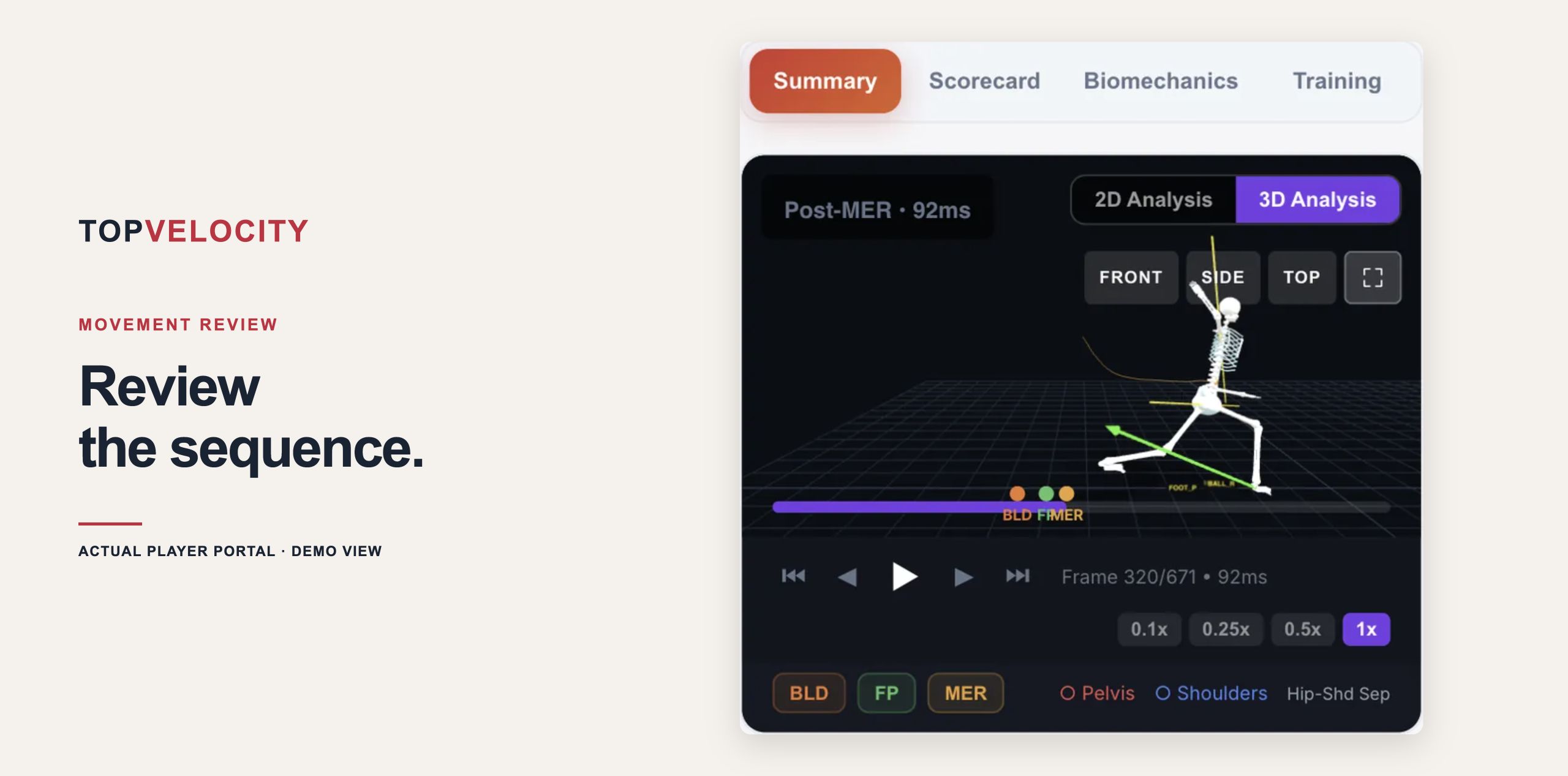
The MechanicsDNA demo above shows the Player Portal’s 3D delivery view, playback controls and pelvis, shoulders and hip–shoulder separation options. Bring a defined coaching question to a walkthrough of that workflow. A visualization alone does not validate a measurement or show that changing the displayed relationship will improve a pitch.
See the portal in an organization demo or review organization plans and register.
Define the movement before coaching it
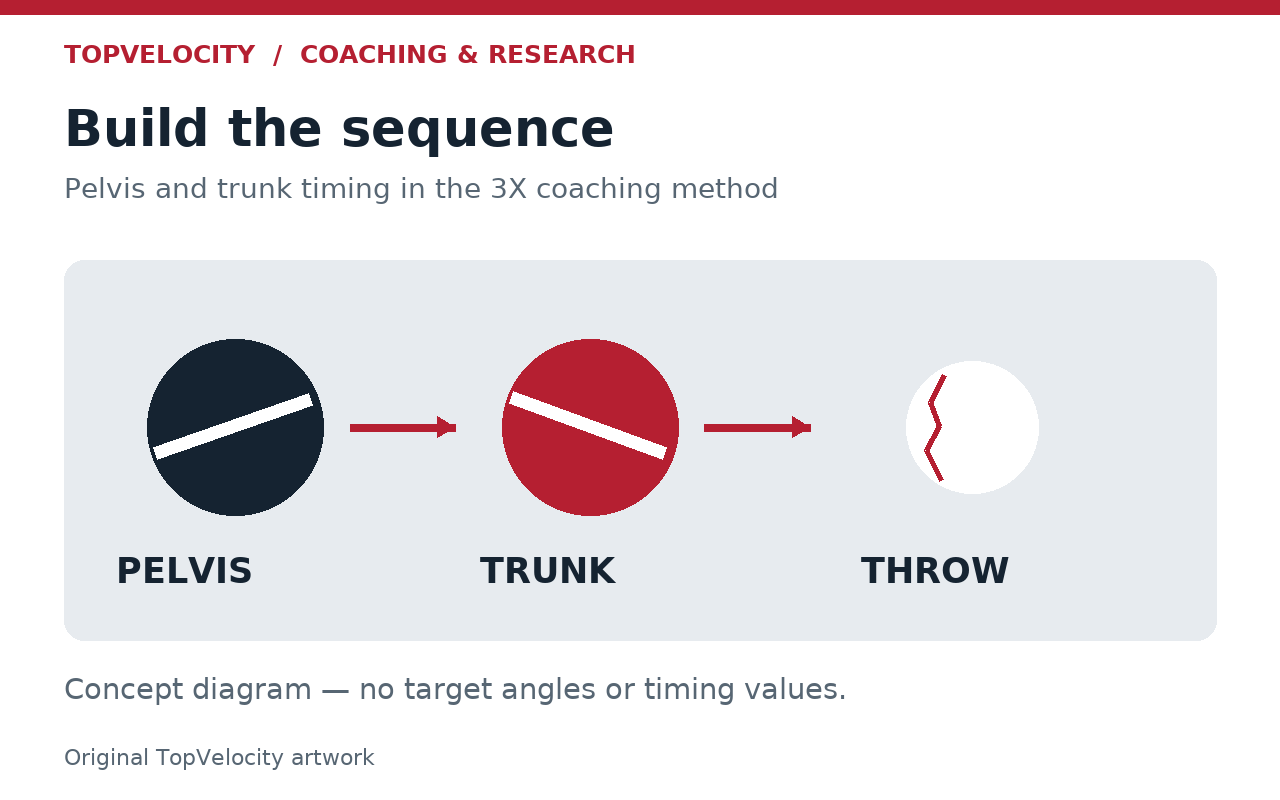
Hip–shoulder separation commonly describes the rotational relationship between the pelvis and upper trunk. An angle at foot contact describes one instant. The order and timing of pelvis and trunk rotation describe how the athlete arrived there and what happens next.
TopVelocity’s 3X mechanics material explicitly includes separation timing alongside triple extension and front-leg action. Its emphasis is a coordinated delivery: lower-body action must relate to what the trunk and throwing arm are doing. For this article, that curriculum supplies the coaching starting point, rather than a universal angle or timing prescription.
The staff should agree on its terminology. “The shoulders opened early” might mean an observation about the start of trunk rotation, its peak speed, or a position at foot contact. These are not interchangeable. Describe the event you actually observed before choosing a correction.
Ask three questions about the athlete
What movement is available?
Begin with the athlete’s physical assessment and training history. Ask whether comfortable, controlled rotation is available during appropriate screening tasks. Note how the athlete achieves the task, rather than recording only its largest range.
This assessment helps the coach decide where further investigation belongs. It does not establish that a specific stretching routine will create the desired delivery. Pain or a suspected clinical limitation belongs with the qualified staff responsible for that athlete’s care.
Can the athlete organize the movement?
Next, select a simple coached task in which pelvis and trunk action can be observed. Reduce unnecessary demands: use a repeatable starting position, one clear target and one instruction. The task should help the athlete understand the relationship the coach is asking for.
Watch for a useful response across several attempts. If the athlete cannot identify the difference between attempts, simplify the task or the feedback. More verbal detail is not automatically more helpful.
Does the relationship appear during pitching?
Bring the task back toward the delivery. Restore the movement, intent and target demands that were simplified. Observe whether the athlete can retain the intended relationship while still executing a pitch.
When the response disappears, record the condition in which it disappeared. That gives the next practice a purpose. It does not automatically mean the athlete needs more flexibility or a stronger cue to hold the trunk closed.
What research contributes to these questions
Bullock and colleagues examined 32 high-school pitchers. They found moderate associations between separation at foot contact and peak trunk rotation velocity, and between trunk rotation velocity and pitch velocity. Their clinical hip and trunk range-of-motion measurements were not associated with the measured pitching kinematics or sequencing.
That result helps distinguish available range from its use during a complex task. It does not show that mobility work is unnecessary, nor identify the best drill for an individual. The study was observational and involved high-school pitchers.
Orishimo and colleagues studied 29 high-school and collegiate pitchers. Their analysis linked aspects of pelvis and trunk behavior with trunk rotation velocity, while peak trunk velocity was related to ball velocity. This supports investigating how those segments interact. It was not a training trial and does not demonstrate that prescribing more separation produces a faster pitch.
The coaching application is to treat separation as one part of a developing explanation. Observe the athlete, choose a manageable change, and check whether the intended response appears. Research informs that process without supplying a single ideal delivery for every pitcher.
A 3X progression from understanding to execution
TopVelocity’s foundations curriculum places assessment and individual goals alongside movement practice and physical preparation. The following is a proposed coaching application of that approach.
- Name one relationship. Write what the pelvis and trunk are doing and the event at which it matters. Keep the description specific enough that another coach could look for it.
- Select an entry task. Choose a familiar 3X drill that lets the athlete practice that relationship with manageable demands. The first successful task may differ between pitchers.
- Add one demand. Change a relevant feature, such as starting movement or target requirement. Keep the other conditions stable enough to understand the response.
- Return to pitching. Review the actual delivery and ball outcome. Continue only if the practice remains connected to the athlete’s development goal.
Use a question sheet instead of an angle target
| Staff question | What to record | What would redirect the work |
|---|---|---|
| Is the selected movement available under simple conditions? | The assessment task, how the athlete performs it and any relevant clinical input. | The athlete already demonstrates comfortable control; investigate the delivery task rather than assuming a range limitation. |
| Which instruction helps the athlete organize the relationship? | The exact cue, starting position and response across attempts. | The cue produces a held pose or interrupts the throw; change the task or simplify the instruction. |
| What happens when pitching demands return? | The delivery event, intended effort, target execution and relevant pitch measurements. | A different appearance produces no useful response, or an existing strength deteriorates; revisit the objective. |
Keep the athlete’s successful delivery features visible
Suppose, in a hypothetical coaching example, an athlete demonstrates comfortable rotation during assessment and can organize a separation-focused drill, yet loses the intended relationship while aiming a fastball. The next useful question concerns the transition into that pitching task. The example does not justify automatically adding stretching or asking for a larger angle.
The coach could simplify the target demand, observe the response and then restore it. Throughout the process, the staff should preserve the athlete’s useful pitch characteristics and ask him what changed in his experience of the movement.
A complete session note records the response, the condition that challenged it and the next question. Over time, those notes create a more useful development history than a series of screenshots labeled good or bad.
Professional player-development staff: discuss a specific sequencing question with Brent Pourciau and define how a coaching project would fit your athlete and staff.
Facilities and academies: explore TopVelocity’s organization platform and 3X curriculum for coordinating evaluations, coaching and training assignments.