A 3X pitching practice should give every athlete a clear task and give every coach a clear decision. A roster may share a training philosophy without sharing the same drill, load or progression. The organizing challenge is to keep individual development visible when several pitchers are training at once.
The practice design below applies TopVelocity’s own 3X curriculum to a staff-led session. It is a proposed coaching workflow, not a published trial or a claim that every TopVelocity location runs an identical schedule. Its purpose is to make the connection between physical preparation, movement practice and pitching easier to coach.
See this inside the Player Portal
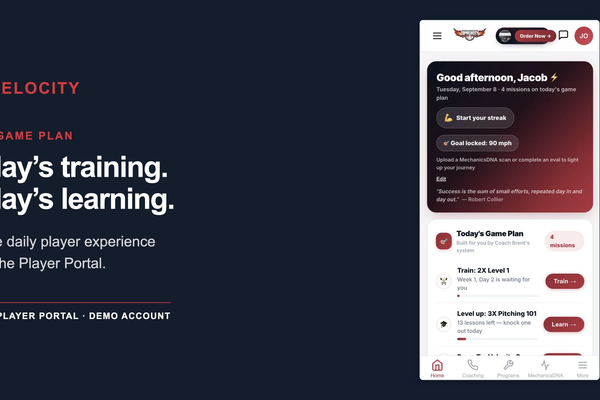
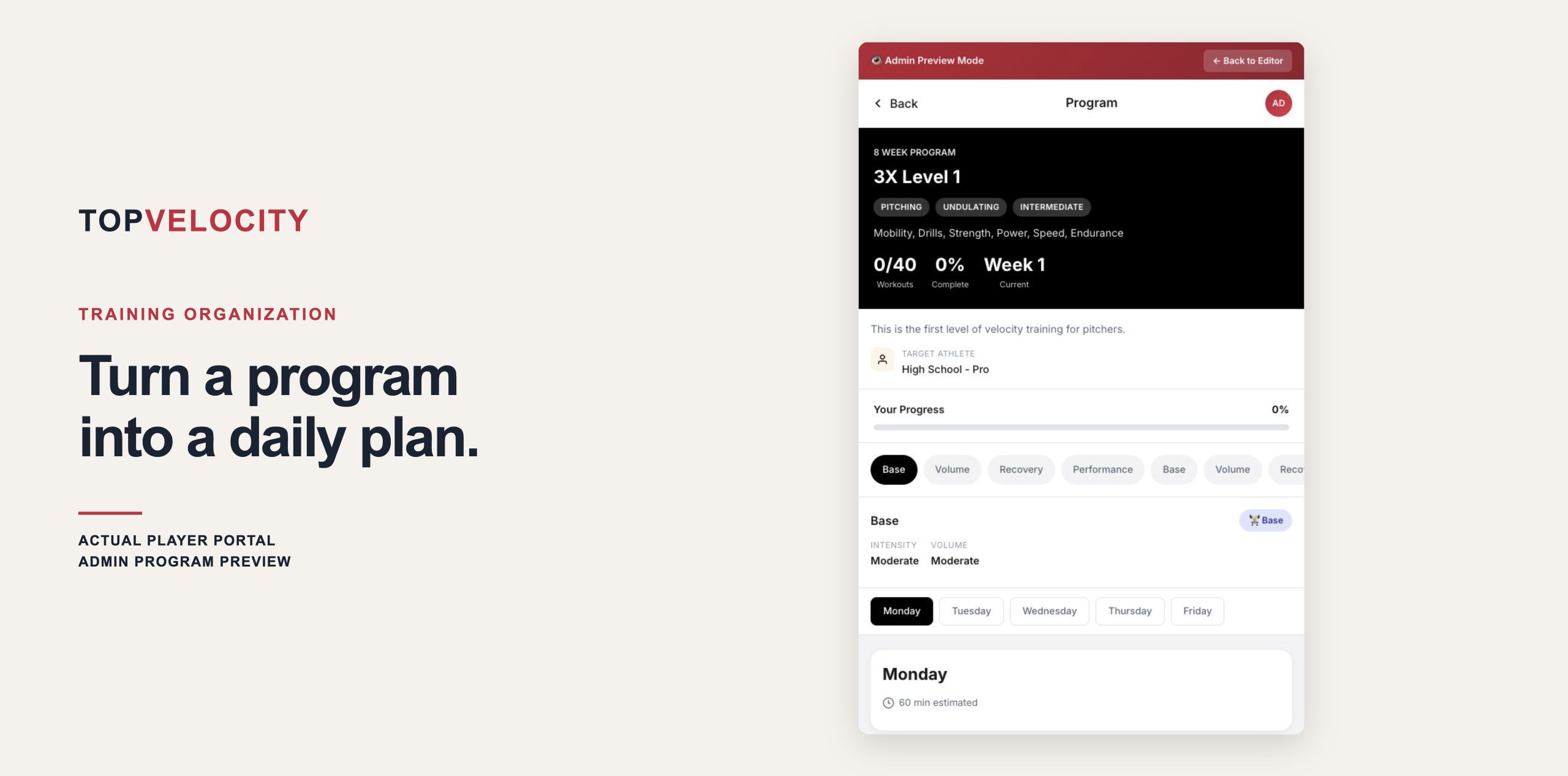
The 3X Level 1 program preview above shows how phases, intensity, volume and weekdays are presented in the Player Portal. It gives staff a concrete view to discuss while organizing a coaching week. The coach still coordinates that work with the athlete’s throwing, lessons and other training; the screenshot does not show automatic workload reconciliation.
See the portal in an organization demo or review organization plans and register.
Give the session one teaching purpose
Start with a question the staff can answer through observation. For example: can these pitchers preserve their intended pelvis-and-trunk sequence as a familiar movement task becomes more demanding? That is more specific than “work on mechanics,” and it tells a coach what to watch.
TopVelocity’s 3X program includes mobility, throwing and medicine-ball drills, Olympic-based strength work and conditioning. A practice should draw from those elements selectively. Putting every element into every session can obscure the teaching purpose and compete with the athlete’s other training.
Define the shared concept, then assign an individual task. One pitcher may be learning to organize a controlled movement. Another may already be testing the same concept in a full delivery. Grouping them under one concept does not require making their tasks identical.
Separate the teaching stations from the athlete’s total workload
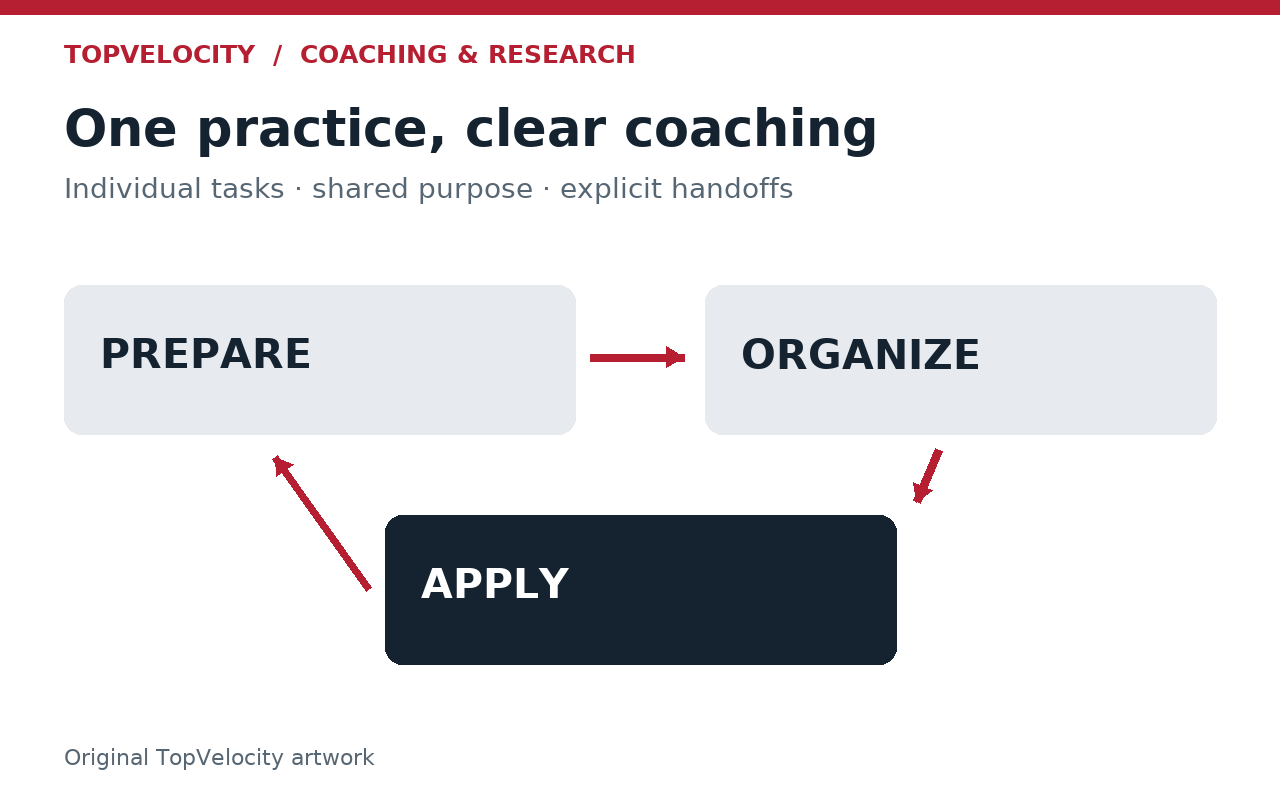
The three stations below are learning roles, not a prescription for throwing volume, frequency or intensity. Coaches choose the activities and exposure within the athlete’s current plan. A pitcher does not need to pass through every station on the same day.
| Station | Coaching purpose | What the coach records |
|---|---|---|
| Prepare | Review readiness for the planned task and rehearse the movement or physical skill it requires. | The task selected, any modification, and the reason for that modification. |
| Organize | Use a controlled 3X movement or medicine-ball task to explore the intended sequence. | What the athlete did, which cue or constraint was used, and whether it changed the observation. |
| Apply | Observe the relevant quality in an appropriate regulation-ball throwing task. | The actual task, its result, and whether the athlete could use the intended movement without constant prompting. |
This design creates a shared language without prescribing an unassessed program. Medical restrictions and return-to-throw decisions remain with the responsible medical staff. Coaches should not interpret successful participation at a station as clinical clearance.
Make the first handoff explicit
Before a pitcher begins, the receiving coach needs a short task card. It should state the athlete’s current objective, the selected activity, the one observation that matters and the reason to modify or stop that activity. This is enough information to start a useful conversation without reproducing an entire evaluation report.
Include a quality to preserve. An athlete working on lower-body timing may already have useful location or a delivery rhythm that supports a particular pitch. Naming that strength helps the next coach avoid treating every visible difference as a defect.
A practical instruction sounds like this: “We are exploring the timing of the drive phase in this task. Watch the transition into landing, record the response to the agreed cue, and tell the next coach whether it carried into the throwing task.” It should not sound like a list of six unrelated corrections.
Let observations decide progression
TopVelocity’s published movement-learning discussion uses changes in task complexity to organize practice. An organization can apply that idea by changing one demand at a time and looking for the intended response.
For a new task, simplify the movement enough that the athlete understands what is being explored. If the intended coordination becomes repeatable under those conditions, restore a demand that matters to the delivery. If the response disappears, the next decision may be to simplify again, change the cue or reconsider whether that task addresses the actual problem.
Progression should not become a race through a drill list. Finishing repetitions establishes participation; it does not establish that a movement was learned. A visibly different repetition also does not establish that the pitcher’s competitive performance improved.
Use a short lesson record, not a second scouting report
The following fields can be completed in a shared staff record or an existing player-development system. They describe the coaching interaction rather than inventing a numerical mechanics score.
- Purpose: what this practice segment was intended to develop.
- Starting task: what the athlete actually performed, including the implement and movement conditions.
- Observation: what the coach saw or measured, kept separate from the proposed explanation.
- Change: the cue, constraint or task modification used.
- Response: whether the intended quality changed in that task and in the subsequent throwing task, if performed.
- Next decision: retain, progress, simplify or review with another staff member.
Record what happened even when the result is inconclusive. A note that an athlete did not perform the planned throwing task is more informative than a blank that later gets interpreted as successful completion.
Protect the athlete from competing instructions
A pitching coach, strength coach and remote specialist can each make a reasonable suggestion that becomes confusing when delivered at the same time. Assign one staff member to reconcile changes to the session’s primary teaching task. Specialists can contribute observations without independently replacing the athlete’s plan between stations.
Consider an illustrative situation: the movement coach wants a pitcher to experiment with a different drive-phase cue, while the strength coach notices that the athlete is struggling to execute a newly introduced lift. These are two learning demands. The staff can choose which deserves attention now, simplify the other task, and explain the choice to the athlete. This is a planning example, not a report of a specific player’s training.
At the end of the session, the athlete should be able to describe what was being developed and what comes next. The coaches should agree on the same answer.
Use the portal to support the coaching conversation
The TopVelocity organization offering describes evaluations, program assignments, player records and coach communication. Those functions can support a consistent practice workflow. A proposed lesson-record format should still be matched to the tools and permissions actually available to the organization; this article does not announce a new automated station-management feature.
For facilities building a staff-led 3X program, review the TopVelocity partner pathway or explore organization registration. For a professional organization considering coach education or a specific development project, discuss the coaching objective with Brent Pourciau. Start with the work your staff needs to perform, the athletes it serves and the evidence it will use to judge progress.