Quick answer: Here is the pitch count by age under MLB and USA Baseball’s Pitch Smart guidelines, the daily pitch limit is 50 pitches for ages 7–8, 75 for 9–10, 85 for 11–12, 95 for 13–16, 105 for 17–18 and 120 for 19–22. Each limit comes with required rest days based on how many pitches were thrown. But the pitch count is the ceiling, not the goal. The research is clear that fatigue, not the number on the clicker, is what puts arms on the operating table.
Conventional wisdom says “he’s under his count, he’s fine.” Science says a tired arm at pitch 60 is more dangerous than a fresh arm at pitch 85. Here’s how to use the numbers correctly, and what the counts don’t tell you.
Pitch count by age: the Pitch Smart chart
The table below is the Pitch Smart daily maximum and rest schedule published by MLB and USA Baseball (Pitch Smart guidelines, accessed October 2026). Little League Baseball uses the same daily limits through age 12 and 95 pitches for league ages 13–16.
| Age | Daily max | 0 days rest | 1 day | 2 days | 3 days | 4 days |
|---|---|---|---|---|---|---|
| 7–8 | 50 | 1–20 | 21–35 | 36–50 | — | — |
| 9–10 | 75 | 1–20 | 21–35 | 36–50 | 51–65 | 66+ |
| 11–12 | 85 | 1–20 | 21–35 | 36–50 | 51–65 | 66+ |
| 13–14 | 95 | 1–20 | 21–35 | 36–50 | 51–65 | 66+ |
| 15–16 | 95 | 1–30 | 31–45 | 46–60 | 61–75 | 76+ |
| 17–18 | 105 | 1–30 | 31–45 | 46–60 | 61–80 | 81+ |
| 19–22 | 120 | 1–30 | 31–45 | 46–60 | 61–80 | 81+ |
How to read it: find the pitcher’s age, find the column that contains the number of pitches he threw, and the column heading is the number of calendar days he must rest before pitching again. A 12-year-old who throws 40 pitches on Saturday needs two days of rest, so he can’t pitch again until Tuesday.
Two rules apply at every age under both Pitch Smart and Little League: no pitching on three consecutive days, and no pitching in more than one game per day for the youngest players. For ages 8 and under, Pitch Smart adds that kids should take at least four months off from throwing every year, avoid catching on days they don’t pitch, and throw only fastballs and changeups.
How many pitches should a 12-year-old throw in a game?
No more than 85, and that’s the absolute ceiling. In practice, the better number for most 12-year-olds is lower. At 66 pitches he’s already locked into four days of rest, so pushing from 66 to 85 buys you a few more outs at the cost of the same recovery window and a lot more fatigue.
The research on this age group is direct. Lyman, Fleisig, Andrews and Osinski (2002, American Journal of Sports Medicine) followed 476 pitchers aged 9–14 for a full season. Half of them had elbow or shoulder pain at some point, and more pitches per game and per season meant more pain. The same study linked the curveball to a 52% higher risk of shoulder pain and the slider to an 86% higher risk of elbow pain. That’s why Pitch Smart keeps the youngest pitchers on fastballs and changeups.
How many pitches can a high school pitcher throw?
It depends on the state. Since 2016, the National Federation of State High School Associations (NFHS) has required every state association to have a pitching restriction policy based on pitches thrown in a game, with mandatory rest. Each state writes its own numbers.
New Jersey’s rule is a good example of a typical structure: a maximum of 110 pitches per game, rest of 0 days for 1–30 pitches, 1 day for 31–50, 2 days for 51–70, 3 days for 71–90 and 4 days for 91–110, no pitching three days in a row, and no more than 150 pitches in any five-day period. Check your own state association’s current rule before the season starts. And remember that high school limits are generally looser than Pitch Smart’s, so the safer standard is the stricter one.
Do pitches from travel ball, school and lessons all count?
They count to your son’s arm, even though no league counts them for you. Each league only tracks its own games. The high school coach doesn’t see the Saturday travel tournament, and the travel coach doesn’t see Tuesday’s bullpen. Pitch Smart puts that year-round responsibility on parents and athletes, because they’re the only ones who see the whole picture.
This is where most arms get hurt. Not in one reckless outing, but in the stacking: a school game Tuesday, a showcase Thursday, two travel games over the weekend, and a “light” bullpen in between. Each outing looks legal on its own. Added together, the arm never recovers. If you want the full picture of how this plays out, read our breakdown of whether travel baseball is destroying your son’s arm.
The practical fix is simple: keep one log for every throw that counts. Games, showcases, bullpens and long, hard throwing sessions all go in it. If your son plays for two teams, the log is the only thing standing between him and a double workload.
Is pitch count or fatigue the bigger injury risk?
Fatigue. This is the most important point in this article, and it’s the one the pitch count table can’t show you.
Yang and colleagues (2014, American Journal of Sports Medicine) surveyed 754 pitchers aged 9–18 nationwide. Pitchers who regularly pitched with arm tiredness had 7.88 times the odds of a pitching injury, and those who pitched with arm pain had 7.50 times the odds. A 2020 meta-analysis by Salamh and colleagues in Physical Therapy in Sport, which pooled the earlier studies, found that playing with arm fatigue carried pooled odds of 13.3 for injury.
Fatigue also changes how a pitcher moves. In a simulated 90-pitch game with youth pitchers, Cecere and colleagues (2024, Journal of Shoulder and Elbow Surgery) found that elbow flexion at ball release increased as the pitch count climbed and ball speed was lowest in the final set. The body starts to compensate before anyone in the dugout notices. That compensation is exactly the kind of mechanical breakdown that loads the elbow.
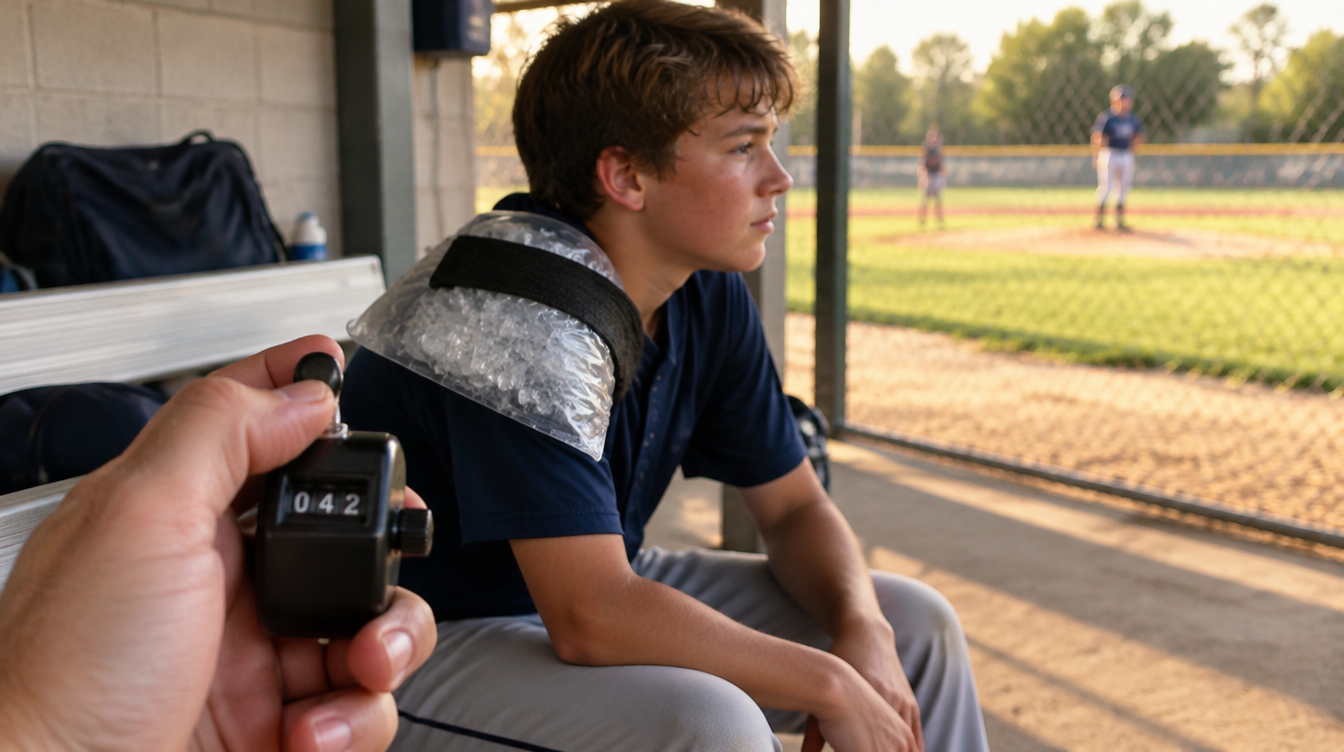
So here’s the rule we teach every parent: if he says his arm is tired, the game is over, no matter what the clicker says. Under the count and fatigued is still fatigued.
How much pitching per year is too much?
Volume over a season and a year matters as much as any single game. Fleisig and colleagues (2011, American Journal of Sports Medicine) followed 481 pitchers aged 9–14 for ten years. Pitchers who threw more than 100 innings in a calendar year were 3.5 times more likely to be injured.
Olsen and colleagues (2006, American Journal of Sports Medicine) compared 95 adolescent pitchers who needed elbow or shoulder surgery with 45 who were never injured. The injured group pitched more months per year, threw more pitches per game and per year, pitched more often with arm pain and fatigue, and pitched in more showcases. Overuse and fatigue had the strongest links to injury.
Our guidelines, built on that research:
- Stay under 100 innings in a calendar year, counting every team.
- Take at least 3–4 months a year off from competitive pitching, with 2–3 of those months in a row.
- Don’t pitch for two teams with overlapping seasons.
- Never pitch on consecutive days, even if the count allows it.
- Treat showcases as games. Max-effort throws count.
Why throwing harder doesn’t have to mean more arm stress
Here’s where most articles on pitch count by age stop, and where the real answer starts. Limits reduce how often the arm gets loaded. They don’t change how much load each pitch puts on it. That comes down to mechanics.
Velocity is supposed to come from the ground up. The arm is the last link in the kinetic chain, not the engine. Kibler and Chandler (1995) showed that a 20% drop in energy from the hips and trunk requires about 34% more rotational velocity at the shoulder to throw the ball at the same speed. In plain terms: when the legs and trunk don’t do their job, the arm makes up the difference, every pitch.
That’s why our 3X Pitching system trains velocity through triple extension of the drive leg, hip-to-shoulder separation and lower-body strength, not through more arm speed or more throwing volume. A pitcher who gets his velocity from his legs and trunk can throw hard with less stress on the elbow per pitch, and that pays off over a whole season of pitch counts.
How do I know if my son’s arm is at risk?
Watch for these warning signs and pull him from pitching if any show up:
- Pain on the inside of the elbow or in the back or front of the shoulder, during or after throwing.
- Arm “tiredness” that shows up earlier in games than it used to.
- Velocity or control dropping off sharply partway through an outing.
- A dropped arm slot or a visibly different delivery late in games.
- Soreness that hasn’t cleared by his next scheduled outing.
Pain that lingers or keeps coming back needs a sports medicine physician, not another week of rest and a return to the mound. Our guide to UCL injury warning signs walks through what to look for.
If you want an objective starting point, take our free Arm Risk Test. It takes a few minutes and flags the workload and mechanical factors most linked to arm injuries in young pitchers.
What’s the best way to build arm durability between outings?
Rest days aren’t “do nothing” days. Recovery between outings should include light, low-intensity throwing to restore range of motion, mobility work for the hips and thoracic spine, and a structured arm care routine. Our baseball arm care exercises are a good place to start.
In the offseason, the priority flips from managing workload to building capacity: lower-body strength, Olympic lifting progressions done with proper coaching, and the mechanical work that moves the effort off the arm. A stronger, better-sequenced athlete handles the same pitch count with far less wear.
Pitch count by age: the bottom line for parents
- Know your son’s Pitch Smart limit and rest schedule, and use the stricter of Pitch Smart or your league’s rule.
- Log every pitch from every team. Nobody else will.
- Stop at fatigue, not at the number.
- Stay under 100 innings a year and take real time off.
- Build velocity from the ground up so each pitch costs the arm less.
Want a plan that does all of that for you? The TopVelocity Player Portal builds your son’s throwing, strength and arm care program around his age and workload, with progress tracking and coaching built in. Start a 7-day free trial, or call us at (985) 315-3130 with questions.
Frequently asked questions
How many pitches can an 11-year-old throw?
Under Pitch Smart and Little League rules, an 11-year-old can throw up to 85 pitches in a game. After 66 or more pitches he needs four days of rest, after 51–65 three days, after 36–50 two days, after 21–35 one day, and 1–20 pitches requires no rest day. He should never pitch three days in a row.
Can my son pitch two days in a row?
Only if he threw 20 pitches or fewer the first day (30 or fewer for ages 15 and up), which is the zero-rest-day range under Pitch Smart. Even then, research ties pitching on consecutive days to higher odds of arm pain, so we recommend avoiding it. No pitcher should pitch three days in a row.
What is the pitch count for a 14-year-old?
The daily maximum for ages 13–14 is 95 pitches under both Pitch Smart and Little League. Rest days are the same as for younger players: 66 or more pitches requires four days of rest. Pitchers who move up to high school ball follow their state association’s rule, which is often less strict.
Does a pitch count include warm-up pitches?
Official counts track pitches thrown to batters in a game, not warm-ups or bullpens. But the arm doesn’t know the difference. Hard warm-up throwing, bullpens and showcase throws all add to fatigue, so log them and factor them in when planning rest and the next outing.
Should a pitcher stop if he’s under the count but his arm is tired?
Yes. Pitching with arm fatigue is one of the strongest injury risk factors in the research, with 7.88 times the odds of injury in a national study of youth pitchers. The pitch count is a maximum, not a target. When he reports a tired arm, his outing is over.