A pitcher can finish an offseason with a better squat, cleaner drills and the same fastball. That does not make physical training or mechanics work useless. It means the staff needs to know which part of the plan changed—and whether that change reached the mound.
A useful offseason pitching plan connects three things: the athlete’s current needs, the time available before reporting, and the pitching task he must be prepared to perform. In a TopVelocity 3X approach, physical preparation, movement learning and throwing belong in that same plan. The goal is to select a clear development priority, train it deliberately and review its effect before adding another demand.
This guide gives coaches an original planning worksheet and a worked example. It is a coaching application of the 3X curriculum, not a universal throwing calendar or a promise of a particular velocity gain.
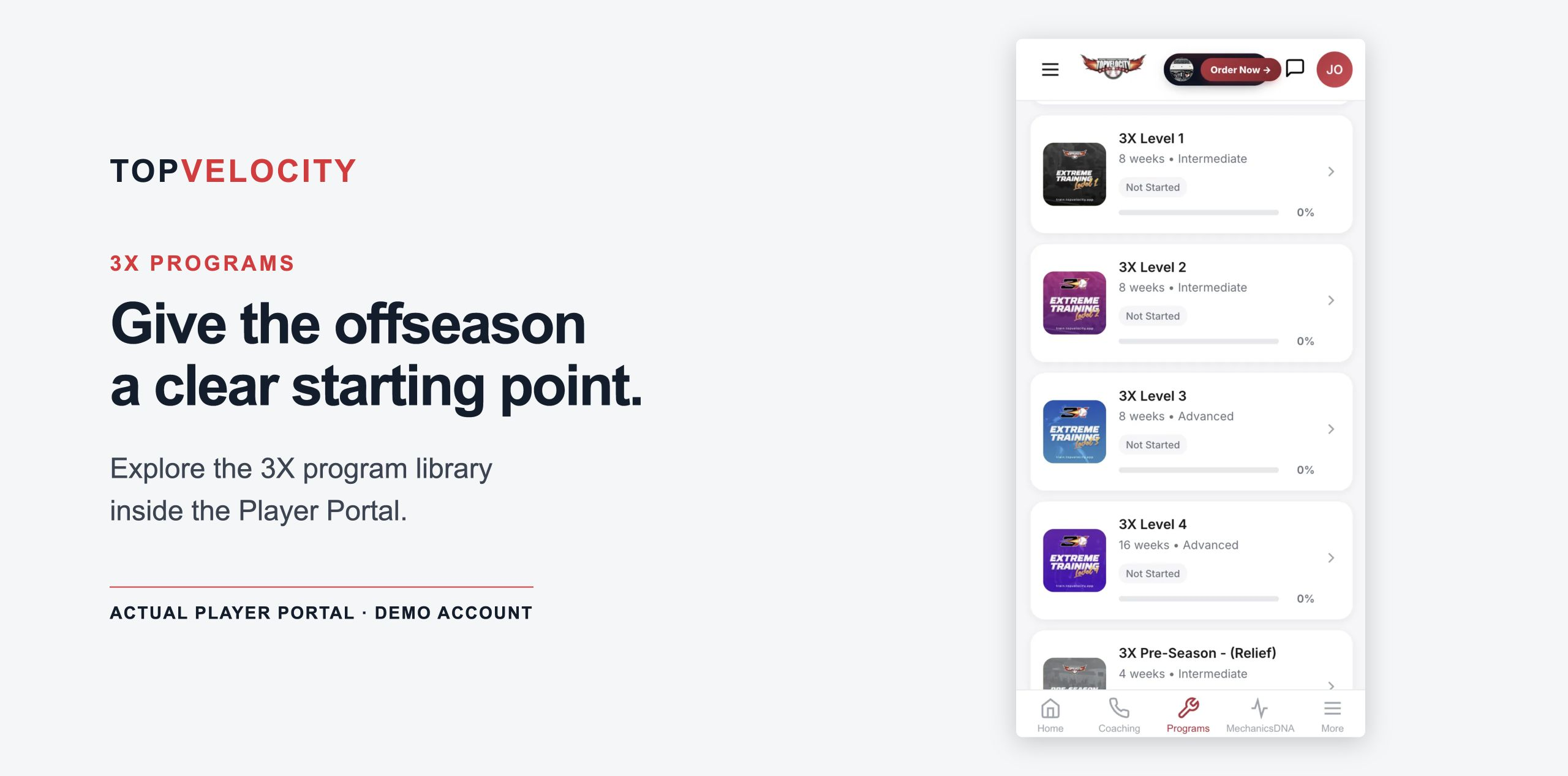
See the 3X programs inside the Player Portal
The Player Portal screenshot above shows 3X program levels with duration, difficulty and progress indicators. It gives athletes a concrete place to find the training material. The coach still selects the appropriate work and connects it to the reporting requirement described below.
Bring this player experience to your organization: see the portal and request an organization demo, or review organization plans and register.
Start with the reporting requirement, not a twelve-week template
“Ready for spring” is too vague to organize training. Does the receiving staff expect introductory catch, a bullpen, live hitters or an appearance? Confirm that expectation directly. Then place the reporting date, travel, school commitments, facility access and any existing restrictions on the calendar.
Count usable training opportunities, not just weeks. A college pitcher returning home for a short break has different coaching access from an athlete training at the facility throughout the offseason. A professional pitcher also needs the outside plan to fit the club’s expectations. Two athletes with the same reporting date can need different progressions.
TopVelocity’s professional offseason material describes preparation in phases and acknowledges different season-end and reporting dates. The useful planning principle is that the phases must fit the athlete’s calendar. The dates and durations in an older example should not become automatic instructions for a new roster.
Write the reporting requirement in a sentence: “The receiving coach expects ___ on ___, subject to the athlete’s current status.” If the answer is unknown, resolving it is the first coaching task. A shorter window is a reason to narrow the development goal, not compress every planned session into fewer days.
Choose a primary problem that the staff can actually test
An evaluation may produce a long list: lower-body strength, movement control, pelvis–trunk timing, inconsistent release and missed targets. A list is not yet a training plan. Select the most useful working explanation, describe the evidence behind it and name what would make you reconsider.
Use three questions to organize that conversation:
- Capacity: Which physical quality is worth developing, given the athlete’s training history and the demands of the selected task?
- Coordination: What relationship in the delivery will the athlete learn to organize more effectively?
- Pitching: What observable ball outcome or execution task will show whether the work is useful?
These are coaching questions, not three diagnostic categories. A video does not prove that an athlete is weak, and a strength test does not identify why he opens his trunk at a particular time. Keep the observation separate from the explanation. When the explanation is uncertain, choose a manageable task that can help the staff learn more.
The Foundations of 3X Pitching curriculum combines individual assessment, physical preparation and skill practice. Applying it well requires matching the work to the pitcher, rather than assigning every athlete the same correction.
Connect physical preparation, 3X movement and pitching practice
The 3X name refers to triple extension: coordinated extension at the hip and knee with ankle plantarflexion. Within the broader method, lower-body action relates to landing, pelvis and trunk rotation, and the throwing action. It is one part of the delivery, not an instruction to force every pitcher into an identical pose.
TopVelocity’s 3X program includes mobility, medicine-ball and throwing drills, Olympic-based strength work and conditioning. A coach still has to explain why a selected exercise belongs in this athlete’s block. “It is in the program” is not the complete explanation.
Build: develop a useful physical quality
Choose physical work the athlete can perform competently and the staff can supervise. For a pitcher learning an Olympic-lift variation, technical proficiency may be the first objective. An athlete with more experience may be ready for a different progression. Record the intended adaptation and the exercise standard; do not turn a lifting number into a guaranteed fastball target.
Connect: give the physical work a movement purpose
Select a 3X task that makes the intended relationship easier to practice. For example, the coaching question might concern how drive-leg action connects with landing and rotation. A medicine-ball task can provide a different practice environment, but its load and setup must suit the athlete. Record the exact cue and the response that would count as useful.
Prepare: restore the demands of pitching
As the athlete’s plan permits, evaluate the relationship during the actual throwing task. A successful drill is an intermediate result. Observe whether the athlete retains the intended movement while directing the ball to a target at the assigned intent. Let the receiving staff’s requirements guide the later preparation.
These emphases overlap. This does not mean physical work stops when pitching becomes more specific, or that every athlete progresses after the same number of sessions. For detailed teaching examples, see the triple-extension progression and 3X medicine-ball task guide.
Use this offseason planning worksheet
Complete one record per athlete. The examples below show the level of detail to discuss; they are not individual prescriptions.
| Planning field | What the staff records | Useful check |
|---|---|---|
| Reporting requirement | Date, receiving coach and expected pitching task. | Has the receiving staff confirmed the expectation? |
| Starting point | Recent actual throwing, training history, relevant assessment findings and existing restrictions. | Are these current observations, or old scores? |
| Primary priority | One specific physical or movement objective, with the evidence supporting it. | What observation would challenge this explanation? |
| Connected work | Physical preparation, a selected 3X learning task and the pitching task used to examine transfer. | Can each coach explain the connection? |
| Measurement | Repeatable test conditions, ball outcomes, target task and session context. | Are baseline and review conditions comparable? |
| Review and handoff | Review date, responsible coach and criteria to retain, modify or progress the work. | Who communicates the next decision to the athlete? |
Keep the record short enough to use between sessions. A roster dashboard can store observations, but a coach must still reconcile competing priorities. Do not assume an evaluation score automatically supplies a training dose or medical clearance.
A worked example: two pitchers, different offseason priorities
Hypothetical planning example—not a TopVelocity athlete case study: Two pitchers arrive with comparable fastball velocity and the same reporting date. Pitcher A is inexperienced in structured strength training. Pitcher B has substantial lifting experience but has trouble carrying a practiced movement into target-directed pitching.
For Pitcher A, the staff selects competent execution of foundational physical tasks as the initial priority. The pitching coach uses one familiar 3X movement task, so learning the strength program does not also require learning six new delivery cues. The first review asks whether the athlete can perform the assigned work consistently and whether the plan fits his available supervision.
For Pitcher B, adding more lifting simply because velocity has stalled would skip the important question. The staff instead examines the transition from the selected 3X task into pitching. It keeps established physical work in the plan and changes one practice demand at a time. The review asks where the useful movement response disappears and whether ball execution changes with it.
Neither decision follows from velocity alone. Neither example predicts a gain. Their value is that each athlete has a reason for the work, a named coach and a question the next review can answer. A professional organization can use that same record to accept, challenge or refine an outside provider’s proposal.
What research supports—and what it cannot promise
Escamilla and colleagues studied 68 high-school baseball players aged 14–17, randomly assigning them to three six-week training approaches or a nontraining control. Each training group improved throwing velocity from its own baseline; the control did not show a significant change. The study did not demonstrate that one training approach was superior to the others.
That is evidence from specific interventions in a defined population. It did not test the complete 3X system, establish an MLB training schedule or guarantee a response within six weeks. Use research to inform program decisions while measuring the response of the athlete in front of you.
Review the block without confusing a gym result with a pitching result
Keep physical and pitching outcomes side by side. If a strength measure improves while the intended pitching outcome does not, record both. The result can justify keeping useful physical work while changing the skill-learning task. It does not justify reporting a pitching improvement that was never measured.
At each planned review, ask whether the athlete completed the assigned work, whether the observation conditions were comparable, and whether the selected priority still fits the reporting requirement. An unexpected competition appearance, illness or change in access may require revising the plan before the review date.
For a roster summary, report how many athletes started, how many completed comparable follow-up assessments and what remains missing. Keep individual responses visible. One athlete’s improvement is a reason to investigate, not a guarantee to the rest of the roster.
Common offseason planning questions
How long should an offseason pitching program last?
The usable window depends on the season-end date, reporting requirement, current status and available coaching. Work backward from the required pitching task with the responsible staff. A generic calendar cannot establish readiness.
Should the whole team follow the same program?
A team can share terminology, session organization and reporting standards while assigning different priorities. The 3X organization practice guide explains how to bring individual tasks into a shared session.
Should velocity be the only goal?
Record velocity alongside the pitch type, target task and the athlete’s actual work. Decide with the receiving staff which outcomes matter. A harder pitch that does not meet the development objective should not be declared a complete success.
As competition begins, shift the planning conversation toward actual appearances and staff handoffs. The companion in-season throwing and strength guide provides a shared coordination board for that transition.
Build the plan with TopVelocity
For an academy, team or facility, the next step is to connect staff education, athlete evaluation and assigned work. Request an organization demo to discuss that workflow, or review TopVelocity Performance Center registration.
For a professional player-development staff, discuss a defined offseason project with Brent. Bring the reporting requirement, the current development question and the evidence your staff wants reviewed. That provides a concrete starting point for deciding whether TopVelocity fits the project.