A more favorable assessment result does not yet establish that a change belongs in a pitcher’s competitive delivery.
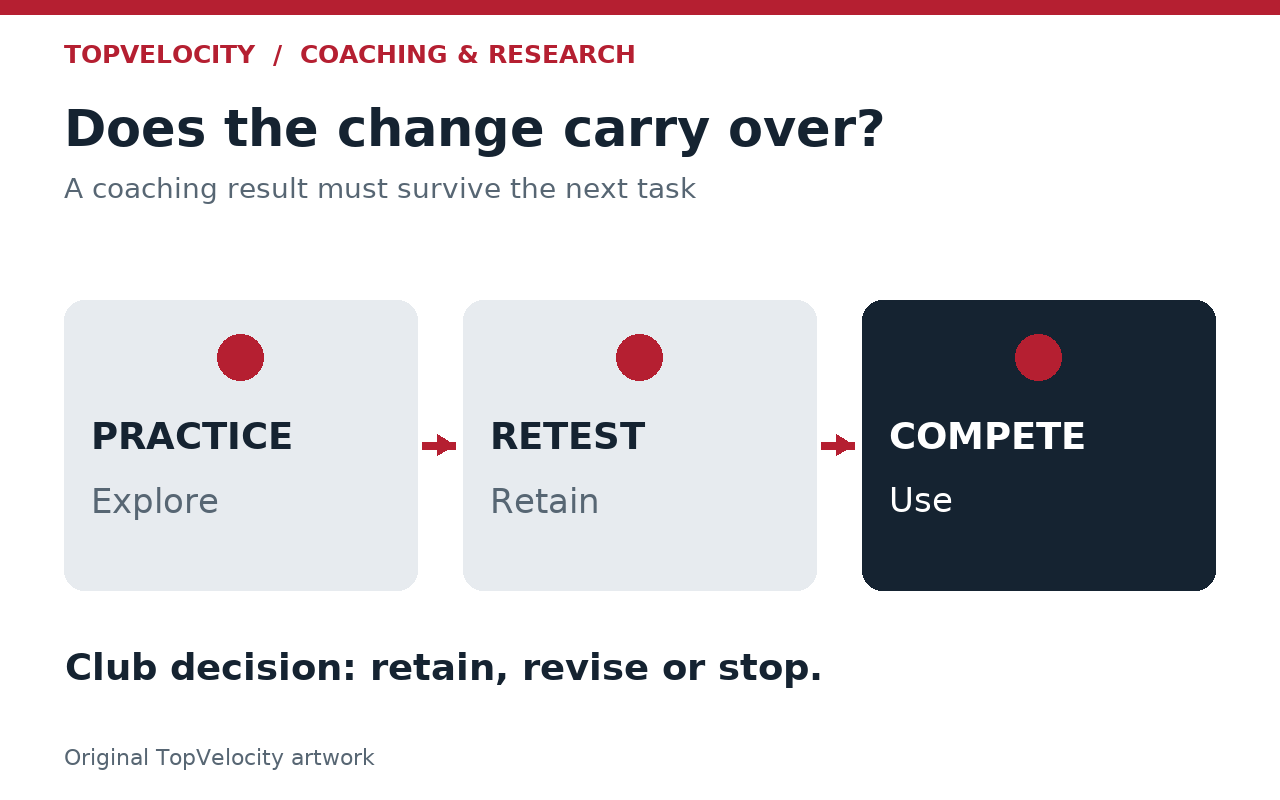
Three distinct tasks in a development sequence: practice, retest and competition, followed by a club decision to retain, revise or stop.
A better bullpen supports a hypothesis. To evaluate it, a club needs to know whether the improvement is repeatable, survives without constant instruction and contributes to the pitcher’s assigned role. The evaluation also needs to reveal what the athlete gave up along the way.
The framework below is a proposed approach to a club-controlled development project. It combines a coaching hypothesis with compatible measurements, retention testing and competitive observation. It is not a report of a completed TopVelocity trial.
Start with the decision the club must make
Write the proposed change as a testable sentence: “We expect this adjustment to improve this pitch characteristic while preserving these capabilities.” Specify the intended use: a pitch against opposite-handed hitters, a more dependable offering early in the count, or velocity that remains available across an outing.
The supporting mechanical measure belongs alongside that baseball objective. Moving toward a reference range should not automatically count as success.
In a study of 46 pitchers across several competitive levels, researchers repeated biomechanical evaluations after an average of 12 months. At follow-up, 44% of the initially identified deviations from elite reference ranges had been corrected. The uncontrolled study did not establish which training caused those changes or whether they improved game performance. Its practical lesson is to connect an assessment with a subsequent evaluation, while keeping mechanical change and competitive benefit separate. Fleisig and colleagues, 2018.
Build a baseline that can support a comparison
Agree on the primary outcome before the development block. Document the regulation baseball, mound, capture system, warm-up, intended effort, target and pitch classification. Record relevant recent throwing exposure and the athlete’s feedback. Use repeated baseline sessions where feasible to understand ordinary variation.
Keep the pitch-level records, but make the athlete the unit of the development decision. One pitcher contributing many throws cannot become the equivalent of many independent pitchers. For a group report, retain the relationship between pitches, sessions and athletes; show individual responses alongside the aggregate.
Describe the velocity distribution and usable pitch characteristics, rather than building the decision around the best throw. Set the smallest worthwhile improvement and acceptable losses from the club’s baseball priorities. Separately establish how the measurement method’s repeatability limits detection of those changes. A change smaller than the uncertainty requires better evidence before it supports a new plan.
Measure the intended location
For a location objective, record the intended target before release and compare the resulting location with that target. Preserve horizontal and vertical error, directional bias and dispersion. Define how a moving target, catcher setup or missing target record will be handled.
A descriptive laboratory study of 121 professional pitchers found no statistically significant ball-velocity difference between its high- and low-accuracy groups. Its constrained fastball task does not capture every component of competitive command, and it does not establish a corrective treatment. It does support evaluating accuracy as a distinct outcome alongside velocity. Manzi and colleagues, 2022.
In the proposed scorecard, zone rate would describe where pitches finished. Target error would describe execution relative to intent. A purposeful chase pitch can miss the strike zone and meet its target. Whiff rate adds information about hitter response, but pitch selection, opponent quality and location can all influence its interpretation.
Document the coaching intervention
Name the coach responsible for the hypothesis, the practice task and the anticipated adaptation. Record the drills, implements, volume, intent, cues and feedback actually delivered. Capture deviations from the plan and concurrent strength, throwing or pitch-design changes.
Specify which other qualities must be preserved. Depending on the project, those might include another pitch’s shape, location consistency, recovery or the athlete’s ability to compete without excessive conscious instruction. The club’s medical staff should control health-related restrictions and escalation.
If the club needs a stronger estimate of the intervention’s effect, its analysts can consider a staggered introduction or suitable comparison condition. A simple before-and-after improvement remains vulnerable to other explanations, including concurrent training and normal fluctuation.
Test retention, then examine the competitive context
Schedule a later assessment under a compatible protocol. Include a condition with reduced prompting so the staff can evaluate whether the athlete can reproduce the skill independently. The club should choose the interval and progression around its calendar, athlete readiness and the question being tested.
One 2025 study compared laboratory data from 30 collegiate pitchers with in-game data from a different group of 30 Division I pitchers. It also used different capture methods. That design cannot isolate environment from technology or demonstrate same-player training transfer. It reinforces the need to identify what produced each comparison. Lerch and colleagues, 2025.
For competitive observation, retain pitch type, role, batter handedness, count and available context about fatigue and conditions. Separate comparable observations from situations that answer a different question. Report an uncertain game effect as uncertain when opportunities are limited.
Agree on go, revise and stop criteria in advance
| Decision | Evidence to review | Club action |
|---|---|---|
| Go | The priority outcome exceeds the agreed meaningful-change threshold, is retained and meets the club’s limits for acceptable tradeoffs. | Progress to the next agreed context and continue monitoring. |
| Revise | Results are mixed, prompting-dependent, uncertain or undermined by incompatible measurements. | Adjust the hypothesis or collection process; set a new review point. |
| Stop or roll back | Club medical restrictions arise, the athlete declines continuation, or predefined unacceptable losses occur. | End the experimental change; let club staff direct the next plan. |
Make the case study auditable
Use the same short record for each athlete: starting problem; baseline dates and conditions; agreed outcome and acceptable tradeoffs; actual training delivered; retest and retention results; competitive observations; missing data; and the club’s final decision. Attach the relevant pitch distributions and session notes. Clearly label any measure collected only after the intervention, because it cannot establish change from baseline.
The final report should account for everyone who entered the project: completed retests, incomplete sessions, unavailable game observations and withdrawals. Record capture failures and reasons for missingness where known. Keep adverse events and changes in availability visible. An athlete who could not finish must not disappear from the denominator behind a favorable headline.
TopVelocity proposes starting a professional collaboration with one club-selected question, a coach-led hypothesis and a documented training-and-retest plan. Scope, staffing, data access and success criteria would be agreed before work begins, with development and medical decisions remaining under club control.
Discuss a professional player-development project with Brent and identify the decision your staff needs the evidence to support.