
Before a development staff turns historical evaluation records into a claim of improvement, it needs to establish who was measured, what each value means and whether the observations can be compared.
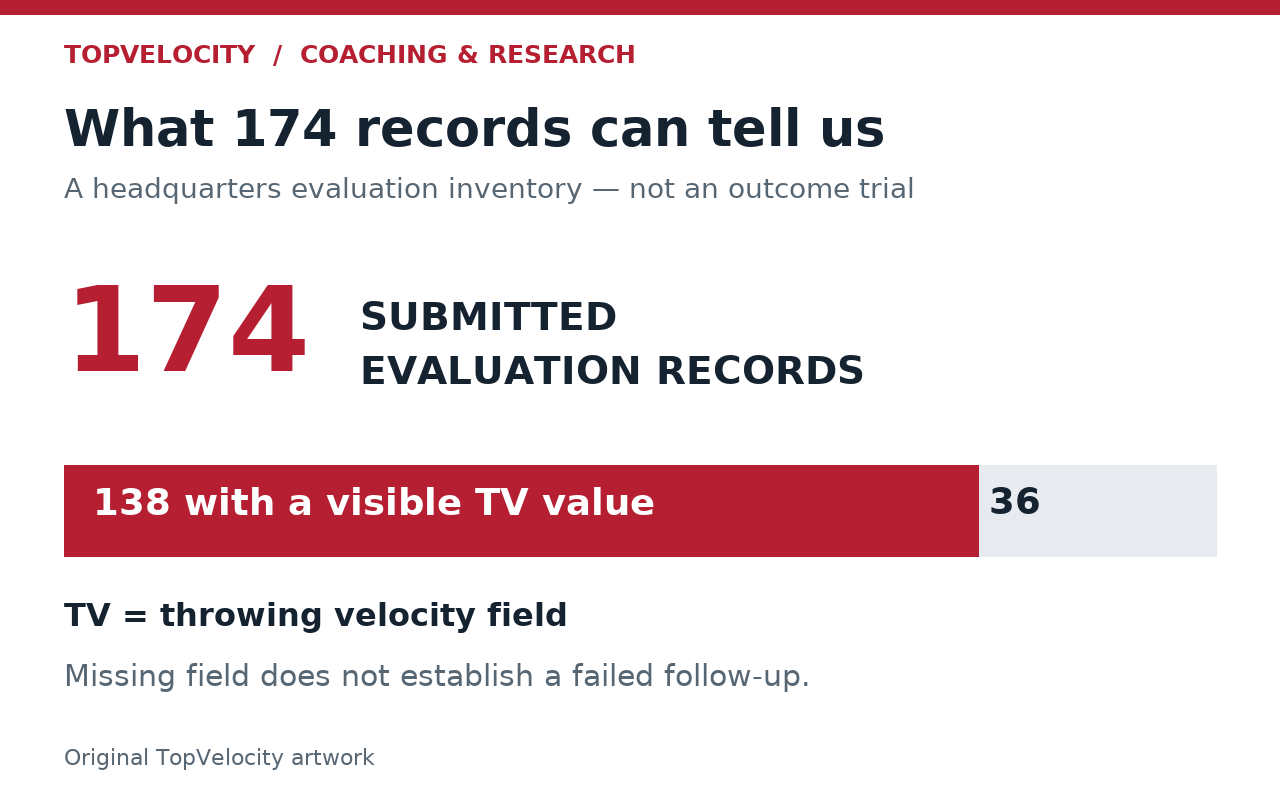
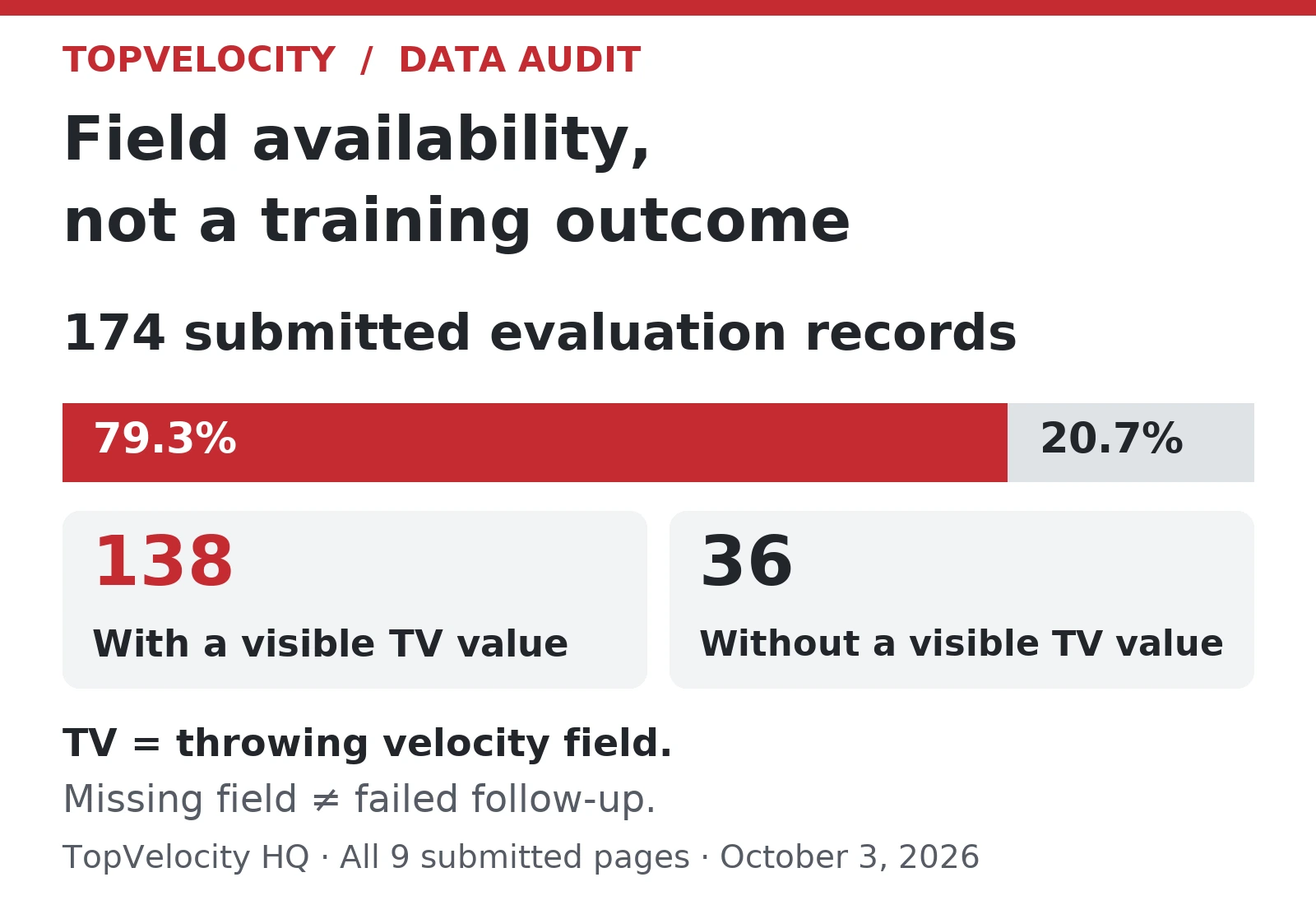
174 submitted HQ evaluation records: 138 had a visible throwing velocity value and 36 did not. This is a field-availability audit, not training outcomes.
We reviewed all 174 submitted evaluation cards visible in TopVelocity’s headquarters portal on October 3, 2026. Their displayed dates spanned January 18 through September 29, 2026. The immediate question was practical: what longitudinal development evidence could this record set support, and what would need verification before reporting athlete improvement?
This article documents a record audit and the review steps it identified. It does not report athlete-development outcomes or an MLB cohort. The purpose is to show how staff can assess whether existing records support a particular development question.
What the submitted records showed
| Observation | Count | Interpretation |
|---|---|---|
| Submitted evaluation cards | 174 | The complete visible submitted-card inventory reviewed in this audit. |
| Cards displaying a TV value | 138 | A value was visible in the card’s TV field; its measurement meaning requires verification. |
| Cards without a visible TV value | 36 | The card did not display that value; this does not establish why it was absent. |
| Distinct display names | 130 | Name labels, not yet a verified count of unique athletes. |
| Repeated-display-name groups | 28 | Candidate groups for longitudinal review, pending identity and protocol checks. |
The counts describe the cards inspected. A detail record may contain information absent from its summary card. “Submitted” describes a portal workflow state; it does not establish that an athlete completed a particular training dose.
These distinctions protect the usefulness of the dataset. They prevent a record count from becoming an athlete count, or a populated field from becoming an unsupported claim of measured development.
Field presence is the beginning of an outcome analysis
The 138 visible TV values identify records worth investigating. They do not, by themselves, create 138 comparable baselines or retests.
Before interpreting change, staff need to establish what TV represents in each record: a same-session measurement, a historical best, a reported value or another defined quantity. A consistent label does not establish consistent collection. The throwing task, implement, device, intended effort and summary statistic also matter.
The 36 cards without a visible TV value should not automatically be called failed evaluations. A session can have a different purpose, a field can be intentionally omitted, or a value can exist elsewhere in the record. Those possibilities need documentation rather than assumptions.
For a professional project, the requirement is therefore specific: collect the fields needed for the agreed decision and record why a planned measure is unavailable. Completeness is meaningful relative to the question being asked.
Repeated names create a review queue, not a development result
The 28 repeated-display-name groups offer a starting point for examining follow-up. Stable athlete identity must be confirmed before linking their records. Names can be shared, changed or entered differently.
After identity, the next checks are date meaning and measurement compatibility. Multiple records on one date may represent separate assessments or overlapping entries. A later submission date may not be the measurement date. Review the details before treating the sequence as a development timeline.
For a longitudinal analysis, select endpoints by a declared chronological rule, not by finding the lowest initial value and the highest later value. Preserve records that complicate the story. Each athlete should contribute one defined comparison to a first-to-last summary, with additional sessions retained for context.
Our proposed measurement passport for pitching biomechanics provides a way to attach the necessary definitions and collection conditions to each comparison.
Connect the assessment to the training that occurred
Two compatible measurements can establish an observed difference. They cannot establish which training caused it.
A useful prospective record would connect the baseline to a stated coaching hypothesis, the practice actually delivered and the planned retest. That means documenting the task, volume, intent, feedback, attendance and meaningful changes to the plan. Concurrent throwing, strength work and pitch-design changes belong in the record when relevant.
Follow-up should distinguish calendar time from training exposure. Several months between evaluations could contain consistent participation, interruptions or substantial work elsewhere. Calling that interval a TopVelocity training block would require supporting records.
For the same reason, an athlete without a visible follow-up cannot simply be labeled a nonresponder. The appropriate result is that follow-up is unavailable in the reviewed record set, with the reason recorded if known.
Define the next decision before the next retest
The strongest next step is a bounded prospective project built around one club-selected question. Agree on the outcome, the collection protocol and acceptable tradeoffs before examining the follow-up result.
- Baseline: Identify the athlete, task, measurement method and ordinary variation relevant to the decision.
- Intervention: Record the coaching plan and what was actually delivered.
- Retest: Repeat compatible measures and explain missing observations.
- Retention: Examine whether the result persists under the agreed conditions.
- Decision: Document why club staff continued, modified or stopped the development approach.
Velocity may be an outcome, but the club might also prioritize intended-target error, pitch characteristics or performance in a defined role. A mechanics change should be evaluated against that baseball objective rather than treated as success on its own.
The proposed framework for testing player-development transfer extends this record structure into a coaching experiment with retention testing and explicit go, revise or stop criteria.
What this audit establishes
This audit establishes the size and visible coverage of one submitted evaluation-card inventory. It identifies candidate follow-up groups and the questions that must be resolved before calculating comparable athlete changes. It does not yet establish a treatment effect, injury outcome or professional-player result.
For TopVelocity, the opportunity is to make that chain auditable: assessment, coaching action, exposure, retest and development decision. The proposed standard gives a club a concrete way to evaluate a collaboration using its own priorities and evidence requirements.
Discuss a professional pitching-development project with a club-defined scope, an agreed record structure and outcomes your staff can evaluate.
Source and scope: Firsthand inventory of TopVelocity headquarters portal submitted evaluation cards, October 3, 2026. Counts refer to visible records and display-name labels. No individual identities, trajectories or private evaluation screenshots are published here. Proposed workflow elements are identified separately from the observations.