How much does a pitching biomechanics analysis cost? A traditional marker-based 3D analysis at a dedicated lab typically runs from several hundred dollars to $1,500+ per visit — and most labs don’t publish pricing at all. Phone-based 3D analysis has collapsed that price: TopVelocity’s MechanicsDNA delivers a full 3D mechanics report from one phone video inside the $99/month Player Portal, and a free 2D version exists for screening. Here’s what each tier costs, what you actually get, and which one your pitcher needs. Knowing the typical pitching biomechanics analysis cost helps you choose the right solution for your pitcher.
| Option | Typical cost | What you get | Best for |
|---|---|---|---|
| Marker-based lab | Several hundred to $1,500+ (rarely published — quote only) |
Research-grade joint kinetics, force plates, biomechanist report, one visit | Pros, post-surgical rehab |
| MechanicsDNA 3D (phone) | $99/mo portal unlimited re-scans |
3D model from one video, 20-80 checkpoint scores, injury-risk flags, #1 leak + est. mph | HS development & recruiting |
| MechanicsDNA Mini (free) | $0 | 2D screen: stride, separation, trunk tilt, top velocity leak | First look — youth & parents |
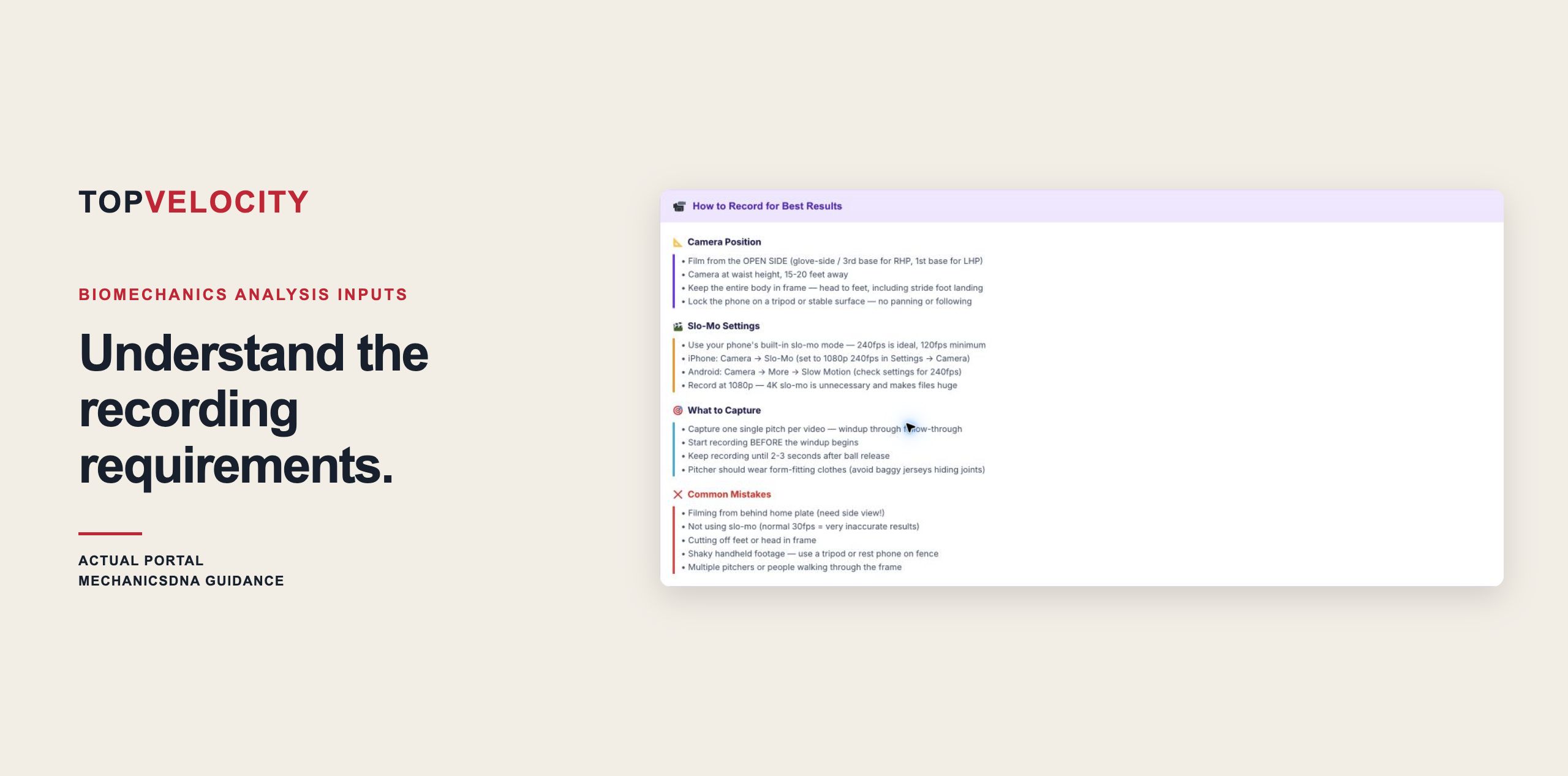
Check the recording requirements
Before comparing analysis options, review the video requirements you would need to meet. This MechanicsDNA guidance panel makes that preparation step visible. Ask separately about the measurements provided, their limitations and the current cost of access.
What Does a Lab-Based 3D Analysis Include?
The traditional gold standard is marker-based motion capture: reflective markers on the body, a camera array, force plates in the mound, and a biomechanist interpreting the output. It produces research-grade joint kinetics — the same methodology used in published pitching studies. The trade-offs are practical. You travel to the facility, you usually get one session, scheduling can take weeks, and because most labs price by quote, budgeting is guesswork — reported figures commonly land anywhere from a few hundred dollars to north of $1,500 per assessment. For professional pitchers and post-surgical rehab cases, that depth is worth it.
What Does Phone-Based 3D Analysis Deliver?
The technology gap has closed dramatically. MechanicsDNA builds a rotatable 3D model of the delivery from a single phone video (glove-side view, 120–240 fps — a modern phone’s slo-mo mode). The report grades five key events — leg lift, leg drive, foot plant, max external rotation, and ball release — against benchmarks from published biomechanics research, then returns:
- An overall mechanics grade plus 20-80 scout-scale scores for each checkpoint
- Compound injury-risk flags (e.g., early trunk rotation — the pattern tied to 1.69x surgery odds in Bullock et al. 2020)
- Your #1 limiting factor with an estimated mph gain for fixing it
- A velocity-capacity projection based on the mechanical profile
Because it lives inside the Player Portal ($99/month), it’s not a one-time snapshot. You re-scan monthly, watch the checkpoint scores move, and the AI coaching adjusts the training plan to the newest scan. A lab tells you where you were on one Tuesday. Repeated analysis tells you whether the training is working — and in development, the trend is the product.
Is There a Free Pitching Mechanics Analysis?
Yes. MechanicsDNA Mini is the free screening tier: browser-based 2D analysis from any video, no slo-mo required. It checks the headline markers — stride length (elite pitchers stride 83–90% of height), hip-to-shoulder separation, trunk tilt — and names your most likely velocity leak. It’s deliberately a screen, not a full report. But for a parent wondering whether the problem is mechanics or maturity, it answers the first question free in about ten minutes.
Which Analysis Does Your Pitcher Actually Need?
- Youth (10–13): Start with the free Mini. At this age, velocity is mostly physical development — we covered why in the late-bloomer guide — so a screen for major mechanical faults is enough.
- High school pitcher chasing velocity or recruiting: Repeated 3D analysis. This is the athlete the monthly re-scan model was built for: fix the #1 leak, verify it on the next scan, move to the next one. The 20-80 checkpoint scores also translate directly into recruiting conversations.
- Velocity suddenly down, or elbow/shoulder history: 3D analysis plus physical testing — mechanics and force output together. Our velocity-drop diagnostic walks the full decision tree.
- Professional or post-surgical: A physician-connected lab assessment, with app-based analysis between visits to track the rehab plan.
The Bottom Line on Pitching Biomechanics Analysis Cost
Five years ago, real 3D pitching analysis meant a road trip and a four-figure budget. Today the question isn’t whether you can afford to look at your son’s mechanics — the free Mini scan removed that excuse. The question is whether you’re still guessing at the thing the data can name in ten minutes. Start free, and if the screen finds something, the full 3D system and the training to fix it are $99/month — about the cost of a single private lesson.
Frequently Asked Questions
Lab-based marker motion capture typically runs from several hundred dollars to $1,500+ per visit, and most labs only quote privately. Phone-based 3D analysis like MechanicsDNA is included in TopVelocity’s $99/month Player Portal with unlimited re-scans, and a free 2D screening version exists.
Modern markerless 3D analysis from high-frame-rate video reliably grades the checkpoints that matter for development – timing, stride, separation, trunk positions – against published benchmarks. Marker-based labs remain the gold standard for research-grade joint forces, which is why pros and rehab cases still use them.
One clip from the glove side, shot in your phone’s slo-mo mode (120-240 fps), under 30 seconds. You mark five events – leg lift, leg drive, foot plant, max external rotation, and ball release – and the system builds the 3D model and report from there.
Yes. MechanicsDNA Mini analyzes one pitch free in your browser from any video. It screens stride length, hip-to-shoulder separation, and trunk tilt, then names your most likely velocity leak – the right first step before paying for anything.
About the Author
Brent Pourciau, M.S., is the founder of TopVelocity. After tearing his rotator cuff at 18 and being told he would never pitch again, he rebuilt his delivery through peer-reviewed biomechanics research and returned to throw 94 mph in professional baseball. He holds a master’s degree in kinesiology with doctoral work in health sciences, and has trained 10,000+ athletes including 100+ MLB draft picks through the TopVelocity Player Portal and Performance Center licensing program.