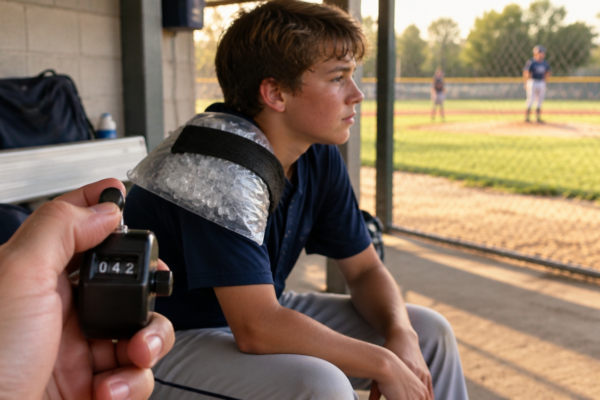

Why does my son throw slower than other kids? In most cases, the answer is simple: he’s earlier in his physical development than they are — not less talented. Research on youth pitchers shows velocity at ages 10–14 is driven primarily by body maturation, not skill. The kids throwing hardest at 12 are usually the kids who grew first. By 17, the gap routinely flips. Here’s the science, and here’s exactly what a late bloomer should train right now.
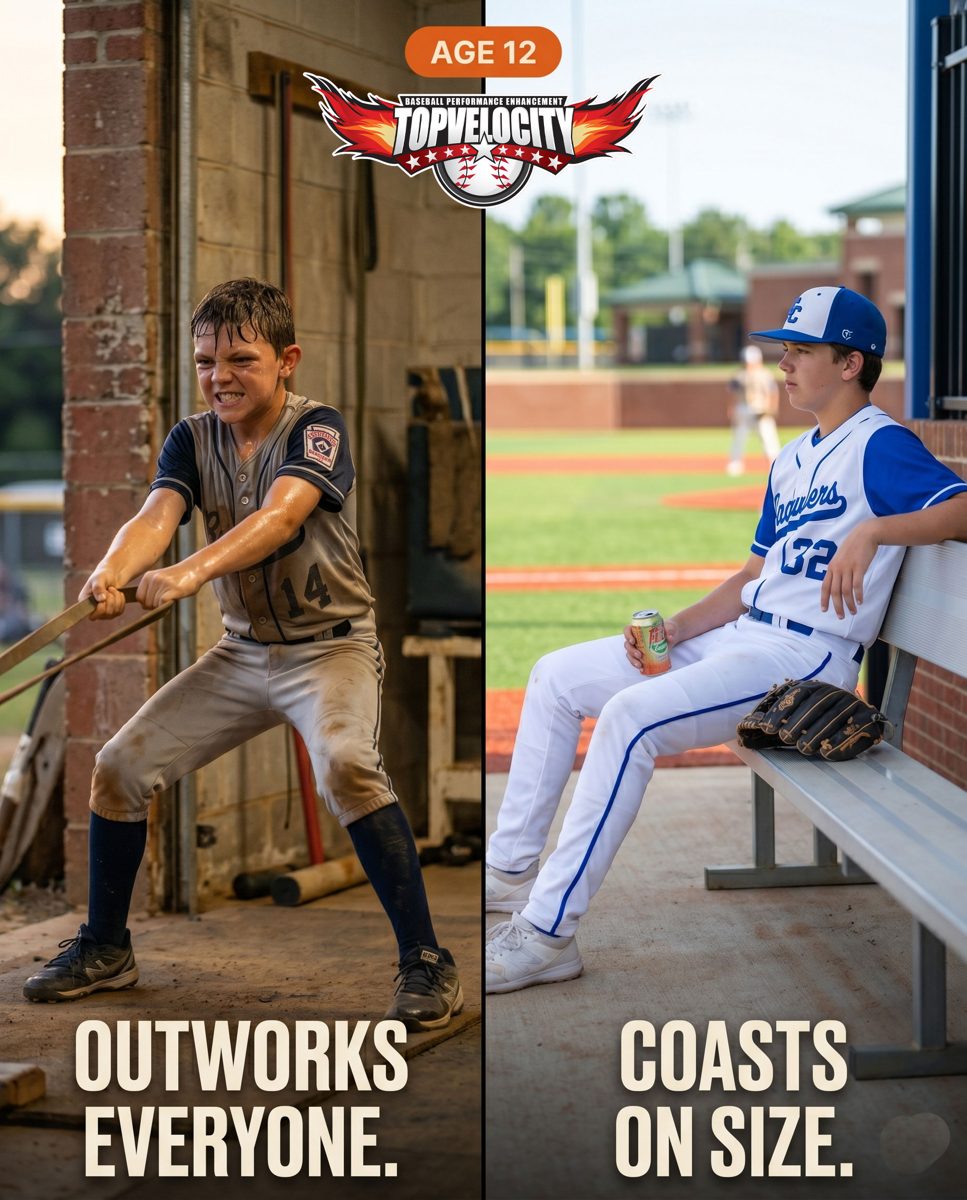
Is My Son Behind, or Just Growing Later?
Almost always: growing later. A study that tracked youth pitchers aged 10–12 found their velocity increased with physical maturation — while their stride length and segmental rotation speeds didn’t significantly change (Washington et al. 2018, International Journal of Sports Medicine). In plain English: at that age, velocity gains come from the body developing, not from mechanics improving. A smaller 12-year-old isn’t pitching worse. He’s pitching in a smaller body.
The bigger picture agrees. In 420 youth pitchers, age, height, hip-to-shoulder separation, and stride length explained 78% of the variance in velocity (Sgroi et al. 2015, Journal of Shoulder and Elbow Surgery). Two of those four factors — age and height — are pure development. Your son controls neither. He does control the other two, and that’s the opportunity.
Why Late Bloomers Often Win in the End
The early-developed kid gets away with bad mechanics, because size covers for inefficiency. He throws hard at 12 without learning to use his lower half, and as a result, many early bloomers plateau hard in high school when everyone else catches up physically. Meanwhile, the late bloomer who spends ages 12–15 building efficient mechanics — triple extension before front-foot strike, full hip-to-shoulder separation, a stable landing leg — owns a delivery that multiplies every pound of muscle when the growth spurt finally arrives.
That’s not a feel-good story. It’s physics. Mechanics are the transmission; the body is the engine. Build the transmission while you wait for the engine, and the velocity arrives all at once.

What Should a Late Bloomer Train Right Now?
Three things — and none of them involve throwing harder:
- Mechanical efficiency. This is the highest-leverage window of his career. Upload one pitching video to the free MechanicsDNA Mini and our AI will grade his mechanics against pro checkpoints and name his #1 velocity leak. If it’s mechanics, you can fix it now. If it’s maturity, you’ll know to be patient.
- Athleticism and ground force. Jumps, sprints, med-ball throws, and age-appropriate strength work. Lower-body power is the strongest trainable predictor of future velocity — in D1 pitchers, jump power correlates with fastball velocity at r = 0.68 (Sakurai et al. 2024, JSCR). We covered the details in our vertical jump and velocity article.
- Patience with the radar gun. Chasing velocity in an undeveloped body is how arms get hurt. Youth pitchers throwing over 85 mph have a 2.6x higher injury rate (Fleisig et al. 2011). The goal at 12 isn’t 70 mph. It’s the movement quality that makes 90 mph possible at 17.
How Do I Know Where He Actually Stands?
Measure, don’t guess. The free TopVelocity Velocity Calculator scores his velocity against our national database for his exact age — percentiles, not playground comparisons. Then check his velocity against the recruiting ladder in our velocity benchmarks by age guide. You’ll likely find he’s far closer to “on track” than the travel-ball dugout makes it feel.
And remember who you’re comparing him to. Roster spots at 17 aren’t awarded for who threw hardest at 12. They’re awarded for velocity, command, and health at 17 — three things a late bloomer with great training habits is positioned to win.
The Bottom Line for Parents
A slower-throwing son at 11, 12, or 13 is a developmental snapshot, not a verdict. The research says youth velocity is mostly maturation. The training science says mechanics and athleticism built now compound later. So use this window. Get the free mechanics grade, build the lower half, and protect his arm. The structured version of all of it — programs by age and level, video analysis, AI coaching, and evaluation tracking — lives in the TopVelocity Player Portal ($99/month, 7-day free trial). The kids who pass everyone at 16 started training like this at 12.
Frequently Asked Questions
Yes. At ages 10-14, velocity differences are driven primarily by physical maturation – research shows youth velocity gains track body development, not mechanics (Washington et al. 2018). Kids who grow first throw harder first. The gap routinely closes, and often reverses, by 16-17.
Absolutely. College rosters are decided by velocity, command, and health at 17-18, not at 12. Late bloomers who spend the early years building efficient mechanics and athleticism often pass early developers once the growth spurt arrives, because their delivery converts new strength into velocity.
Measure it. A free MechanicsDNA Mini scan grades his mechanics from one phone video and names the biggest leak. If the mechanics grade well, the answer is patience and athletic development. If they don’t, you’ve found a fixable problem early – the best possible outcome.
Mechanical efficiency (triple extension timing, hip-to-shoulder separation), general athleticism (jumps, sprints, med-ball throws), and age-appropriate strength work. Avoid chasing radar-gun numbers – youth pitchers throwing 85+ mph have a 2.6x higher injury rate (Fleisig 2011).
About the Author
Brent Pourciau, M.S., is the founder of TopVelocity. After tearing his rotator cuff at 18 and being told he would never pitch again, he rebuilt his delivery through peer-reviewed biomechanics research and returned to throw 94 mph in professional baseball. He holds a master’s degree in kinesiology with doctoral work in health sciences, and has trained 10,000+ athletes including 100+ MLB draft picks through the TopVelocity Player Portal and Performance Center licensing program.