Indeed, oes an online pitching coach actually work? The research says yes — with one condition: supervision. In a study of remote training adherence, athletes following a remote coach completed their assigned work at 56% versus just 12% for athletes programming themselves. Remote coaching works when somebody is watching. It fails when “online program” means a PDF and a goodbye. Here’s how to tell the difference, and what the market actually costs in 2026.
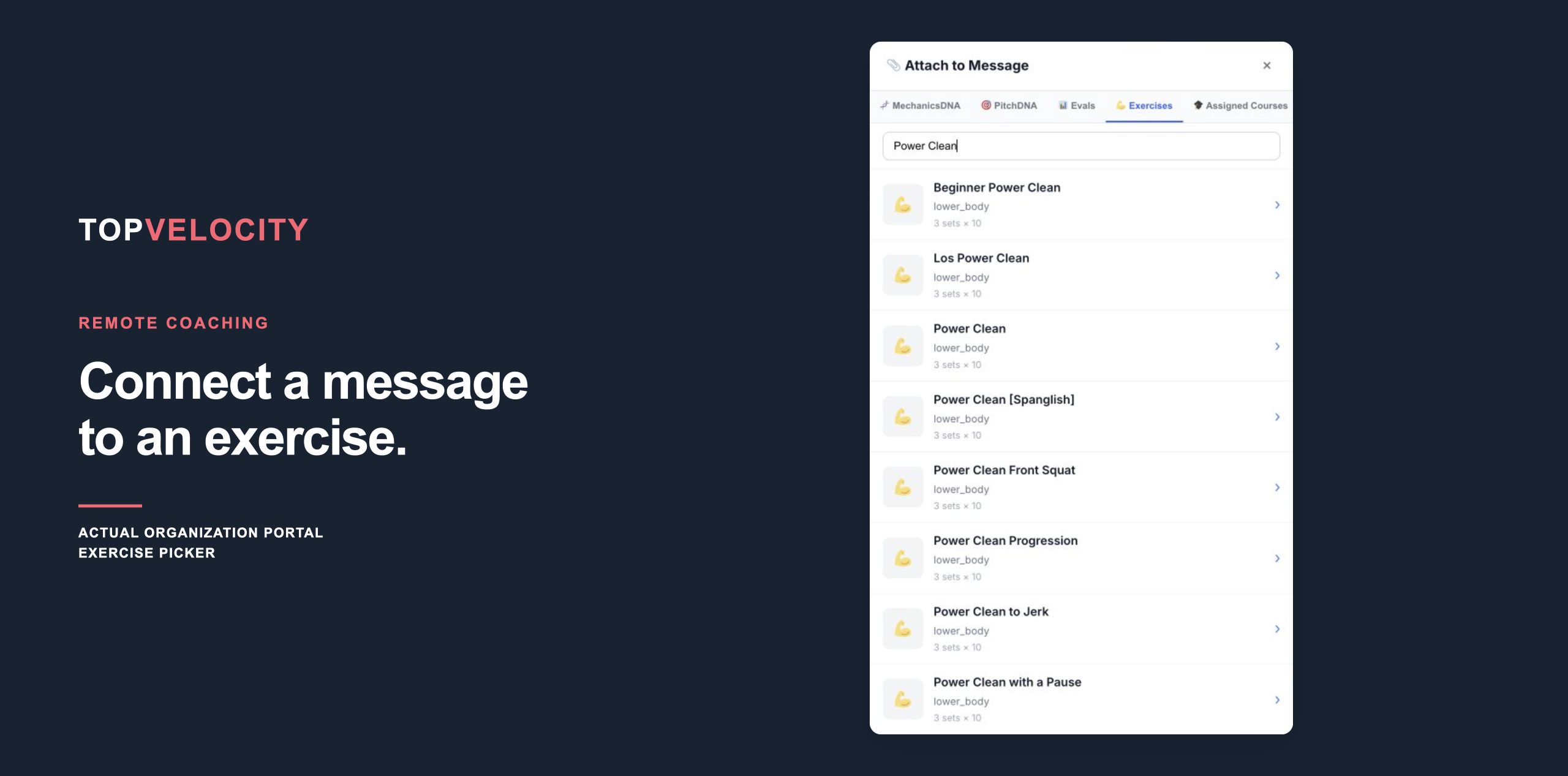
See an exercise reference in remote coaching
The Attach Exercise picker shows a concrete way to select a shared exercise reference. Ask how exercise resources, athlete questions and coach feedback fit together in the service you are considering, including what human coaching is included.
What Does Online Pitching Coaching Cost?
Three price tiers dominate the market:
In-person private lessons run $80–$140 per hour, so twice-monthly lessons cost $160–$280/month — for two hours of eyes on your pitcher. Published remote-coaching programs run roughly $170–$277/month, often with setup fees and 12-month commitments. The TopVelocity Player Portal is $99/month: unlimited programs by level, video mechanics analysis, evaluation tracking against national percentiles, and an AI coach available around the clock — with no setup fee and a 7-day free trial.
What Makes Remote Training Actually Work?
Four ingredients, straight from the adherence research and 17 years of running remote athletes:
- Objective measurement. Remote coaching lives or dies on data instead of eyeballs. Video-based 3D mechanics analysis (MechanicsDNA grades five delivery events on the 20-80 scale), monthly evaluations, jump and sprint testing. If an online program doesn’t measure, it’s guessing from far away.
- A real method. The program has to know what it’s building — in our case, ground-force mechanics and Olympic-lift-based power, the system behind 100+ MLB draft picks. A remote coach without a method is a cheerleader with a payment link.
- Supervision between sessions. The 56%-vs-12% gap is the whole story. Someone has to see the uploads, answer the Tuesday-night questions, and adjust the plan. This is exactly what Coach Brent’s AI does at any hour — it reviews your situation, knows your evaluation history, and escalates to the human staff when hands-on is needed.
- A clear path to in-person. The best remote systems aren’t anti-facility — they’re the bridge to one. Remote athletes in our system route into the 3X Velocity Camp when it’s time for hands-on coaching, then return to remote training with a year of the app included.

Who Should (and Shouldn’t) Train Remotely?
Online coaching fits the pitcher with no qualified velocity coach within driving distance — which, given that most lesson coaches teach arm action rather than force production, is most pitchers. It fits the travel-ball athlete whose schedule kills weekly lessons, and the self-driven high schooler who’ll actually upload his videos. It does not fit rehab cases (see a physician and physical therapist), or the athlete who needs in-person accountability to do anything — though the data says supervision solves most of that.
How to Choose in One Conversation
Before you sign any 12-month remote commitment, do two free things. First, run a free MechanicsDNA Mini scan so you know what the actual problem is. Second, ask Coach Brent’s AI what a remote plan for your pitcher would look like — age, velocity, goals, equipment at home. You’ll get a straight answer about whether remote training fits your situation, what it should cost, and where to start. That’s the test any online pitching coach should pass: ask first, pay second.
💬 Talk to Brent — Free, No Signup
Frequently Asked Questions
Published remote-coaching programs run roughly $170-$277 per month in 2026, frequently with assessment/setup fees and 12-month commitments. The TopVelocity Player Portal is $99/month with no setup fee: programs by level, video mechanics analysis, evaluations, and a 24/7 AI coach, with a 7-day free trial.
Yes, when it’s supervised and measured. Remote-coached athletes completed 56% of assigned training versus 12% for self-programmed athletes in adherence research. The working ingredients are objective measurement (video analysis, evaluations), a real method, and someone – human or AI – watching between sessions.
Less than most parents expect: a phone with slo-mo video for mechanics analysis, space for med-ball throws and jump work, and access to basic barbell equipment for the strength program (a garage setup or any gym works). Ground-force tools like the King of the Hill are add-ons, not requirements.
Availability and memory. A human remote coach reviews your video when they get to it; the AI answers at 9 PM, knows your whole evaluation history, and never has 40 other clients that week. TopVelocity runs both: AI for the daily questions, human coaching staff and camps for the milestones.
About the Author
Brent Pourciau, M.S., is the founder of TopVelocity. After tearing his rotator cuff at 18 and being told he would never pitch again, he rebuilt his delivery through peer-reviewed biomechanics research and returned to throw 94 mph in professional baseball. He holds a master’s degree in kinesiology with doctoral work in health sciences, and has trained 10,000+ athletes including 100+ MLB draft picks through the TopVelocity Player Portal and Performance Center licensing program.