Want to know how to start a baseball training facility in 2026? Start with this: baseball training is one of the few youth-sports businesses where demand consistently outruns supply. Parents already pay $75–$150 an hour for private lessons. Meanwhile, travel organizations are hunting for facilities that can develop their rosters. So the question isn’t whether a baseball training facility can work. It’s whether you build it the slow, expensive way — or the fast, leveraged way. This guide covers both.
What Does It Cost to Open a Baseball Training Facility?
Your startup costs fall into five buckets:
- Space. The biggest line item. Most facilities lease industrial or warehouse space — enough for batting cages, portable mounds, and a strength area. Lease rates vary widely by market. Therefore, your first spreadsheet should be local commercial listings, not a national average.
- Training infrastructure. Cages, netting, turf, portable mounds, L-screens, radar. Quality here is visible to every parent who walks in.
- Strength equipment. Real athlete development requires platforms, bars, and racks — not a row of machines. It’s where the results and the retention come from.
- Technology and programming. This bucket separates a cage-rental business from a player-development business: evaluation systems, video analysis, structured programs, athlete tracking.
- Insurance, LLC setup, and 3–6 months of operating reserve.
The traditional route to solving the technology-and-programming bucket is a sports franchise. That’s where costs explode. Typical franchise models run $50,000–$200,000+ upfront, plus ongoing royalties — before you’ve trained a single athlete.
The Licensing Model: Skip the Franchise Fee
This is the model we built the TopVelocity Performance Center licensing program around. Instead of a six-figure franchise buy-in, a facility licenses the complete player-development platform month to month.
| License | Monthly | Roster | Revenue potential |
|---|---|---|---|
| Level 1 | $1,250 | 30 athletes | Entry point for a lessons business going structured |
| Level 2 MOST POPULAR | $1,500 | 50 athletes | $80K–$175K/yr · 4.4x–9.7x ROI |
| Level 3 | $2,500 | 100 athletes | $150K–$350K/yr · 5x–11.7x ROI |
The license includes the entire technology stack that would otherwise take years to assemble: AI-powered athlete evaluations with national percentiles, MechanicsDNA 3D mechanics analysis from a phone video, PitchDNA pitch grading on the 20-80 scout scale, ForceIQ strength and injury-risk testing, 15+ training programs, an org portal that runs your roster, billing, events, and staff, certification training for your coaches, marketing materials, and ongoing mentorship. Most facilities are operational in 30 days. The license is month-to-month with a 30-day money-back guarantee — and partner organizations have reported revenue increases of 40%+ after adding the system.
Before you commit to anything, model your own numbers in the free Performance Center Revenue Calculator. Plug in your athlete counts and local pricing, and it computes gross revenue and net profit after the license, live.

Why Science-Based Development Is the Moat
Here’s the uncomfortable truth about this market: anyone can hang cages and sell lessons. You need a license to cut hair — but anyone can coach a kid’s throwing arm, and the youth arm-injury epidemic shows it. In fact, a 2018 study found 56% of youth coaches were noncompliant with pitch-count guidelines, and only 13% could identify overuse risk factors (Knapik et al., Journal of Pediatric Orthopaedics).
That gap is what a science-based facility fills. It’s also the marketing. Show a parent their son’s evaluation scored against national percentiles, his mechanics graded in 3D against pro benchmarks, and his arm-injury risk factors measured and tracked — and you’re no longer competing on price with the cage down the road. Velocity development built on ground-force mechanics and structured strength programming (the 3X method) produces documented results. Documented results produce referrals.
Your Revenue Model: Think Streams, Not Sessions
The facilities that struggle sell hours. The facilities that scale sell outcomes through multiple offers: group classes, annual academy memberships, evaluation clinics, team partnerships, camps, and remote training that earns revenue from athletes who never enter the building. We broke the full model down in The 8 Revenue Streams of a Profitable Baseball Performance Center. Read that next if you’re serious about the business plan.
How to Start a Baseball Training Facility: A Realistic Sequence
- Validate local demand. Count travel organizations, high schools, and existing lesson providers within 30 minutes.
- Model the numbers with the revenue calculator, using your real local pricing.
- Secure space sized to your 12-month plan — not your 5-year dream.
- License the development platform so programming, evaluations, and certification are solved on day one.
- Launch with evaluations, not lessons. An evaluation event fills your pipeline and starts every athlete with data.
Finally, if you want to see the platform before you model anything, book a free 30-minute demo. We’ll walk you through exactly how partner facilities run it.
Frequently Asked Questions
The big variables are space, build-out, and programming. Traditional sports-franchise models run $50,000-$200,000+ upfront plus royalties. The licensing alternative replaces that buy-in with a month-to-month platform license of $1,250-$2,500 depending on roster size.
Facilities running a multi-stream model (memberships, evaluations, team partnerships, camps) on the TopVelocity platform target $80K-$350K in annual revenue depending on license level, a 4.4x-11.7x return on the license cost. Hourly-only cage businesses earn far less.
It’s your biggest credibility asset. Research shows 56% of youth coaches don’t follow pitch-count guidelines and only 13% can identify overuse risk factors. TopVelocity licensing includes certification training for your staff plus the evaluation technology to back it up.
Licensed facilities are typically operational within 30 days. The license is month-to-month with a 30-day money-back guarantee and includes the org portal, evaluation systems, 15+ programs, certification, and marketing materials.
About the Author
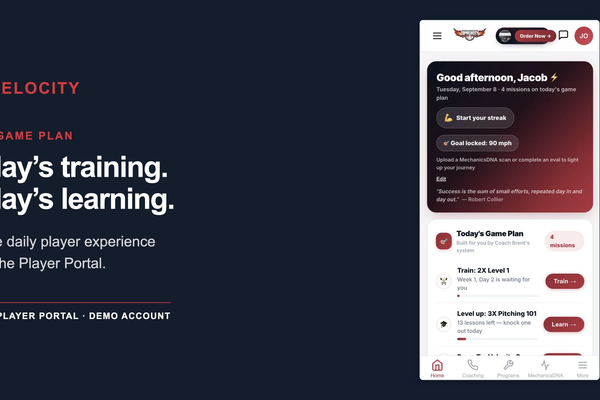
Brent Pourciau, M.S., is the founder of TopVelocity. After tearing his rotator cuff at 18 and being told he would never pitch again, he rebuilt his delivery through peer-reviewed biomechanics research and returned to throw 94 mph in professional baseball. He holds a master’s degree in kinesiology with doctoral work in health sciences, and has trained 10,000+ athletes including 100+ MLB draft picks through the TopVelocity Player Portal and Performance Center licensing program.