Most baseball facilities run on two revenue streams: cage rentals and private lessons. That’s exactly why most baseball facilities are one slow winter away from trouble. Both streams sell the same thing — an hour of time. Both cap out at the hours in a day. And both disappear when the owner takes a vacation. The profitable performance centers we work with run eight baseball facility revenue streams, and most of them aren’t hourly.
These are the eight streams built into the TopVelocity Performance Center Revenue Calculator — the same model our licensed facilities operate on. Plug your own numbers in as you read.
The 8 Baseball Facility Revenue Streams
1. Group Training Classes
Entry-level monthly group programming — think 50 athletes at $250/month. Groups break the hours-for-dollars trap: one coach, one time slot, ten athletes. This is your volume engine and your feeder system. Nearly every academy member and camp registration starts here. Done right (structured curriculum, measurable progress, not glorified open gym), it’s $150,000/year on its own.
2. Academy Memberships
Your premium tier: annual memberships at $2,997+ for athletes who train year-round with full access — structured programs, evaluations, video analysis, strength training. Thirty academy athletes at $3,000 is another $90,000/year. Moreover, annual commitments smooth out the seasonal revenue curve that kills hourly businesses.
3. Remote Coaching
Full remote programming at $2,997–$3,997/year for athletes outside driving distance. With video-based mechanics analysis and online program delivery, your coaching expertise stops being limited by your zip code. Ten remote athletes ≈ $30,000/year, with near-zero marginal facility cost.
4. Remote Training
The lighter-touch version: evaluation plus portal access (~$1,500/year) for athletes who train off-site but want the structure, tracking, and progression of your system. This is the offer for the travel-ball kid two towns over — the one who’ll never make Tuesday sessions, but whose parents want a real development plan.
5. Evaluation Clinics
Monthly evaluation events: 20 athletes at $97, twelve times a year, is over $23,000 annually. But the direct revenue is the smaller half of the value. Every clinic fills your pipeline with measured athletes whose parents have just seen exactly where their son stands against national percentiles — and what the gap costs him. As a result, evaluations convert to memberships better than any ad you’ll ever run.
6. One-Time Evaluations
Individual deep-dive evaluations at $97–$497, depending on depth: mechanics analysis, strength testing, injury-risk screening. These serve the athlete who isn’t ready to commit but wants answers. They’re also your highest-credibility first impression. With AI-driven tools like MechanicsDNA and ForceIQ, a single staff member delivers pro-grade assessment in under an hour.
7. Team & Organization Player Development
The stream most owners never think of. Partner with travel organizations to run player development for their entire roster. You charge the organization per player (say $500), your platform cost is $250 per registered athlete, and you keep the spread. One hundred players is $25,000/year from one partnership — plus a building full of prospects for your other seven streams. Better yet, this stream turns local travel orgs from competitors into customers. It’s the core of how TopVelocity-licensed facilities scale past their four walls.
8. Camps & Everything Else
Holiday clinics, summer camps, merchandise, facility rentals. Camps deserve special attention. A focused 2-day velocity camp at premium pricing — modeled on the 3X Velocity Camp — both earns directly and recruits your next class of academy members. The rest is opportunistic. But it adds up, and the calculator has a line for it.
What the Full Model Looks Like
Run the calculator’s default inputs across all eight streams and a mid-sized facility models out at $340,000+ in gross annual revenue. That’s why the licensing economics work the way they do. TopVelocity Performance Center licenses run $1,250–$2,500/month depending on roster capacity. Partner facilities target 4.4x–11.7x ROI on the license, and organizations have reported revenue increases of 40%+ after adding the system.
| License | Annual cost | Revenue potential | Target ROI |
|---|---|---|---|
| Level 1 · 30 athletes | $15,000 | Entry tier | — |
| Level 2 · 50 athletes | $18,000 | $80K–$175K | 4.4x–9.7x |
| Level 3 · 100 athletes | $30,000 | $150K–$350K | 5x–11.7x |
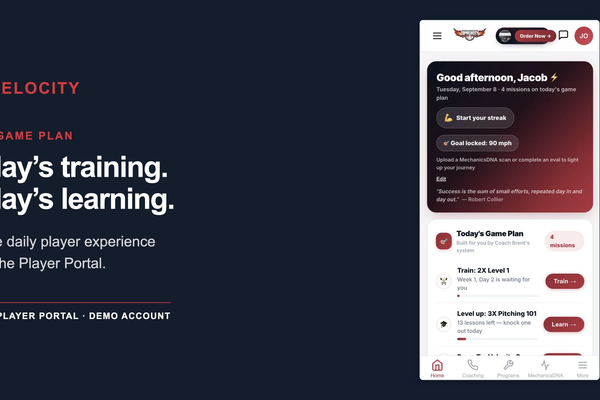
The license covers the infrastructure all eight streams run on: evaluations, MechanicsDNA, PitchDNA, ForceIQ, 15+ training programs, the org portal for roster, billing, and events, coach certification, and marketing support.
Two minutes in the free revenue calculator will show you what this model looks like with your athlete counts and your local pricing. If the output surprises you, book a free 30-minute demo and we’ll show you how facilities like yours are actually hitting it. Still at the “should I even open a facility?” stage? Start with our guide on starting a baseball training facility.
Frequently Asked Questions
Annual academy memberships and team-organization partnerships. Thirty academy athletes at $3,000/year is $90,000 of committed revenue, and a single 100-player travel-org partnership can add $25,000/year while filling your pipeline for every other stream.
Modeled across all eight streams, facilities on the TopVelocity Level 2 license ($1,500/mo, 50 roster spots) target $80,000-$175,000 in annual revenue – a 4.4x-9.7x return on the license. Larger Level 3 facilities target $150,000-$350,000.
Directly: 20 athletes at $97 across monthly clinics is $23,000+/year. Indirectly: every evaluated athlete gets a data-backed development plan, and parents who see their son’s national percentile convert to memberships at higher rates than any advertising.
AI athlete evaluations, MechanicsDNA 3D analysis, PitchDNA, ForceIQ testing, 15+ training programs, an org portal for roster/billing/events/staff, coach certification, and marketing support – $1,250-$2,500/month by roster capacity, operational in about 30 days.
About the Author
Brent Pourciau, M.S., is the founder of TopVelocity. After tearing his rotator cuff at 18 and being told he would never pitch again, he rebuilt his delivery through peer-reviewed biomechanics research and returned to throw 94 mph in professional baseball. He holds a master’s degree in kinesiology with doctoral work in health sciences, and has trained 10,000+ athletes including 100+ MLB draft picks through the TopVelocity Player Portal and Performance Center licensing program.