Can an AI pitching coach actually make you throw harder? Yes — if it’s trained on a real development system and paired with human coaching, and no, if it’s a generic chatbot guessing at baseball. The difference matters, because AI coaching has gone mainstream fast: 91% of fitness coaches now use AI, and 85% of athletes adjust their training based on AI feedback. Here’s what an AI pitching coach does well, where it fails, and how to test a real one free in the next two minutes.
See the Brent AI interface
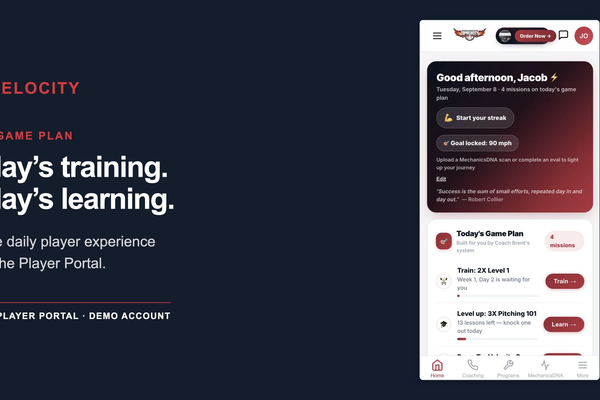
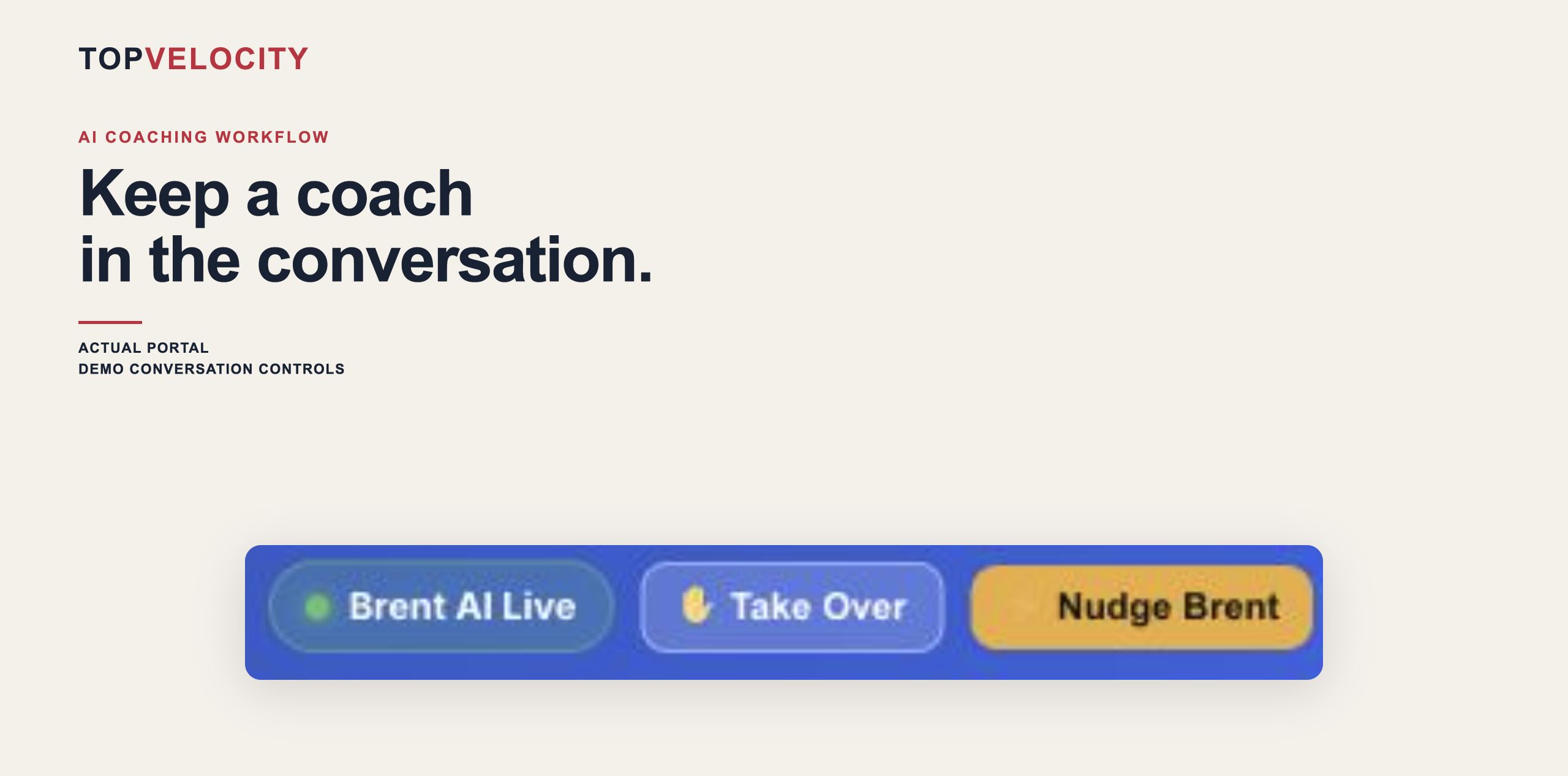
The staff view makes the Brent AI controls visible. Use a demonstration to understand the available AI and human-coaching workflow, then review the current membership details. An interface preview does not establish the quality of an answer or a training result.
What Can an AI Pitching Coach Actually Do?
Specifically, a real AI coaching system does four things a weekly lesson can’t:
- Answer at 9 PM on a Tuesday. The questions that decide a pitcher’s development — “is this elbow soreness normal?”, “should he pitch tomorrow on two days’ rest?” — don’t arrive on lesson day. An AI coach answers when the question happens, not when the appointment does.
- Analyze mechanics from video. Modern systems build a 3D model from one phone clip and grade checkpoints against published biomechanics benchmarks — our MechanicsDNA scores five delivery events on the 20-80 scout scale and flags injury-risk patterns.
- Predict from data instead of eyeballs. TopVelocity’s velocity-prediction model is trained on 1,500+ professional-grade evaluations. It ranks the broad jump as the single best predictor of fastball velocity — the kind of pattern no human notices from the bleachers.
- Remember everything. Every evaluation, every scan, every conversation. The 40th chat knows what the first 39 said.
Notably, the market believes this is the future — AI in sports will grow from $10.6 billion in 2025 to nearly $50 billion by 2033, and more than half of MLB organizations already run AI simulation tools. Youth baseball is simply catching up to what pro player development became years ago.
Where AI Pitching Coaches Fail
Two places. First, generic AI has no method. Ask a general-purpose chatbot how to throw harder and you’ll get a smoothie of every training philosophy on the internet — including the arm-overload approaches that injured 24% of participants in a randomized trial (we covered that evidence in Are Weighted Baseballs Safe?). An AI coach is only as safe as the system it’s trained on.
Second, AI can’t hold a standard. It can’t watch your power clean in person, feel a mound session, or look a 16-year-old in the eye. The coaches are right about this one: in the FitBudd industry survey, 77% said AI will never fully replace a human coach — and 80% of athletes said they want digital and human support together. In truth, the honest answer is hybrid: AI for daily decisions, data, and access; humans for hands-on coaching milestones.
What Makes Coach Brent’s AI Different?
Unlike generic AI, it runs on one system, not the internet. Coach Brent’s AI runs on the 3X Pitching method — 17 years of peer-reviewed research synthesis, the mechanics model behind 100+ MLB draft picks, and the actual evaluation database. It knows the drill progressions, the lift standards by level, the injury red flags, and when to say “stop throwing and see a physician.” And it’s connected to the real thing: video analysis, evaluations, programs, camps, and Brent’s human coaching staff in Covington, Louisiana, when hands-on is the right call.
💬 Talk to Brent — Free, No Signup
Should You Trust an AI Coach With Your Son’s Arm?
Ultimately, trust it the way you’d trust any coach: by checking what it’s built on. Ask it where velocity comes from — the answer should be the legs and trunk, not the arm. Next, ask it about weighted balls — the answer should cite the injury data. Ask it something it shouldn’t answer — a good system tells you to see a doctor instead of playing one. Run that test on Talk to Brent right now; it’s free and there’s nothing to install.
Then, if the answers earn it, the full system is the TopVelocity Player Portal — $99/month with MechanicsDNA, programs by level, and the AI coach built in. AI coaching isn’t coming to baseball. It’s here. The only question is whether your pitcher’s AI learned from science or from the comment section.
Frequently Asked Questions
Yes. Coach Brent’s AI at topvelocity.org/talk-to-brent is trained on the 3X Pitching system – 17 years of research synthesis, the TopVelocity evaluation database, and the methods behind 100+ MLB draft picks. It answers free, 24/7, with no signup, and connects to video analysis and human coaching.
Not fully – and the industry agrees: 77% of coaches using AI say it can’t replace humans. AI wins on availability, data analysis, and consistency; humans win on hands-on instruction and accountability. The effective model is hybrid: AI for daily decisions, human coaching at milestones like camps.
Modern systems build 3D models from high-frame-rate phone video and grade delivery checkpoints against published biomechanics benchmarks. TopVelocity’s velocity-prediction model is trained on 1,500+ professional-grade evaluations and ranks lower-body power metrics – like the broad jump – as the strongest predictors of fastball velocity.
Yes. The chat at topvelocity.org/talk-to-brent is free with no account required. The full system around it – MechanicsDNA 3D analysis, structured programs, and evaluation tracking – lives in the TopVelocity Player Portal at $99/month with a 7-day free trial.
About the Author
Brent Pourciau, M.S., is the founder of TopVelocity. After tearing his rotator cuff at 18 and being told he would never pitch again, he rebuilt his delivery through peer-reviewed biomechanics research and returned to throw 94 mph in professional baseball. He holds a master’s degree in kinesiology with doctoral work in health sciences, and has trained 10,000+ athletes including 100+ MLB draft picks through the TopVelocity Player Portal and Performance Center licensing program.