
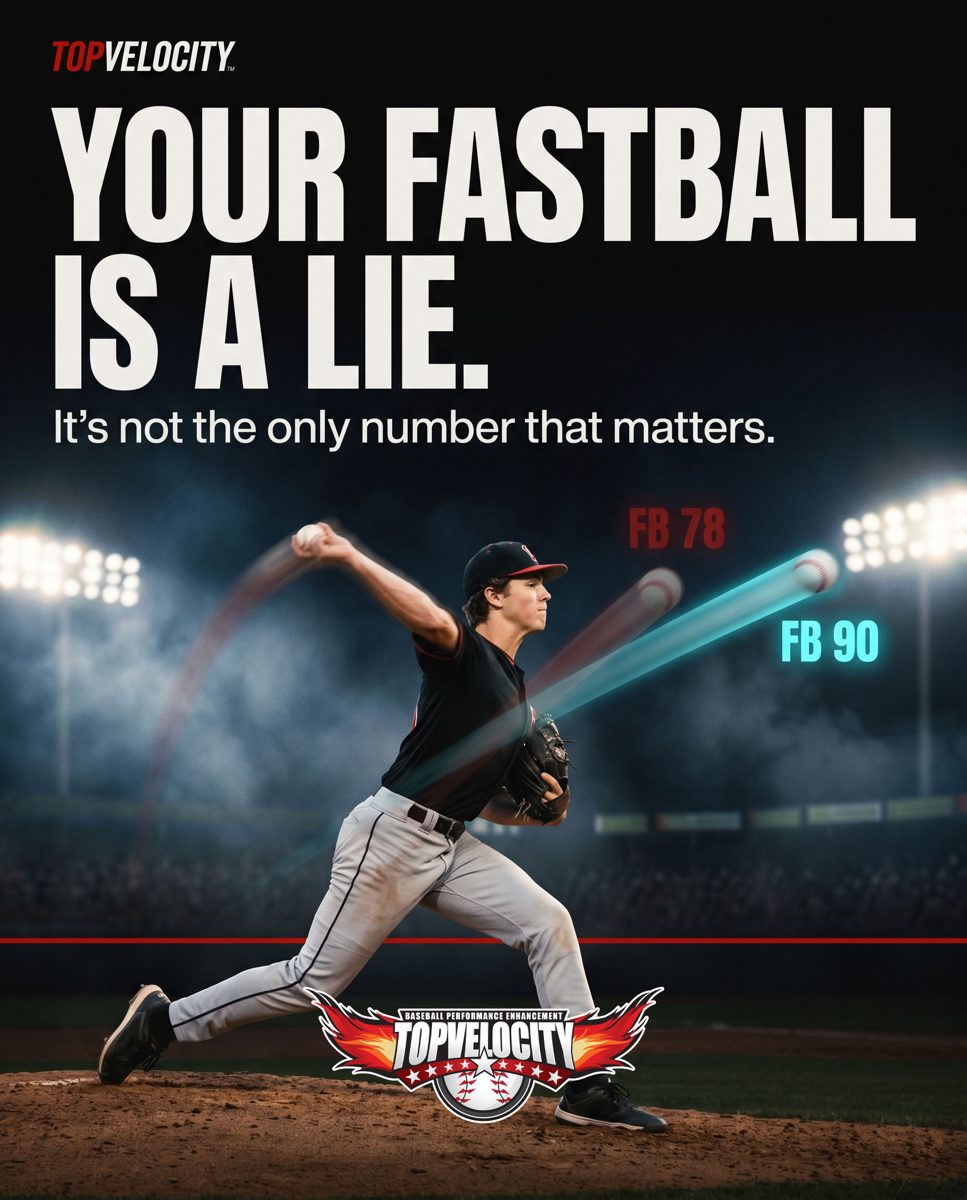
How hard should a pitcher throw at each age? It’s the question every baseball parent eventually types into a search bar. Here’s the short answer most coaches won’t give you: today’s radar-gun number matters less than the number your body can produce once your mechanics and lower-half power catch up. However, you still need honest benchmarks to know where you stand. So let’s lay them out.
At TopVelocity, we’ve evaluated thousands of pitchers across 50+ tracked metrics. The data tells a consistent story. Velocity tracks with age, height, lower-body power, and mechanical efficiency — not arm strength. In fact, a study of 420 youth pitchers found that age, height, hip-to-shoulder separation, and stride length together explained 78% of the variance in pitching velocity (Sgroi et al. 2015, Journal of Shoulder and Elbow Surgery). Your arm barely makes the list.
How Hard Should a Pitcher Throw? Benchmarks by Level
These are the working benchmarks we use in recruiting conversations. First, find your level. Then compare your most recent velocity reading against the range.
| Level | Velocity | What it means |
|---|---|---|
| Middle school (12–14) | 55–70 mph | Mechanics & athleticism matter more than the gun |
| JV (14–16) | 68–78 mph | On track; lower-half strength becomes the separator |
| Varsity HS (16–18) | 78–85 mph | Competitive high school arm |
| D2 / JUCO recruit | 85–88 mph | On the college radar |
| D1 recruit | 88–92 mph | The commitment range |
| Draft prospect | 93+ mph | Pro conversations begin |
| MLB average (4-seam) | ~94.5 mph | The professional standard |
For a 17-year-old, our evaluation database puts the 50th percentile around 78 mph. The 75th percentile sits near 86 mph, and elite territory starts at 92+. Want your exact percentile against athletes your age? Run your numbers through the free TopVelocity Velocity Calculator. It scores you against our national database in about two minutes.
Why “Average for Your Age” Is the Wrong Goal
Conventional wisdom says average velocity for your age means you’re fine. Science says average doesn’t get recruited. The pitchers who jump levels are the ones who understand where velocity actually comes from.
It isn’t the arm. Research on 227 high school and college pitchers found that elbow extension velocity, lead-leg ground reaction force, and pelvis-trunk timing were among the strongest predictors of velocity. Moreover, no single mechanical variable explained more than about 20% of the difference between pitchers (Nicholson et al. 2022, Journal of Biomechanics). Velocity is a full kinetic-chain product. Force comes off the ground, travels up through the drive leg, transfers through hip-to-shoulder separation — and the arm delivers it last.
That’s why two pitchers with identical arm action can sit 8 mph apart. The harder thrower produces more ground force and times his triple extension — ankle, knee, and hip of the drive leg extending just before front-foot strike. Meanwhile, the slower one leaks power before his foot ever lands. This timing rule is the foundation of the 3X Pitching method.
The Health Warning Nobody Gives Young Flamethrowers
One number every parent should know: youth pitchers who throw over 85 mph have a 2.6x higher injury rate (Fleisig et al. 2011). Velocity that arrives before the body is strong enough to support it is a liability, not an asset. For that reason, high velocity with poor mechanics and weak stabilization is the most dangerous profile in baseball.
This is why we evaluate before we train. Performance is the byproduct of healthy mechanics — never the goal that overrides them.
How to Know Your Real Velocity Ceiling
Your current velocity is an output. Your ceiling, however, is set by inputs you can measure today:
- Lower-body power. In Division 1 pitchers, countermovement-jump power correlates with fastball velocity at r = 0.68 (Sakurai et al. 2024, JSCR). Similarly, MLB pitchers in a 343-player study averaged a 28.3-inch vertical at 223 pounds (Hoffman et al. 2009, JSCR). We covered this fully in our article on the vertical jump–velocity connection.
- Mechanical efficiency. Stride length (elite pitchers stride 83–90% of their height), hip-to-shoulder separation, and 3X timing before front-foot strike.
- Body development. Mass moves mass. Body weight correlates with velocity at r = 0.58 in D1 pitchers (King 2025, JSCR).
You can get the mechanical half of that picture for free. Upload one pitching video to MechanicsDNA Mini, and our AI grades your mechanics against the same checkpoints used for pro evaluations — including your #1 velocity leak.
What to Do With Your Number
Measured your velocity and came up short of the level you want? That gap is closable. But it won’t close by playing more games or throwing harder in bullpens. Instead, the pitchers in our system gain 5–10+ mph by training the inputs: ground-force production, Olympic-lift-based lower-half power, mobility, and 3X mechanics, with arm care built in.
That full system — programs, video analysis, AI coaching, and unlimited evaluations against national percentiles — is what the TopVelocity Player Portal delivers for $99/month, with a 7-day free trial. In short: measure first, then train what the measurement tells you.
Frequently Asked Questions
Most Division 1 programs recruit pitchers sitting 88-92 mph. Velocity in the 90-92 range is where D1 commitments typically happen, while 85-88 mph keeps you on the radar for D2 and JUCO programs. Mechanics, command, and projectability also factor heavily.
The average MLB four-seam fastball sits around 94.5 mph. Physically, a 343-player study (Hoffman et al. 2009) found MLB pitchers averaged a 28.3-inch vertical jump at 223 pounds – evidence that professional velocity is built on lower-body power.
Yes. Research by Fleisig et al. (2011) found youth pitchers throwing over 85 mph had a 2.6x higher injury rate. Velocity that outpaces strength and mechanics is a risk factor, which is why evaluation should come before velocity training.
Measure the inputs: vertical jump, broad jump, body weight, sprint speed, and mechanical efficiency. TopVelocity’s free Velocity Calculator scores your numbers against a national athlete database and projects what your power profile supports.
About the Author
Brent Pourciau, M.S., is the founder of TopVelocity. After tearing his rotator cuff at 18 and being told he would never pitch again, he rebuilt his delivery through peer-reviewed biomechanics research and returned to throw 94 mph in professional baseball. He holds a master’s degree in kinesiology with doctoral work in health sciences, and has trained 10,000+ athletes including 100+ MLB draft picks through the TopVelocity Player Portal and Performance Center licensing program.