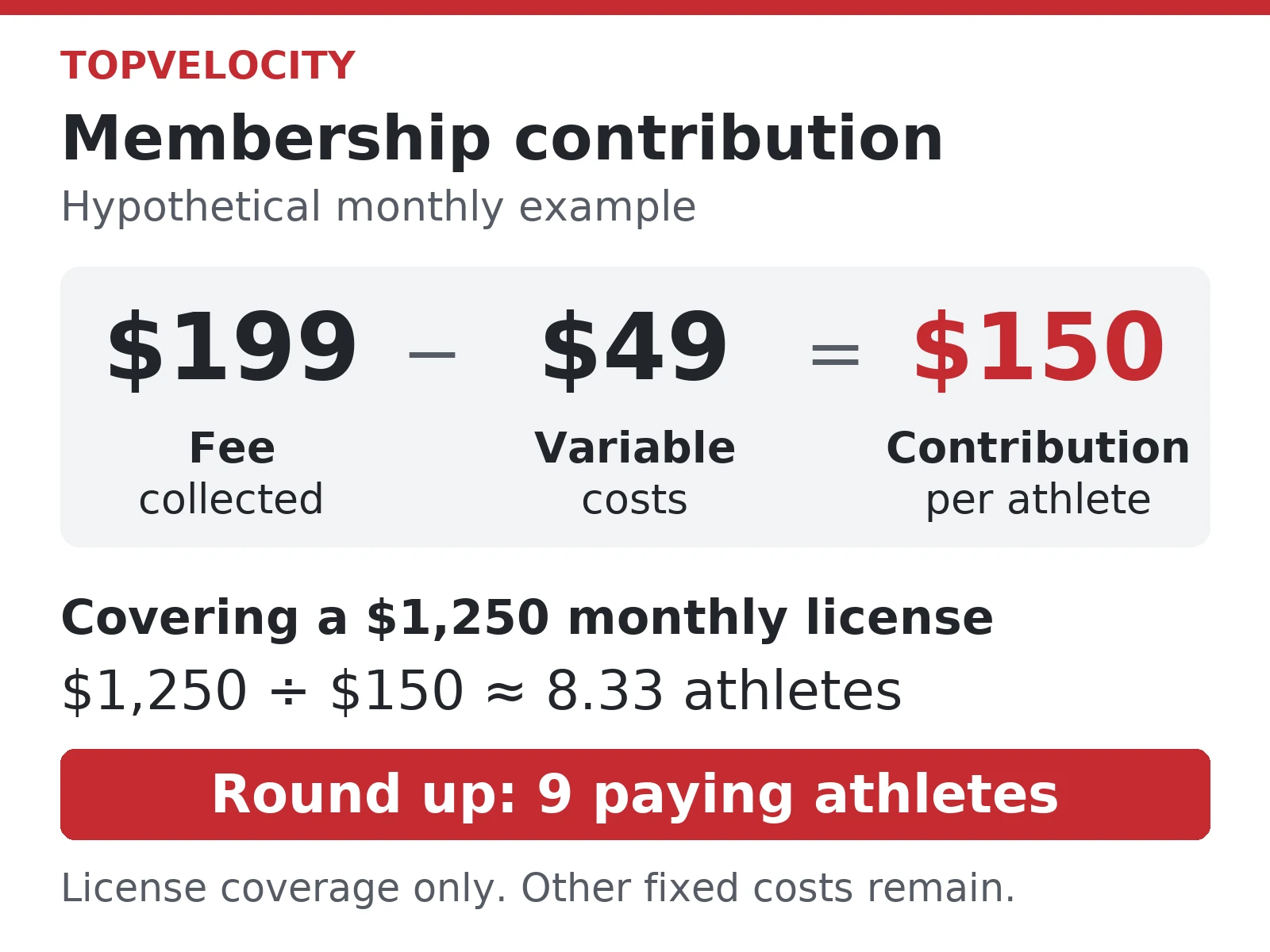
To price a baseball facility membership, start with what each paying athlete contributes after delivery costs. Then divide the program’s fixed monthly costs by that contribution. For example, a $199 membership with $49 in variable costs contributes $150; nine paying athletes would cover a $1,250 platform license, before other fixed expenses.
This worksheet helps academy owners and facility operators estimate the enrollment needed to support a development program. Every membership fee and operating-cost example below is hypothetical. Replace those assumptions with your own collected fees, coaching costs and capacity.
Download the printable membership pricing worksheet (PDF) to follow along with your own numbers.
What does a TopVelocity organization license cost?
As of October 3, 2026, the TopVelocity organization pricing page lists $1,250 per month for up to 30 athletes, $1,500 for up to 50, and $2,500 for up to 100. The listed package includes the organization portal, player app, 15+ training programs, MechanicsDNA, PitchDNA, ForceIQ, staff certification and support, and a TopVelocity brand license.
Evaluate the package against the work your facility needs to deliver. Our baseball player development platform guide explains how training management, evaluations and progress tracking fit together.
Evaluating the fit for your facility? Compare organization plans and roster sizes, then use the worksheet below to build your own budget.
Step 1: Calculate contribution per athlete
Monthly contribution is the membership revenue collected from an athlete minus the costs that increase when you serve that athlete. Those costs may include direct coaching time, payment processing, consumables and other delivery expenses. Account for fixed costs separately.
Contribution per athlete = monthly fee collected − monthly variable cost per athlete.
Athletes needed to cover the license = monthly license cost ÷ contribution per athlete, rounded up to a whole athlete.
The following examples use a hypothetical $49 monthly variable cost per athlete. The membership fees are example prices a facility might test in its budget; they are not TopVelocity fees, market averages or promised selling prices.
| Monthly fee collected | Variable cost | Contribution | Athletes covering license only |
|---|---|---|---|
| $149 | $49 | $100 | 13 |
| $199 | $49 | $150 | 9 |
| $249 | $49 | $200 | 7 |
At the hypothetical $199 fee, nine athletes contribute $1,350. After the $1,250 license, $100 remains before other fixed expenses. That is a license-coverage threshold, not a profit estimate for the facility.
Step 2: Include administration and launch costs
Roster setup, staff coordination, parent questions and reviewing training records take time outside coached sessions. Separate that recurring work from per-athlete delivery so you count both without counting the same hours twice.
Consider a second hypothetical budget:
- $1,250 per month for the license.
- $450 per month for additional fixed administration.
- $600 of initial setup labor, spread over three months for planning purposes.
The first-three-month planning target is $1,900 per month: $1,250 + $450 + $200. At $150 contribution per athlete, 13 athletes contribute $1,950, leaving $50 before any expenses not included in that budget.
Spreading setup cost across three months does not change when cash leaves your account. If the $600 is paid in month one, that month’s target is $2,300. It takes 16 athletes contributing $150 each to cover that amount.
Include the owner’s delivery time at a realistic replacement cost. Add rent, insurance, utilities and other overhead where appropriate to the decision. A program’s contribution toward existing overhead and the facility’s overall profitability are different calculations.
Step 3: Use paid enrollment, not available roster spaces
A $1,250 license works out to approximately $41.67 per athlete at 30 athletes, $62.50 at 20 and $125 at 10. These figures allocate the license cost only; they exclude coaching and other expenses. An unused roster space generates no membership revenue.
Count revenue attributable to the proposed offer. Moving an existing $199 member into a new platform does not automatically create another $199 of revenue. If the price stays the same, assess the service improvement, potential additional sales or measurable cost savings on their own merits.
Step 4: Test a slower start and a smaller roster
At 20 athletes contributing $150 each, $1,750 remains after the $1,250 license. If two athletes leave without replacements, that amount falls to $1,450. Both figures exclude other fixed costs; neither predicts retention.
Run the worksheet at the number of paying athletes you can reasonably support with actual commitments. Then test a lower enrollment scenario. Log staff hours during the first weeks to see whether delivery costs match your assumptions, and track cancellations separately from payment failures and temporary pauses.
Use the worksheet for your own facility
Download the printable membership pricing worksheet (PDF). Enter your collected fee, variable cost per athlete, monthly license, other fixed costs, startup costs and expected paying athletes. The one-page worksheet includes a lower-enrollment scenario and a check against your license and staff capacity.
Subtract variable cost from collected fees before dividing. If contribution per athlete is zero or negative, revise the offer first. Round required enrollment up to a whole athlete, and compare it with both your plan limit and the number your staff can serve. For the launch month, include startup cash costs when they are due.
What should you confirm before choosing a plan?
- Your expected paid enrollment and the coaching hours it requires.
- The written billing, renewal and cancellation terms.
- How athlete capacity is counted and when a tier change applies.
- Any separate athlete charges, taxes, equipment or other costs.
- Staff certification dates, support scope and permitted branding.
Use our baseball academy software checklist to connect your budget with the workflows your staff needs.
Once the budget fits, use our first 30-day Performance Center launch plan to organize staff preparation, athlete onboarding and your weekly review.
Build a membership model around your facility
Bring your roster size, current membership structure and weekly coaching schedule to a TopVelocity organization demo. Use the walkthrough to check how the portal and training package would fit your operation.
Ready to choose a roster tier? Review current organization pricing and register your TopVelocity Performance Center when the fit and terms are clear.