
Travel Baseball Arm Injuries: The Peer-Reviewed Evidence Every Baseball Parent Must Read
Travel baseball arm injuries are an epidemic: UCL injuries in youth baseball increased 12-fold in 16 years. Tommy John surgery is now more common in high schoolers than in pros. And 90% of travel teams are ignoring the only safety guidelines designed to protect your kid’s arm. Here is every peer-reviewed statistic — and what you can do about it.
Every weekend, across every state in America, hundreds of thousands of youth pitchers load into the back seat of an SUV and head to a travel ball tournament or a showcase event. Their parents spend thousands of dollars. Their coaches fill out lineup cards. And nobody is tracking how many pitches that kid throws across three games in two days — or what that is doing to the growth plates and ligaments in a still-developing 14-year-old arm. This is how travel baseball arm injuries begin.
The peer-reviewed science on this is not subtle. It is not mixed. It is not a matter of debate among researchers. The travel and showcase baseball system — the way it is currently structured and practiced across the United States — is producing a documented, measurable, and accelerating epidemic of elbow and shoulder injuries in youth pitchers.
This article compiles the most important findings from peer-reviewed journals and presents them in plain language so that every baseball parent, coach, and player can understand what the evidence actually says. Because this industry is not going to protect your son. The data makes that perfectly clear.
Stat #1: 74% of Youth Pitchers Throw in Pain — and Coaches Tell Them to Keep Going
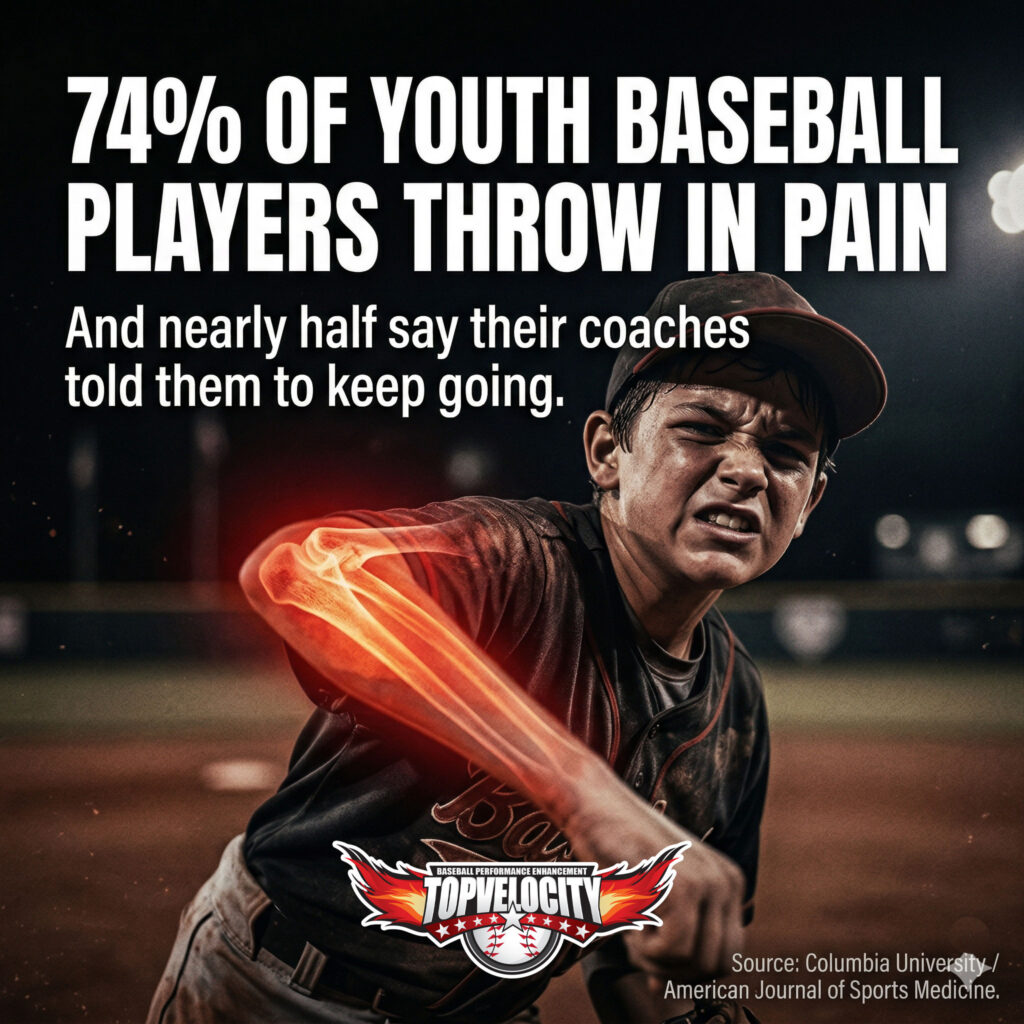
Before we get to surgery rates and UCL tear data, start here: most youth baseball pitchers are already playing in pain. Not soreness. Pain.
74% of youth baseball players report arm pain while throwing. Nearly half (47%) say they were encouraged by a coach or adult to keep playing despite that pain.
Source: Dr. Christopher Ahmad, Columbia University Medical Center / American Journal of Sports Medicine (2015) — pubmed.ncbi.nlm.nih.gov/25367016
Let that number sink in. Nearly half of all youth baseball players have been told — by an adult in a position of authority — to keep pitching through arm pain. One in eight players aged 17–18 said they “always” felt pressure to keep going despite pain.
Arm pain in a developing pitcher is not a minor inconvenience. It is the body’s early warning signal that microtrauma is occurring in the elbow or shoulder. Ignoring that signal, especially repeatedly across a showcase weekend, is precisely how a UCL goes from fatigued to frayed to torn.
This is not speculation. The American Sports Medicine Institute (ASMI) — the world’s leading research center on baseball injuries — confirmed that pitching with fatigue is the most critical modifiable risk factor for elbow and shoulder injury in youth pitchers.
Stat #2: 45% of 13–14 Year Olds Have Arm Pain Every Single Season
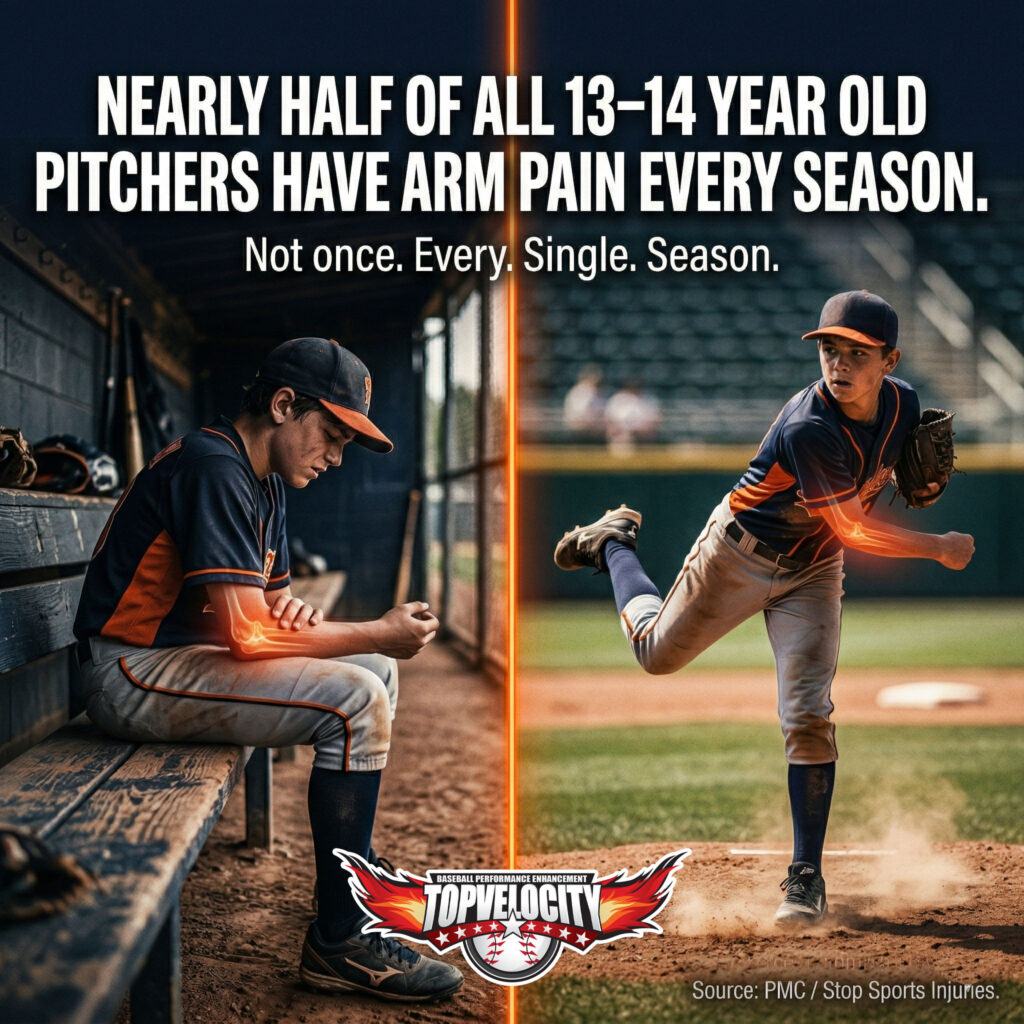
This is not a fringe statistic buried in an obscure paper. It comes from Stop Sports Injuries, the national campaign backed by AAOS, AOSSM, and NATA.
20% of youth pitchers ages 8–12 and 45% of those ages 13–14 will experience arm pain during a single baseball season.
Source: PMC / Stop Sports Injuries — pmc.ncbi.nlm.nih.gov/articles/PMC4526793
Not once in their career. Every year. Nearly half of all 8th and 9th grade pitchers in America are pitching through arm pain every season — and the system is set up to keep them on the mound anyway, because tournaments need to be won and scouts need to be impressed.
The direct connection to travel and showcase culture is this: the compressed tournament schedule, the pressure to pitch through fatigue, the lack of anyone tracking total pitch counts across multiple teams — these are the exact mechanisms turning seasonal arm pain into structural injury.
Stat #3: Travel Baseball Arm Injuries — UCL Injuries Have Increased 12-Fold in Under 16 Years
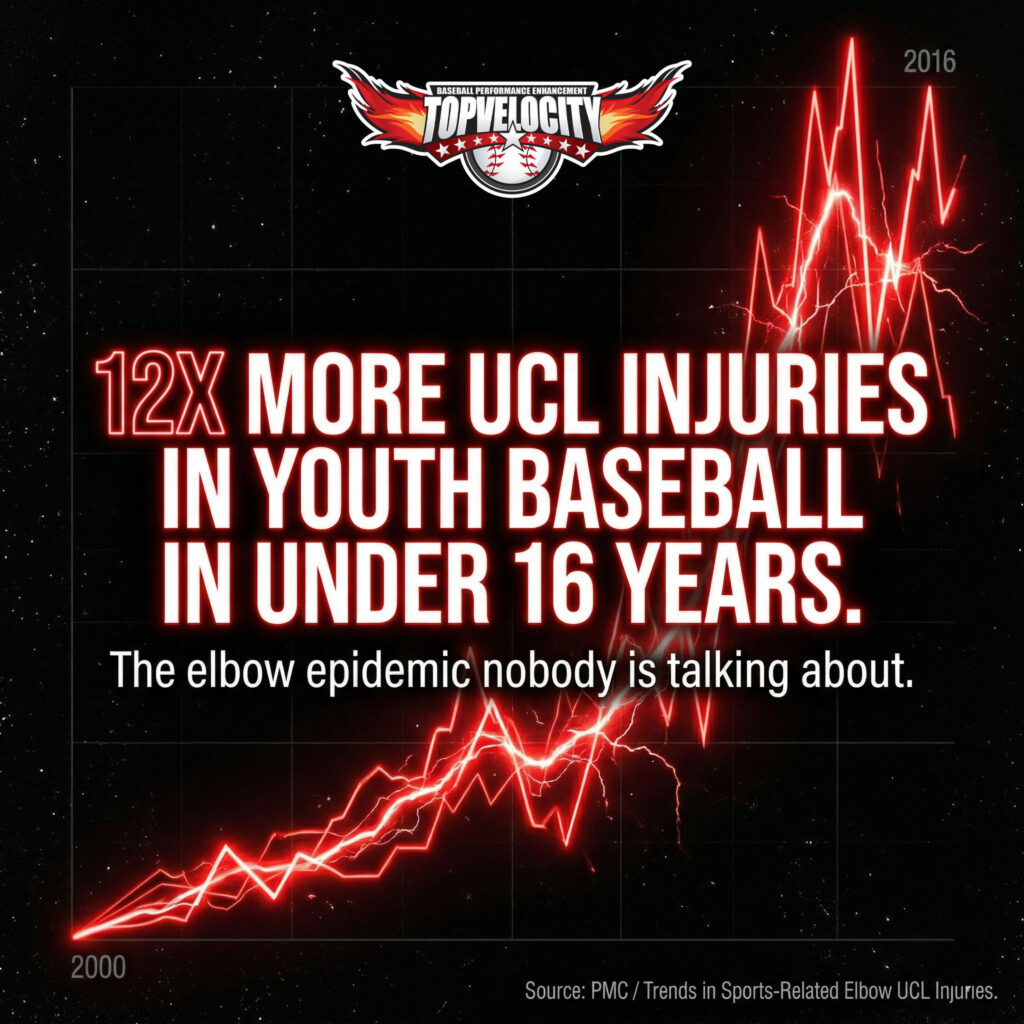
If there were a single statistic capable of stopping every travel ball parent in their tracks, this is it.
UCL injury volume went from 5 cases between 2000–2003 to 72 cases between 2012–2016 — a more than 12-fold increase in less than 16 years.
Source: Trends in Sports-Related Elbow UCL Injuries, PMC — pmc.ncbi.nlm.nih.gov/articles/PMC5648099
This is not a statistical artifact from better diagnosis or increased participation. The sport has not grown 12x. The injury rate has. The rise maps almost exactly onto the expansion of travel ball, year-round showcase competition, and early single-sport specialization.
A separate national epidemiological study found that nonsurgical UCL injury cases increased 9-fold between 2000–2008 and 2009–2016. Another study across 155 Division I college baseball programs found that 2.5% of all eligible athletes underwent UCL reconstruction in a single season — and pitchers were nearly 6 times more likely to require surgery than non-pitchers.
Stat #4: Tommy John Surgery Is Growing at 9.12% Per Year in Teenagers — High Schoolers Now Get It More Than Pros
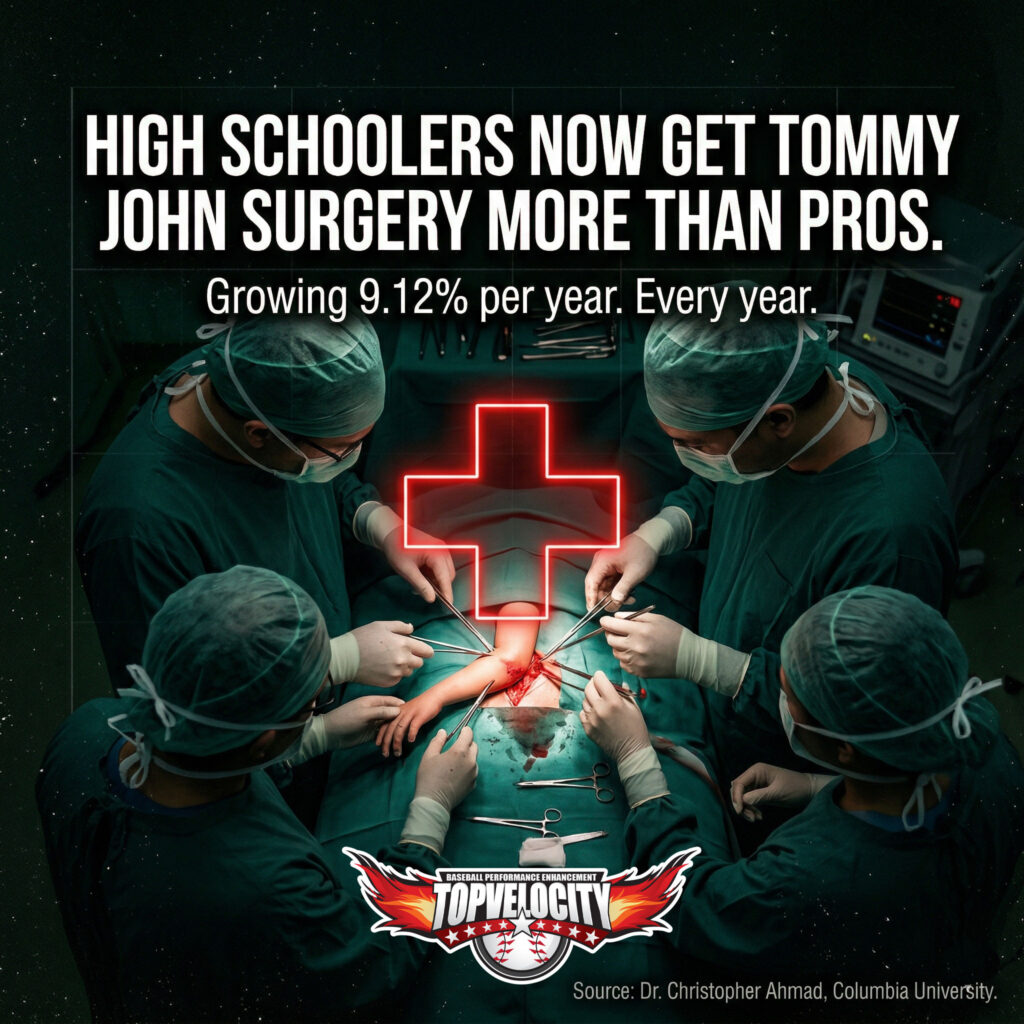
Tommy John surgery was invented in 1974 for a professional pitcher. For the first two decades of its existence, it was almost exclusively performed on professional or elite college-level athletes. That era is over.
Tommy John surgery in the 15–19 year old age group is increasing at 9.12% per year. High schoolers now undergo UCL reconstruction more frequently than college or professional players.
Source: Foundation for Orthopaedic Research and Education / Dr. Christopher Ahmad, Columbia University — drahmadsportsmedicine.com
By 2014, 67.4% of all UCL reconstruction surgeries were performed on athletes ages 16–20. Almost all of the growth in the Columbia University study (2002–2011) occurred in two groups: 17–18 year olds and 19–20 year olds.
Source: American Medical Association / Columbia University Irving Medical Center — cuimc.columbia.edu
One of the most chilling data points from the Columbia study: total UCL surgery volume increased nearly 200% between 2002 and 2011 — while the number of UCL reconstructions per 100,000 people tripled. The researchers also found that patients with private insurance were 25 times more likely to undergo the surgery than those with Medicaid — a finding that indirectly maps the geography of travel baseball culture, which is heavily concentrated in higher-income suburban markets.
Stat #5: The Shift Happened Quietly — Youth Tommy John Cases Jumped from 7% to 26% in One Decade
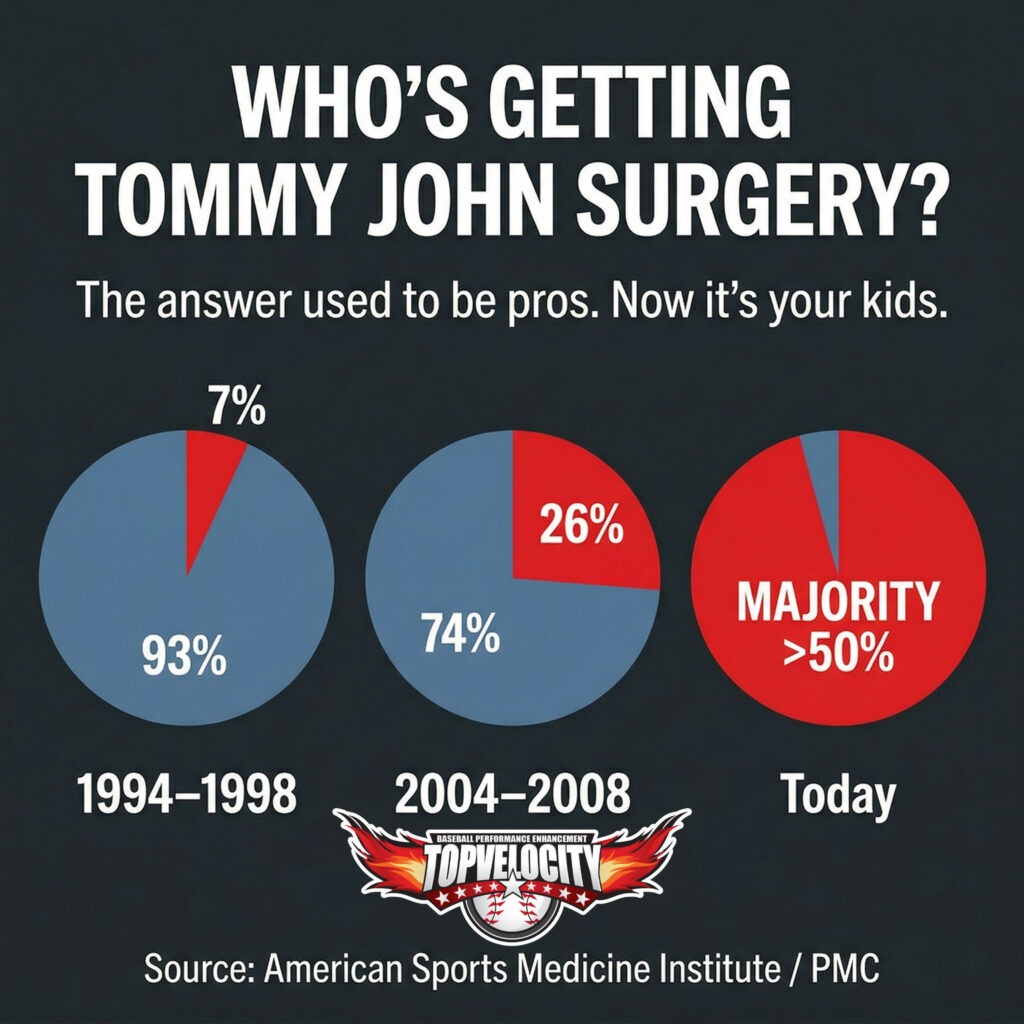
The American Sports Medicine Institute (ASMI) — the most cited institution on baseball arm injuries in the world, home to Dr. James Andrews — has watched this transformation unfold in their own surgical records.
Between 1994–1998, only 7% of UCL reconstructions at ASMI were performed on high school aged or younger patients. By 2004–2008, that number had risen to 26%. Today it represents the majority of cases at many orthopedic centers.
Source: Optimal Management of UCL Injury in Baseball Pitchers, PMC — pmc.ncbi.nlm.nih.gov/articles/PMC4646591
This is the same institution where Dr. Andrews — who has performed more Tommy John surgeries than anyone in the world — estimates that approximately 20% of his UCL patients are major leaguers, and another 20–25% are minor leaguers. The remaining majority are amateurs — youth and high school pitchers.
That transition from a professional procedure to a youth procedure happened during the exact years that travel baseball and showcase culture expanded nationwide. The timing is not coincidental.
Stat #6: Monthly Showcase Travel Is Directly Linked to Worse Arm Health — Even in 7–12 Year Olds
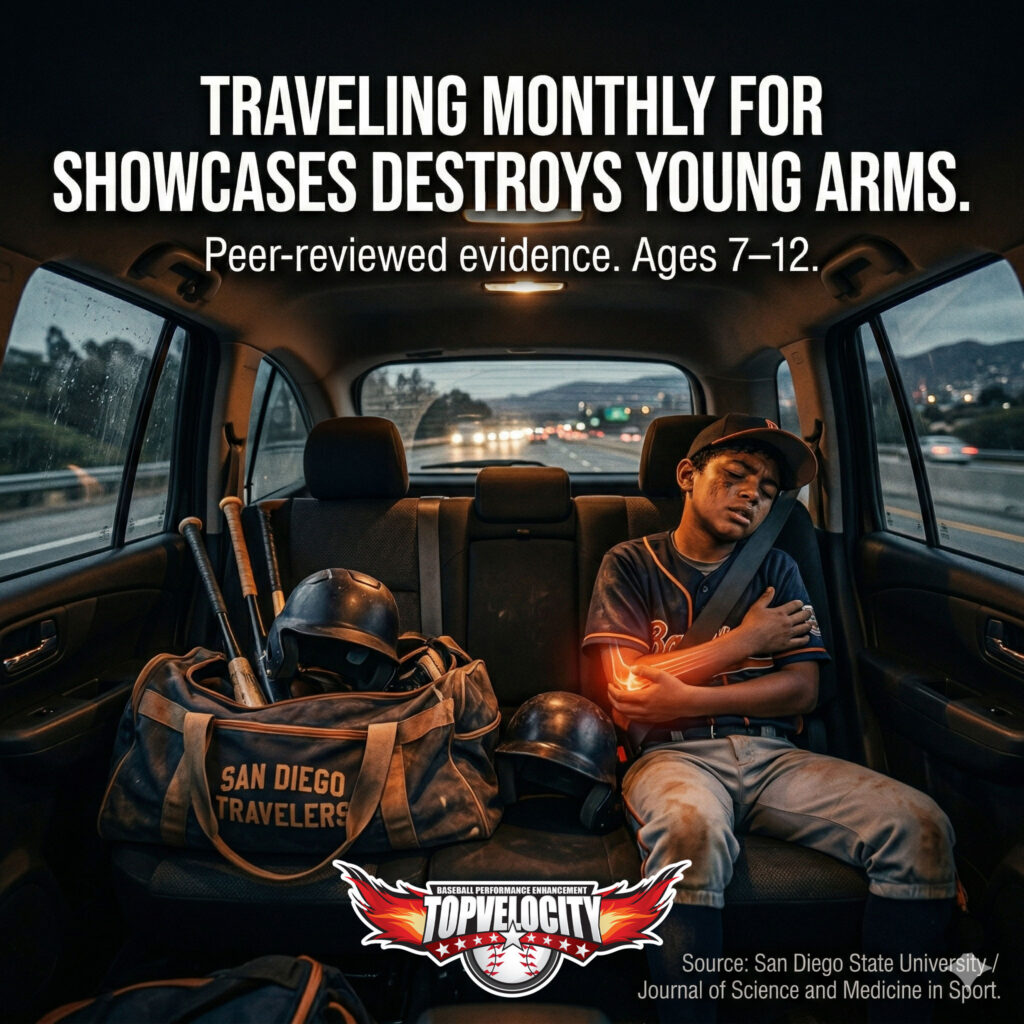
This is the peer-reviewed smoking gun for the showcase industry specifically. This isn’t about pitching volume in general. This is about showcase travel — the exact behavior that the $15 billion youth sports industry aggressively promotes.
In a study of Little League pitchers ages 7–12, traveling at least once a month to participate in showcases was significantly associated with worse throwing arm health (p = 0.01).
Source: San Diego State University / Journal of Science and Medicine in Sport — pmc.ncbi.nlm.nih.gov/articles/PMC10426709
A separate study confirmed: showcase participation was significantly associated with reports of pitching with elbow pain and arm tiredness among youth pitchers. Pitching on a travel ball team was associated with elbow pain and shoulder pain.
Source: Athletic Training & Sports Health Care / Pitching Practices and Self-Reported Injuries Among Youth Baseball Pitchers — journals.healio.com
This is direct causation language from peer-reviewed research. Monthly showcase travel — a completely normalized behavior in the youth baseball world — is measurably, statistically, significantly harming the throwing arms of children as young as 7 years old.
The mechanism is not mysterious. Showcases compress high-intent throwing into tight windows, remove recovery time, bypass pitch count oversight (especially when a player is on multiple teams), and apply social pressure that pushes players and parents to override pain signals.
Stat #7: Pitching Through Arm Fatigue Makes Injury 13.32 Times More Likely
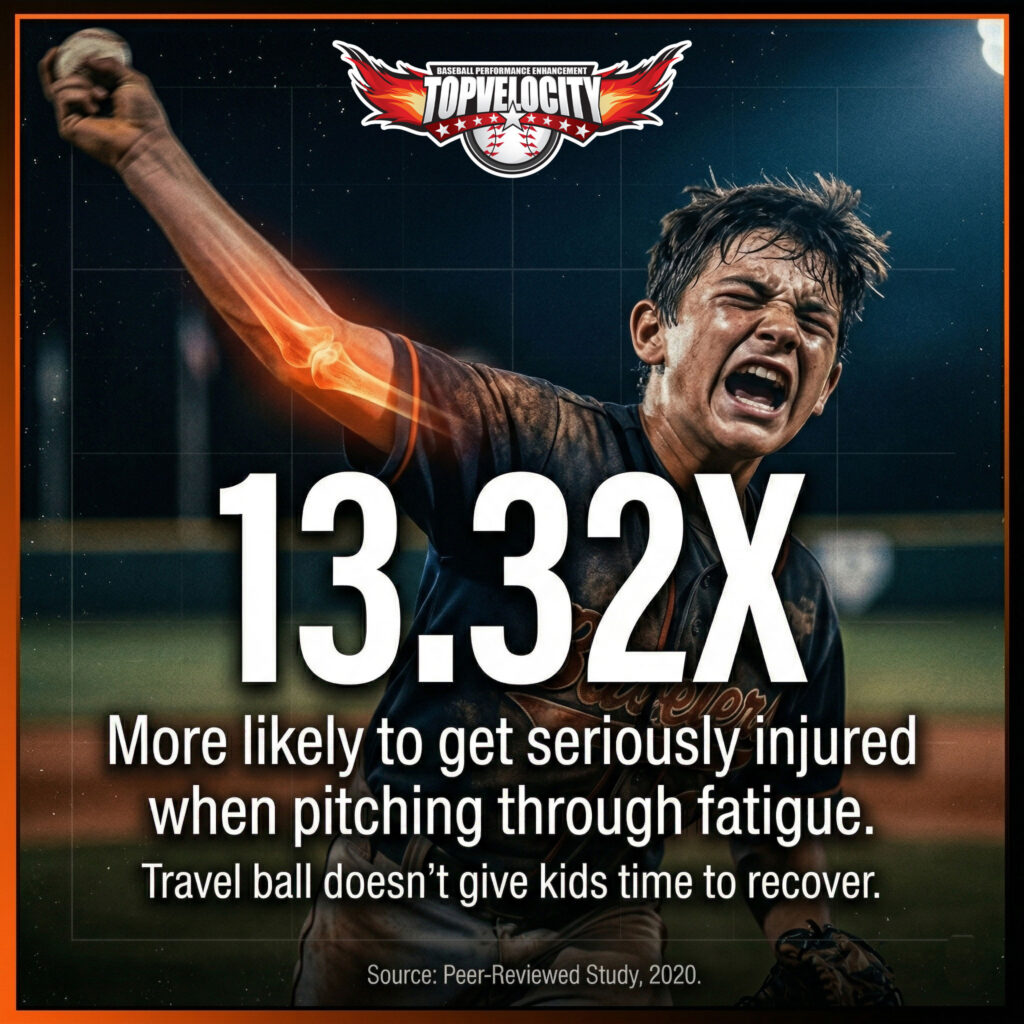
Travel ball weekends are the definition of accumulated arm fatigue. A pitcher throws 90 pitches in Game 1 on Saturday, then returns to throw 50 more in a relief appearance in Game 3 on Sunday. No one is tracking the total. No one is enforcing rest. And the coach needs to win.
A 2020 peer-reviewed study found that youth pitchers who compete with arm fatigue are 13.32 times more likely to suffer a serious shoulder or elbow injury.
Source: Cited in: BSR Physical Therapy / Foundation for Orthopaedic Research and Education research, 2020
ASMI research supports this with an even more dramatic figure: fatigue during pitching creates a 36-to-1 increased incidence of throwing shoulder and elbow injury in youth players. Whether you use the 13x or 36x multiplier, the conclusion is the same: sending a fatigued youth pitcher back to the mound is not a coaching decision. It is a medical one — and the data says it is the wrong one.
The three types of fatigue that destroy youth pitching arms, identified by ASMI research:
- Event fatigue — too many pitches thrown in a single game
- Seasonal fatigue — too many pitches and innings accumulated across a season
- Year-round fatigue — the cumulative toll of playing baseball 11–12 months per year without recovery
Travel ball, by its design, manufactures all three simultaneously.
Stat #8: Travel Baseball Arm Injuries — 1 in 4 Youth Pitchers Will Be Injured
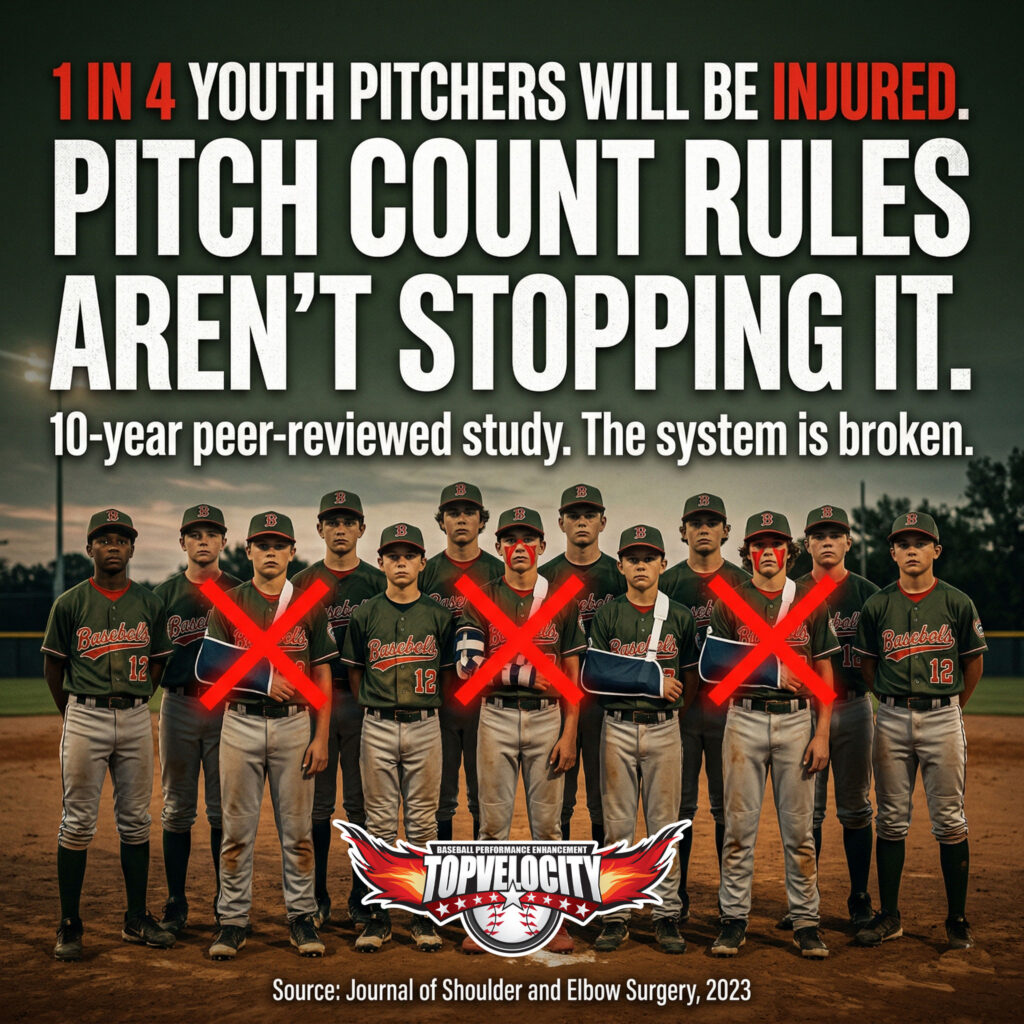
Perhaps the most sobering finding in all of the research reviewed for this article is not the injury rate itself. It is the conclusion that the industry’s primary prevention tool — pitch count rules — is failing.
A 10-year prospective cohort study of 261 youth and high school pitchers found an overall arm injury incidence of 25.6 per 100 athletes. Researchers concluded that the arm injury burden ‘appears unmitigated by pitch counts and other large injury reduction efforts.’
Source: Journal of Shoulder and Elbow Surgery, 2023 — pubmed.ncbi.nlm.nih.gov/36828286
A 2021 study reinforces exactly why: 90% of surveyed youth baseball teams are not complying with Pitch Smart guidelines — the evidence-based recommendations jointly developed by Major League Baseball and USA Baseball to reduce exactly these injuries.
The rules exist. The science exists. The guidelines exist. And the system is ignoring all of them because showcases are run by private organizations with no accountability to player health, tournaments are won by teams that push their pitchers hardest, and nobody is watching a 12-year-old’s total pitch count across three different teams on a fall weekend.
Stat #9: 1 in 3 Current MLB Pitchers Has Already Had Tommy John Surgery

This statistic is not about youth baseball. It is about where youth baseball leads — and why the injury pattern that starts on the travel ball fields of America ends up on the operating tables of professional sports medicine.
One-third of current Major League Baseball pitchers have had Tommy John surgery at some point. Since the first procedure in 1974, an estimated 2,500 professional baseball players have undergone it. The number of overall procedures increases approximately 9% per year.
Source: The Conversation / ASMI — theconversation.com/50-years-after-the-first-procedure
The ASMI has been explicit on this point: the injury leading to Tommy John surgery in today’s young professional pitchers began while they were adolescent amateurs. The frayed UCL a surgeon removes from a 24-year-old MLB pitcher was damaged — incrementally, through repetitive microtrauma — during the same youth baseball years being discussed throughout this article.
The damage is not random. It accumulates. And the system that accelerates it most efficiently is the one selling your family $2,000 showcase weekends every fall.
Stat #10: Travel Baseball Arm Injuries Persist Because 90% of Youth Teams Ignore Safety Rules
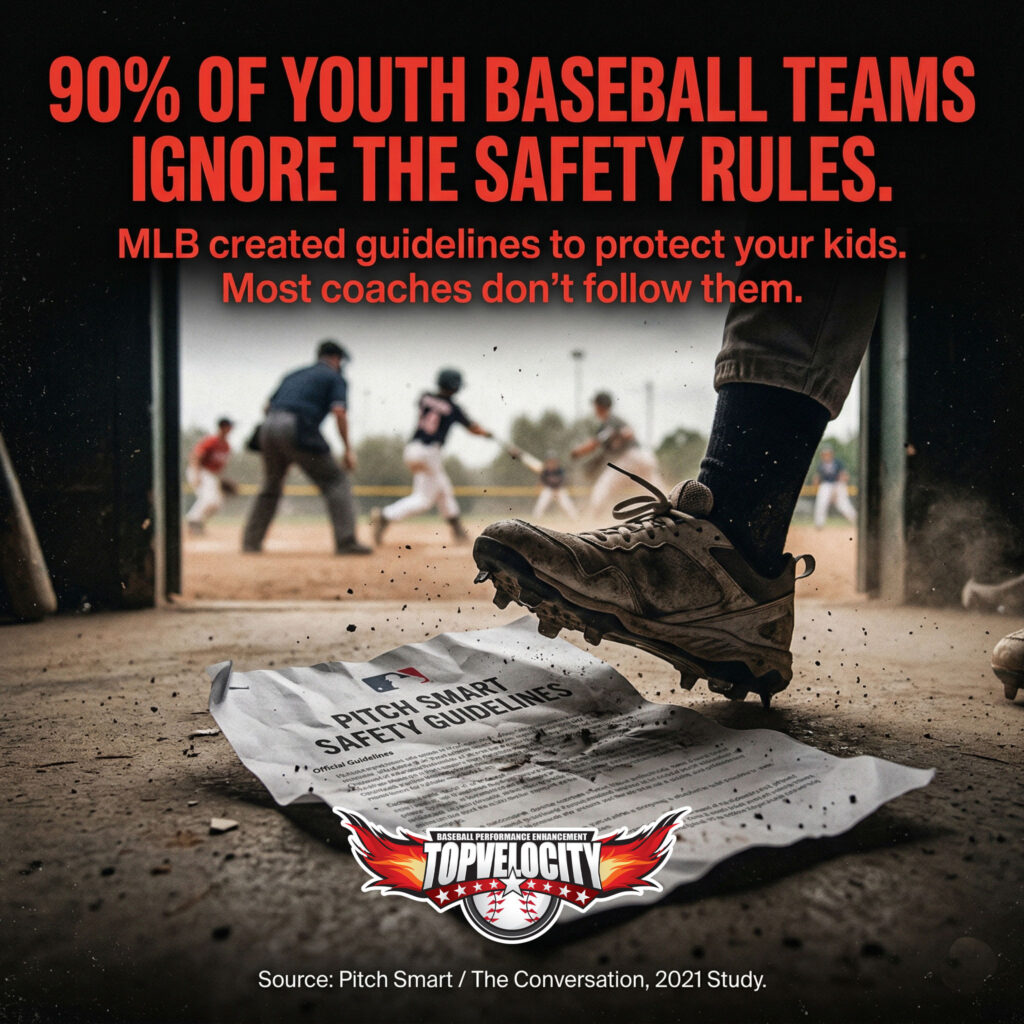
Pitch Smart is a joint initiative between Major League Baseball and USA Baseball. It provides clear, age-specific pitch count limits, rest day requirements, and seasonal workload recommendations built entirely around the goal of preventing the exact injuries documented throughout this article.
A 2021 study found that 90% of surveyed youth baseball teams are not complying with Pitch Smart guidelines. Compliance with safe throwing regulations is marginal at best, with only 58% of parents even aware that pitch count guidelines exist.
Source: The Conversation / AOSSM Sports Medicine News — theconversation.com
The rules are free. They are publicly available. They were designed by the same organization that employs the best sports medicine professionals in the world. Nine out of ten youth baseball programs in America are not following them.
This is not an ignorance problem at this point. It is a culture problem. The travel baseball and showcase industry has created a system where winning — and visibility — is prioritized over the long-term physical health of the athletes inside it.
Bonus: 250,000 Youth Athletes Are Injured Playing Baseball Every Year
Recent data shows 250,000 youth athletes are injured each year playing baseball. Of the 16 million youth baseball players worldwide, 20% of those between ages 9 and 15 will seek medical attention. The medical cost of these injuries is close to $1.8 billion — and 50% are related to overuse, meaning they are preventable.
Source: Dr. Christopher Ahmad, Columbia University / Children’s Health
Half of all youth baseball injuries are preventable. They are not accidents. They are the predictable output of a system that overworks developing arms, ignores recovery science, and measures success by radar gun readings and showcase rankings rather than by the long-term health of young athletes.
Why Is the Travel Baseball System Causing Arm Injuries?
The injury data does not exist in a vacuum. Researchers have identified the specific structural features of modern youth baseball that drive these outcomes:
Year-Round Play Without Adequate Recovery
Professional athletes — the most physically developed humans on earth — take 3–4 months off every year specifically to allow their throwing arms to heal and recover. Youth athletes, whose ligaments and growth plates are still forming, are now expected to play spring league, summer travel ball, fall showcases, and winter velocity camps. The human elbow was not designed for this.
Multi-Team Participation and Pitch Count Laundering
When a pitcher plays for his school team, his travel team, and his fall showcase team simultaneously, each coach sees only a fraction of the total throwing load. Each coach believes he is being responsible by staying within “his” pitch count. No one is watching the cumulative total. Research confirms this is one of the most reliably injurious configurations in youth baseball.
Radar Gun Culture and the Velocity Obsession
The showcase industry has reduced the evaluation of a developing pitcher to a single metric: how hard he throws. This creates pressure — from coaches, from parents, and from the pitcher himself — to push maximum effort on every pitch regardless of fatigue, arm health, or physical maturity. Research specifically identifies radar gun use in youth practice as a correlate of increased injury risk.
Early Specialization Before Physical Maturity
A 2020 study of over 500 high school baseball players found that highly specialized players were 3.7 times more likely to report an arm overuse injury. Players who pitched more than 8 months per year were 2.03 times more likely to report an overuse injury. The human arm is designed to throw — but not to throw the same way, with maximum intent, 300+ days per year from age 9 onward.
Travel Baseball Arm Injuries: What Parents Must Know Before the Next Showcase
This is not an argument against competitive baseball. It is an argument for competing smarter — and for understanding that the biggest threat to your son’s baseball future is not a lack of showcase exposure. It is an arm injury that ends his career at 17.
Based on the peer-reviewed evidence, every baseball parent should know and enforce the following:
- Never allow your son to pitch through arm pain. Pain is not weakness. Pain is an injury signal.
- Track total pitches across all teams, not just one team’s pitch count.
- Insist on at least 2–4 months of total throwing rest every year.
- Prioritize multi-sport participation through at least age 14.
- Evaluate showcases critically — most don’t scout with the intensity parents believe they do, and none of them are worth a Tommy John surgery.
- Seek a pitching development program built around biomechanics and force production — not radar gun readings.
Travel Baseball Arm Injuries Can Be Prevented: A Better Way to Develop Elite Pitchers
At TopVelocity, we have spent more than 15 years building pitching development programs that reject the showcases-and-radar-gun model entirely. Our founder, Brent Pourciau — a former Division I pitcher who rebuilt his own career after injury through evidence-based training — built TopVelocity on a single premise: you can develop elite pitching velocity AND protect the arm that produces it.
Our approach is rooted in:
- Biomechanics-first mechanics development — building movement patterns that generate velocity through force production, not arm stress
- ForceIQ training — ground force measurement and optimization that adds velocity without adding elbow torque
- MechanicsDNA video analysis — AI-powered biomechanical feedback so every pitcher understands exactly what their arm is doing
- Structured periodization — training cycles with built-in recovery that mirror how professional programs protect their investments
- The 3X Velocity Camp — an in-person intensive where pitchers learn to throw harder by throwing smarter
The research is clear. The system is broken. But your son does not have to be a statistic.
Learn more and start your son’s evidence-based development at topvelocity.org.
Travel Baseball Arm Injuries — Frequently Asked Questions
Is travel baseball safe for youth pitchers?
Travel baseball itself is not inherently unsafe. The injury risk comes from the structure of how travel baseball is typically practiced: year-round competition, multi-team participation that bypasses pitch count oversight, compressed tournament formats, and a culture that pressures pitchers to play through pain. When managed responsibly — with strict pitch count enforcement, adequate rest, and no year-round play — travel baseball carries no greater inherent risk than organized school baseball.
At what age can pitchers start specializing in baseball?
Based on the peer-reviewed research, most sports medicine organizations recommend against single-sport specialization before age 14–15. Players who specialize early are documented to have higher rates of overuse injury, higher rates of Tommy John surgery, and — contrary to what the showcase industry implies — no proven advantage in achieving elite status compared to multi-sport athletes who specialize later.
What are the warning signs of UCL damage in a youth pitcher?
Key warning signs include: medial (inner) elbow pain during or after throwing, pain that persists the day after pitching, reduced velocity or accuracy without an obvious mechanical cause, a sensation of instability or ‘looseness’ in the elbow, and tingling or numbness in the ring or pinky finger. Any of these symptoms warrants immediate evaluation by a sports medicine physician and cessation of throwing until cleared.
What is the Pitch Smart program and does it work?
Pitch Smart is a joint initiative between Major League Baseball and USA Baseball that provides age-specific pitch count limits and rest requirements. The science behind it is sound. The problem is compliance: research shows 90% of youth teams are not following the guidelines, and only 58% of parents are even aware they exist. The guidelines work when followed — but the travel ball culture creates systemic pressure to ignore them.
How can my son add pitching velocity without increasing injury risk?
The most evidence-supported path to safe velocity development focuses on force production through ground force mechanics and hip-to-shoulder separation — not arm speed or raw throwing volume. Programs that teach pitchers to generate velocity from their legs, hips, and core rather than their elbow and shoulder produce both higher velocity and lower joint stress. This is the foundational principle behind TopVelocity’s training methodology.
Your Son Deserves a Smarter System
The evidence is clear. The travel and showcase system is broken. At TopVelocity, we’ve spent 15+ years building a development method rooted in biomechanics, force production, and real science — not showcase weekends and radar gun pressure.
→ Build elite velocity AND protect your son’s arm at the same time.
Start here: topvelocity.org
References and Further Reading
All statistics cited in this article are drawn from peer-reviewed sources accessible at the links below:
- Makhni EC et al. Arm pain in youth baseball players: a survey of healthy players. American Journal of Sports Medicine. 2015. pubmed.ncbi.nlm.nih.gov/25367016
- Injury Prevention in Baseball: from Youth to the Pros. pmc.ncbi.nlm.nih.gov/articles/PMC5825337
- Trends in Sports-Related Elbow UCL Injuries. PMC. pmc.ncbi.nlm.nih.gov/articles/PMC5648099
- Columbia University: Tommy John Surgeries on the Rise Among Young Athletes. cuimc.columbia.edu/news/tommy-john-reconstructive-surgeries-rise
- Optimal Management of UCL Injury in Baseball Pitchers. PMC. pmc.ncbi.nlm.nih.gov/articles/PMC4646591
- Sport participation behaviors and throwing arm health in Little League pitchers. PMC. pmc.ncbi.nlm.nih.gov/articles/PMC10426709
- Arm injury in youth baseball players: a 10-year cohort study. Journal of Shoulder and Elbow Surgery. 2023. pubmed.ncbi.nlm.nih.gov/36828286
- Risk of Serious Injury for Young Baseball Pitchers: A 10-Year Prospective Study. American Journal of Sports Medicine. 2011. esaabb.org/docs/10-year-youth-pitching-study.pdf
- 50 years after the first procedure, Tommy John surgery is more common than ever. The Conversation. theconversation.com
- Seasonal and Monthly Trends in Elbow UCL Injuries. PMC. pmc.ncbi.nlm.nih.gov/articles/PMC10426475
- ASMI Position Statement for Tommy John Injuries in Baseball Pitchers. asmi.org
- Pitching Practices and Self-Reported Injuries Among Youth Baseball Pitchers. Athletic Training & Sports Health Care. journals.healio.com
- Prevention of Elbow Injuries in Youth Baseball Pitchers. PMC. pmc.ncbi.nlm.nih.gov/articles/PMC3435945